


Russia warned Kosovo's leaders that if they declare independence the territory will never become a member of the UN or other international political institutions.
The US and Britain countered on Wednesday by reaffirming their support for Kosovo's drive for independence from Serbia, a close ally of Russia.
The future status of Kosovo, a province of Serbia that has been run by the UN and NATO since 1999, was not on the Security Council's official agenda on Wednesday. The council was supposed to discuss a report on the UN Mission in Kosovo, but instead the two sides replayed their debate last month on independence versus autonomy for the Serb province and neither side budged.
With Kosovo's ethnic Albanian leaders expected to declare independence as early as next month, the stakes were high and the key players sent their top leaders -- Serbian President Boris Tadic and Kosovo's newly elected Prime Minister Hashim Thaci -- to make their case again to the UN's most powerful body.
Tadic echoed Russia's call for further negotiations, saying a solution that would both provide autonomy and guarantee rights for Kosovo Albanians was "possible and attainable."
He said Serbia had become a peaceful democracy and there was no reason it should be "unjustly punished again" because of former Yugoslav leader Slobodan Milosevic's crackdown on ethnic Albanian separatists a decade ago.
But Thaci told the council that Kosovo has laid the foundations to be a democratic state and independence is a "first step to regional success and our integration in the European family," according to a copy of his speech.
Later, he told reporters: "Very soon we will take a decision and we hope that very soon [the] international community will recognize us -- Washington, Britain and other states."
After the Dec. 19 Security Council debate, US Ambassador Zalmay Khalilzad declared the views of the two sides "irreconcilable," and said it was time for an independent Kosovo, a stand backed by Britain, France and most members of the EU.
On Wednesday, Khalilzad told reporters: "We know where we are heading. There is no change with regard to the fact that the council is blocked."
Britain's UN Ambassador John Sawers agreed that "nothing's changed."
"I don't think there's any prospect of further negotiations, so we need to plan ahead and the European Union's made clear its approach," he said. "There will be a further discussion among EU foreign ministers on Saturday."
But Russian Ambassador Vitaly Churkin said the future of Kosovo was a Security Council issue and not an issue concerning EU leaders.

DOUBLE-MURDER CASE: The officer told the dispatcher he would check the locations of the callers, but instead headed to a pizzeria, remaining there for about an hour A New Jersey officer has been charged with misconduct after prosecutors said he did not quickly respond to and properly investigate reports of a shooting that turned out to be a double murder, instead allegedly stopping at an ATM and pizzeria. Franklin Township Police Sergeant Kevin Bollaro was the on-duty officer on the evening of Aug. 1, when police received 911 calls reporting gunshots and screaming in Pittstown, about 96km from Manhattan in central New Jersey, Hunterdon County Prosecutor Renee Robeson’s office said. However, rather than responding immediately, prosecutors said GPS data and surveillance video showed Bollaro drove about 3km

Tens of thousands of people on Saturday took to the streets of Spain’s eastern city of Valencia to mark the first anniversary of floods that killed 229 people and to denounce the handling of the disaster. Demonstrators, many carrying photos of the victims, called on regional government head Carlos Mazon to resign over what they said was the slow response to one of Europe’s deadliest natural disasters in decades. “People are still really angry,” said Rosa Cerros, a 42-year-old government worker who took part with her husband and two young daughters. “Why weren’t people evacuated? Its incomprehensible,” she said. Mazon’s
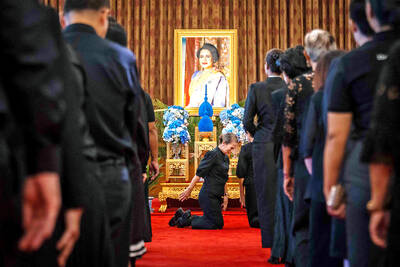
‘MOTHER’ OF THAILAND: In her glamorous heyday in the 1960s, former Thai queen Sirikit mingled with US presidents and superstars such as Elvis Presley The year-long funeral ceremony of former Thai queen Sirikit started yesterday, with grieving royalists set to salute the procession bringing her body to lie in state at Bangkok’s Grand Palace. Members of the royal family are venerated in Thailand, treated by many as semi-divine figures, and lavished with glowing media coverage and gold-adorned portraits hanging in public spaces and private homes nationwide. Sirikit, the mother of Thai King Vajiralongkorn and widow of the nation’s longest-reigning monarch, died late on Friday at the age of 93. Black-and-white tributes to the royal matriarch are being beamed onto towering digital advertizing billboards, on
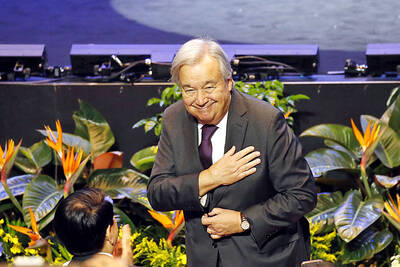
POWER ABUSE WORRY: Some people warned that the broad language of the treaty could lead to overreach by authorities and enable the repression of government critics Countries signed their first UN treaty targeting cybercrime in Hanoi yesterday, despite opposition from an unlikely band of tech companies and rights groups warning of expanded state surveillance. The new global legal framework aims to bolster international cooperation to fight digital crimes, from child pornography to transnational cyberscams and money laundering. More than 60 countries signed the declaration, which means it would go into force once ratified by those states. UN Secretary-General Antonio Guterres described the signing as an “important milestone,” and that it was “only the beginning.” “Every day, sophisticated scams destroy families, steal migrants and drain billions of dollars from our economy...


 RSS
RSS