

An alliance of rebel leaders from Darfur said on Thursday that they needed more time to heal internal splits, and that unless something changes quickly, the anticipated peace talks scheduled for later this month would probably fail.
Khamis Abdullah Abakar, chairman of the United Front for Liberation and Development, an umbrella group of several Darfur rebel factions, said "we are trying to consult with each other but there are still serious divisions."
"Right now we're headed toward another Abuja," he said, referring to Abuja, Nigeria, where a peace deal signed by the Sudanese government and one rebel faction last year hardly stopped Darfur's bloodshed and may have only added to the chaos.
On Thursday, Khamis and a group of fellow rebels from Darfur, the troubled region of western Sudan, lounged in a mustard-colored villa in Asmara, Eritrea's capital, making phone calls and watching European soap operas on TV.
All of this was courtesy of the Eritrean government, which has been a loyal friend to many of Darfur's rebel groups and a player in the peace negotiations, even as US officials are accusing Eritrea of sponsoring terrorism in other parts of the region.
BIG AMBITIONS
Eritrea is a little country with big ambitions.
Since its independence from Ethiopia in 1993, it has projected an aggressive foreign policy, shaping events in the Horn of Africa, though it has only 5 million people and is one of the poorest countries in the world.
In the past few months, Eritrea has opened its doors to rebel commanders from its neighbors, especially Ethiopia, Sudan and Somalia, which is part of the reason US officials are alarmed.
The State Department says Eritrea has been shipping arms to Islamist fighters in Somalia, an allegation that the Eritrean government denies.
At the same time, US diplomats have been quietly working with the Eritreans to push Darfur's ever-expanding galaxy of rebel groups to participating in peace talks scheduled for the end of this month in Libya.
The Eritreans have a decent track record, US officials say, when it comes to Sudan. Last year, Eritrean President Isaias Afewerki brokered a peace deal between the Sudanese government and rebels in a separate conflict in eastern Sudan that had ground on for 15 years and that cost thousands of lives.
INFLUENCE IN DARFUR
African Union (AU) officials said Eritrea wields even more influence in Darfur, because of its contacts with the rebel groups there.
The Eritreans "have control over some of these movements," said Sam Ibok, a senior adviser of the AU. "And the Eritreans have played a constructive role."
Leaders of Darfur rebel groups are spread out among a number of countries, including Chad, Libya, Egypt, as well as within Darfur itself.
More than half a dozen Darfur rebel groups have hung a shingle in Asmara.
And in some cases, like the United Front for Liberation and Development, which claims to have more than 10,000 fighters in Darfur, the Eritrean government pays the rent.
The rebels say Eritrea is a good base of operations because it is safe; its has an international airport and reliable phone lines; and various rebel leaders can meet anytime, day or night, in one of the city's countless sidewalk cafes and talk shop over a cup of espresso -- something they definitely could not do in Darfur itself.
"This has been an important front for Darfur for years," Khamis said, strolling down a sunny street in Asmara. "We like it here."
ATTACK ON AU TROOPS
The situation on the ground in Darfur seems to be degenerating by the day, as evidenced by the massacre of 10 AU peacekeepers last weekend.
The rebel leaders in Asmara denied that their fighters were responsible, even though AU officials have blamed the attack on groups allied to some of them. Several rebel leaders said they feared the bloodshed would only get worse if the talks in Libya failed.
"We could get the people's hopes up and there could be a lot of frustration when nothing is accomplished," said Abdulaziz Dafallah, a leader of the Revolution Democratic Forces Front, a Darfur rebel group that is part of Khamis' alliance.
He said the rebels were behind in two key areas that were supposed to be wrapped up by now: appointing a negotiating team to represent all major groups and training the negotiators.
Ibok agreed this was a problem and said "the people we require urgently for these talks don't seem to be ready for them."
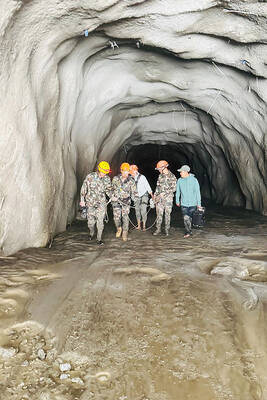
DEATH TOLL 903: More than 900 workers are believe to be trapped in the tunnels and underground areas of several hydropower projects after flash floods in Nepal-Tibet Rescue teams were working to reach more than 900 people thought to be trapped in the tunnels and underground areas of half a dozen hydropower projects in Nepal following the devastating flash floods, ?the National Disaster Risk Reduction and Management Authority said yesterday. The death toll from the unprecedented deluge of ice, rock, mud ?and debris that crashed through valleys of Nepal on Wednesday last week has risen to 903 people, with 16 more dead reported on the Tibet side of the border. More than 4,000 are missing in Nepal, with another 500 in Tibet. Hundreds of bodies, many unidentified, have been

Ontario Premier Doug Ford on Saturday answered US President Donald Trump’s “Lake America” decree with a billboard-sized message on the Canadian shoreline — “Lake Ontario. Now and Always” — as Canadian leaders met Trump’s move with ridicule rather than outrage. Wearing a Canada national soccer team jersey, Ford unveiled the sign near Grimsby and posed for photographs. The message is repeated in French. The display followed Trump’s executive order directing US federal agencies to call Lake Ontario “Lake America.” After months of tariffs, threats to make Canada the 51st US state and personal attacks on its leaders, the reaction in
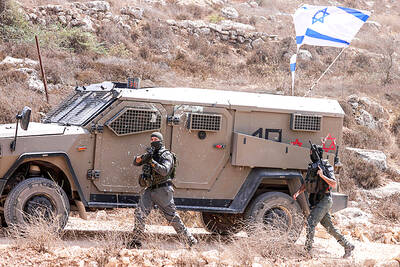
Dozens of Israeli settlers on Saturday attacked the Palestinian village of Qusra in the northern occupied West Bank after nearly three weeks of tension in the area, drawing rare condemnation from Israeli Prime Minister Benjamin Netanyahu. Earlier this month, a group of settlers began blocking supplies from entering Palestinian houses on the outskirts of the village near Nablus, trapping residents inside and drawing unusually strong criticism from the US ambassador. Weeks later, Israeli forces continue to operate in the area while settlers still roam the surrounding hills. On Saturday, Qusra residents and dozens of settlers had descended on the village,
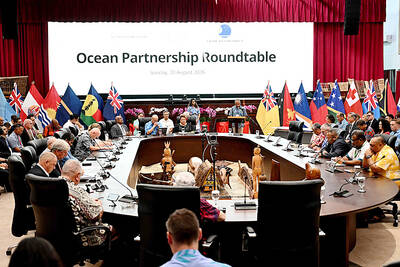
TAIWAN-CHINA ISSUE: Beijing has protested Taiwan’s inclusion in the 18-member state forum, which is being hosted by Palau, an ally of Taiwan At least five leaders would skip the Pacific Island region’s annual summit, officials said yesterday, hours before the opening of talks overshadowed by Taiwan-China tensions. The gathering aims to grapple with challenges such as climate change, drug crime and the Chinese test-firing of a ballistic missile in July that landed in the Pacific Ocean. China’s security and economic influence has added resonance this year, because the 18-member Pacific Islands Forum is being hosted by Palau, a diplomatic ally of Taiwan. Beijing has protested against Taiwan’s inclusion among aid partners invited to attend along with China, Singapore, Japan, the UK and the US. China has


 RSS
RSS