


The unmarked trucks had out-of-state license plates. They came through the city at night on regular intervals and left with thousands of tonnes of rubbish -- all of it recyclable.
Department of Sanitation officials say these thefts, which they began investigating earlier this year, were costing the city perhaps hundreds of thousands of dollars a year.
The City Council unanimously passed a bill on Tuesday that would sharply increase fines for people who steal recyclable material from curbsides -- to US$2,000 from US$100 for a first offense, and US$5,000 for each subsequent offense within a year.
Officials say the bill is aimed at organized enterprises that use vehicles, which would be impounded under the new law, adding that the US$100 fine had not been large enough to prevent these thefts. Mayor Michael Bloomberg is expected to sign the bill, an administration spokesman said.
Sanitation officials estimated the city might be losing as much as 14,000 tonnes of paper a year from Manhattan alone. Based on the city's current recycling contract, which pays US$10 to US$30 a tonne, that means an annual loss of between US$140,000 and US$420,000.
That an underground market has developed for the city's recycled material is a big reversal for a program that took years to find a steady footing after a series of court battles and budget cuts in the 1990s. Even the Bloomberg administration, now known for its environmental policies, considered sharply scaling back recycling in its early years, calling it too costly.
"Our recyclable waste that used to be thought of as worthless is getting so valuable that people now see an economic advantage to stealing it," said Eric Goldstein, a senior lawyer for the Natural Resources Defense Council, an environmental group that helped prepare the city's original recycling law in 1989. "What this sensible legislation does is create a mechanism that would get at the problem of rustlers of recyclables."
"It's a little ironic that five years ago the administration was saying we should end recycling because there was no market for it," said City Councilman Michael McMahon, a Staten Island Democrat and chairman of the Council's Sanitation Committee.

Crowds in Bangladesh are flocking to snap photographs with an unlikely social media star — an albino buffalo with flowing blond hair nicknamed “Donald Trump” that is due to be sacrificed within days. Owner Zia Uddin Mridha, 38, said his brother named the 700kg bull over its flowing helmet of hair resembling the signature look of the US president. “My younger brother picked this name because of the buffalo’s extraordinary hair,” he said at his farm in Narayanganj, just outside the capital, Dhaka. Mridha said that a constant stream of curious visitors — social media fans, onlookers and children — have come throughout

The Bolivian government on Friday struck a deal with protesting miners, but was still grappling with blockades and demonstrations by other workers across La Paz. Other groups are still blocking access roads into the city, which is also the seat of the government. Police on Thursday prevented the miners from entering the main square by using tear gas, while the demonstrators hurled stones and explosives with slingshots. Protests against the policies of Bolivian President Rodrigo Paz have convulsed the Andean nation since early this month, and roadblocks were choking routes into La Paz throughout Friday, the national road authority said. Miners demanded that Paz
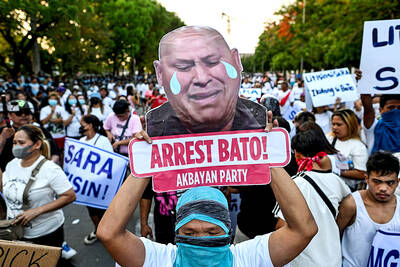
The Philippines said it has asked the country’s Supreme Court to allow it to arrest former Philippine president Rodrigo Duterte’s chief drug war enforcer to stand trial in an international tribunal. The International Criminal Court (ICC) last week unsealed an arrest warrant against Philippine Senator Ronald dela Rosa, accusing him along with Duterte and other “coperpetrators” of the “crime against humanity of murder.” Dela Rosa briefly sought refuge in the Philippine Senate last week while asking the Philippine Supreme Court to stop an ongoing attempt by government agents to arrest him. “By his own conduct, he has placed himself outside the protection of

The researchers in Ireland looked at their computer screen, marveling at a medieval book tracked down in a Roman library. They flipped through its digitized pages and found their sought-after treasure: the oldest surviving English poem. “We were extremely surprised. We were speechless. We couldn’t believe our eyes when we first saw that,” said Elisabetta Magnanti, a visiting research fellow at Trinity College Dublin’s school of English. The poem was also within the main body of Latin text, she said, calling it “extraordinary.” Composed in Old English by a Northumbrian agricultural worker in the 7th century, Caedmon’s Hymn appears within some copies of


 RSS
RSS