


Indian and US aircraft carriers plow through the Bay of Bengal launching fighter jets into the air. US submarines cruise below Japanese, Australian and Singapo-rean warships.
The stated aim of this week's massive war games off India's east coast is to improve the ability of the five participating militaries to fight terrorism and piracy. But in the five days of naval exercises that began on Tuesday, experts see a broader strategic shift that is being driven in large part by the fear of a rising China.
At the center of Asia's new strategic landscape is the warming relationship between New Delhi and Washington -- and, to a lesser extent, India and Japan -- after decades spent on opposite sides of the Cold War divide.
China isn't the only issue drawing them closer -- the nations have increasingly entwined economies and populations, for example -- but it is certainly among the biggest.
"The Chinese are expanding in a huge way into the Indian Ocean," says Rahul Bedi of the London-based Jane's Defense Weekly.
He pointed to a series of moves by Beijing into the Indian Ocean -- an area that New Delhi has long considered its turf -- that raised alarm bells in Asia and the US.
Myanmar's military junta has allowed China to build an intelligence gathering post on the Coco Islands, deep in the Bay of Bengal. And China is assisting Pakistan and Bangladesh in building deep sea ports that its navy could use.
"The whole game, as I see it," Bedi says, referring to naval exercises, "is about China containment."
Still, India is loath to antagonize China, with which it fought a 1962 border war, and has gone to great lengths to assure its neighbor that the drills are not focused on Beijing.
"There is no question of confrontation. There is no military alignment. It's only an exercise," Indian Defense Minister A.K. Antony told reporters last month.
Defense officials at the US embassy in New Delhi had no comment on the exercises, although reporters were being allowed onto US warships for the drills.
Last month, Admiral Timothy Keating, commander of the US Pacific Command, denied the exercises were aimed at isolating China.
"We are looking to minimize the potential areas for misunderstanding and confusion between all of us in the region and China," Keating said during a visit to New Delhi.
Even so, analysts say, while securing vital trade routes for oil and energy resources is certainly part of the rationale behind the exercises, the scope and location of the exercises won't go unnoticed, they say.
"India has taken the precaution of informing China that this is not meant to make an Asian bulwark to contain China," said New Delhi-based strategic analyst Ashok Mehta, a retired Indian general. "Nevertheless, perceptions will lead many others to a different conclusion."
The exercises stretch from India's eastern coast, past the Coco Islands to the Strait of Malacca, one of the world's busiest waterways through which 25 percent of all sea-borne oil shipments pass, US government figures showed.
The war games come as both China and India boost defense spending and modernize their militaries.
Buoyed by its booming economy, China has raised its military budget by 17.8 percent to 351 billion yuan (US$44.94 billion) this year, the largest annual increase in more than a decade. The US Defense Department estimates actual defense spending may be much higher.
China is largely trying to catch up with countries like the US and Japan, which have large modern navies, armies and air forces.
But India too has boosted its defense spending, particularly for its navy, and plans to have three aircraft carriers at sea in the next decade.
"India has realized that the navy is best for projecting force," Mehta says.
Still, India's defense budget of 960 billion rupees (US$21.7 billion) this year lags far behind China.
Taking part in the exercises are 13 US warships, including the nuclear-powered aircraft carrier USS Nimitz and the nuclear submarine USS
Two Japanese destroyers, a frigate from Singapore and an Australian frigate and tanker are also taking part.

Hungarian authorities temporarily detained seven Ukrainian citizens and seized two armored cars carrying tens of millions of euros in cash across Hungary on suspicion of money laundering, officials said on Friday. The Ukrainians were released on Friday, following their detention on Thursday, but Hungarian officials held onto the cash, prompting Ukraine to accuse Hungary’s Russia-friendly government of illegally seizing the money. “We will not tolerate this state banditism,” Ukrainian Minister of Foreign Affairs Andrii Sybiha said. The seven detained Ukrainians were employees of the Ukrainian state-owned Oschadbank, who were traveling in the two armored cars that were carrying the money between Austria and

Kosovar President Vjosa Osmani on Friday after dissolving the Kosovar parliament said a snap election should be held as soon as possible to avoid another prolonged political crisis in the Balkan country at a time of global turmoil. Osmani said it is important for Kosovo to wrap up the upcoming election process and form functional institutions for political stability as the war rages in the Middle East. “Precisely because the geopolitical situation is that complex, it is important to finish this electoral process which is coming up,” she said. “It is very hard now to imagine what will happen next.” Kosovo, which declared

MORE BANS: Australia last year required sites to remove accounts held by under-16s, with a few countries pushing for similar action at an EU level and India considering its own ban Indonesia on Friday said it would ban social media access for children under 16, citing threats from online pornography, cyberbullying, online fraud and Internet addiction. “Accounts belonging to children under 16 on high-risk platforms will start to be deactivated, beginning with YouTube, TikTok, Facebook, Instagram, Threads, X, Bigo Live and Roblox,” Indonesian Minister of Communications and Digital Meutya Hafid said. “The government is stepping in so that parents no longer have to fight alone against the giants of the algorithm. Implementation will begin on March 28, 2026,” she said. The social media ban would be introduced in stages “until all platforms fulfill their
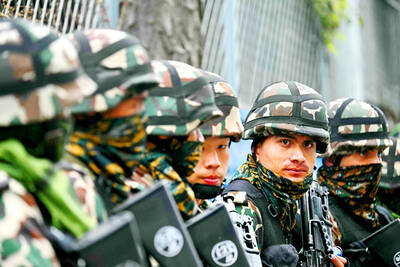
Counting was under way in Nepal yesterday, after a high-stakes parliamentary election to reshape the country’s leadership following protests last year that toppled the government. Key figures vying for power include former Nepalese prime minister K. P. Sharma Oli, rapper-turned-mayor Balendra Shah, who is bidding for the youth vote, and newly elected Nepali Congress party leader Gagan Thapa. In Kathmandu’s tea shops and city squares, people were glued to their phones, checking results as early trends flashed up — suggesting Shah’s centrist Rastriya Swatantra Party (RSP) was ahead. Nepalese Election Commission spokesman Prakash Nyupane said the counting was ongoing “in a peaceful manner”


 RSS
RSS