


US President George W. Bush met yesterday with the man tipped to be Australia's next prime minister, Kevin Rudd, who has pledged to pull the nation's troops out of Iraq.
Rudd, leader of the center-left Labor Party, indicated that Bush had been unable to persuade him to change his mind about Iraq, saying he had stuck to his well-known position on a staged withdrawal.
Bush did not respond to reporters' questions about the talks, but White House national security spokesman Gordon Johndroe said the US leader "had a good session" with Rudd.
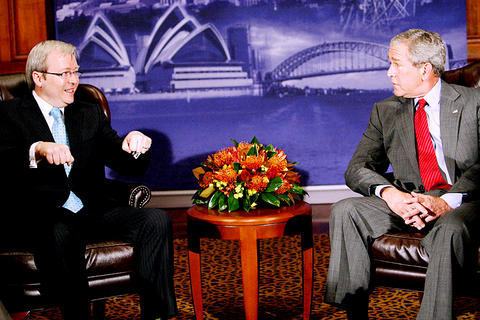
PHOTO: AP
"They exchanged views on issues in Asia, the upcoming APEC meeting and the war on terror, including Iraq," Johndroe said.
Rudd and his party have a commanding lead over Australian Prime Minister John Howard and the conservative government in opinion polls ahead of an election due by the end of the year.
Howard is Bush's staunchest remaining war ally, and the US leader made a point of expressing his friendship and high regard for the prime minister after they met on Wednesday.
"My own judgment is I wouldn't count the man out," he told a joint news conference. "As I recall, he's kind of like me: We both have run from behind and won."
Bush had said ahead of his trip to Australia for the weekend APEC summit that he would try to convince Rudd it was important for coalition forces to remain in Iraq.
"He doesn't know me and I don't know him, so I look forward to sharing my views and would ask, if he were to win, that he would consider conditions on the ground before making any decisions," Bush said.
Rudd said late on Wednesday, however, that he would not change his position and would implement a staged withdrawal from Iraq if he won the elections.
"That view is that we need to have a staged, negotiated withdrawal of our troops from Iraq, and I have no intention of changing that position," he said.
Howard, in contrast, pledged at Wednesday's joint news conference with Bush that Australia's 1,500 troops involved in Iraqi operations would not be cut or withdrawn.
That won him a firm endorsement from the US leader.
"I admire your vision, I admire your courage," he said.
Howard is one of Bush's last major allies in Iraq in a coalition that has previously included former prime ministers Tony Blair of Britain, Spain's Jose Maria Aznar, Italy's Silvio Berlusconi and Poland's former president Aleksander Kwasniewski.
Rudd told reporters after his own meeting yesterday with Bush that they had agreed to keep the content of the talks off the record.
"The talks lasted for 45 minutes in Mr Bush's Sydney hotel today," he said. "We had a wide-ranging, good-natured, very open discussion."
Rudd, a former diplomat who served in Beijing and speaks Mandarin, said they talked about the rise of China and developments on the Korean Peninsula and Taiwan.
"We talked at length about the history of the alliance between Australia and the United States and about Iraq, Afghanistan and climate change," Rudd said.
Bush has previously made it clear that despite his friendship with Howard, the US-Australia relationship is "bigger than any individual in office."
In turn, Rudd has stressed that he values Australia's close ties with the US and that despite disagreements over Iraq, he is ready to work with Bush.
Asked if he thought he could develop a friendship with Bush similar to that enjoyed by Howard, Rudd replied: "I'm a friendly sort of guy."

‘CROSSING THE LINE’: China’s embassy in Seoul criticized US Forces Korea Commander General Xavier Brunson, asking if his ‘hostile’ remarks were authorized by Washington South Korea and the US are in talks over recent public remarks by the commander of US Forces Korea, Seoul’s presidential office said yesterday, after the comments drew sharp criticism from China. In a recent podcast interview, US Forces Korea Commander General Xavier Brunson described South Korea as “the dagger in the heart of Asia” from China’s east coast, prompting the Chinese embassy in Seoul to say that he had “truly crossed the line.” The interview came amid growing speculation that Washington might seek to expand the role of US Forces Korea in countering the growing regional influence of China, a key

Through the noise of rushing papers and whirring belts at a print factory in Kyoto, two creators watch their photo essay come to life in broadsheet form — part of an effort to win new audiences in the age of artificial intelligence (AI). Despite the decline of the publishing industry, self-publication and handmade “zine” magazines are growing in popularity in Japan, reflecting the nation’s enduring love of paper in the digital era. While speaking to Agence France-Presse at the plant, his hands black with ink, one of the creators, Kazuma Obara, said: “I think [paper] is a medium that engages all five

Australian researchers have trained lab-grown brain cells on a silicon computer chip to play the 1990s shooter game Doom and said they are just scratching the surface of what the neurons could be capable of doing. It is the science-fiction work of biotech boffins at Cortical Labs, who researched and developed the technology that harnesses the workings of the brain’s networking system. Each so-called “biological computer” contains about 200,000 living human brain cells, grown from stem cells that were harvested from blood donations. Having mastered the simple computer game Pong, where a paddle is moved up and down to send a ball

France experienced its hottest spring on record, the French weather service said on Tuesday, after an exceptional early heat wave that also broke highs for the season in England and Wales. Meteo-France said the average nationwide temperature over March to May was 13.8°C — about 1.7°C above the norm, and surpassing records set in 2011 and 2020. “The warmest spring since records began in 1900,” it said in a bulletin. All three months were warmer than average, but the onset of an “unprecedented heatwave” late last month pushed the mercury to highs typically seen at the height of the summer. “Our country had never


 RSS
RSS