


Ramping up the pressure on Sudan, British Prime Minister Gordon Brown and French President Nicolas Sarkozy have united to boost peace efforts in Darfur, warning Khartoum of sanctions if it got in the way.
In a comment piece published yesterday in the Times newspaper in Britain, the two also urged the international community to intensify its action on the territory.
"There is still a gap between the efforts pursued by the international community and the dramatic situation that remains on the ground," they wrote.
They said that only "a ceasefire, a peacekeeping force, economic reconstruction and the threat of sanctions that can bring a political solution to the region."
The pair vowed to "redouble our efforts to make further progress," noting that "the situation remains completely unacceptable."
Their article comes ahead of the deployment of a 26,000 UN-African Union (AU) force which was agreed by the UN Security Council last month after months of intense diplomatic activity to convince Sudanese President Omar al-Beshir.
The full force, that is to replace a poorly-equipped AU contingent, is not expected to be on the ground before the middle of next year.
The UN has said that more than 200,000 people have died and more than 2million have been displaced by four years of conflict in Darfur.
Sarkozy and Brown wrote that French Secretary of State for Foreign Affairs and Human Rights Rama Yade and junior British Foreign Office Minister Lord Mark Malloch-Brown would soon visit Sudan, including Darfur.
The two men also called for a political settlement that would allow Darfur to participate in Sudanese national elections in 2009.
They wrote that if sufficient progress was not made on security in the region, a ceasefire, the political process and humanitarian access, sanctions would be on the table.
"We will work together for further sanctions against those who fail to fulfil their commitments, obstruct the political process or continue to violate the ceasefire," they wrote.
They also said more had to be done on economic reconstruction and about the broader problems in the region surrounding Darfur.
"The causes of conflict in Sudan are deep-rooted -- economic, environmental and political. Neither Britain nor France, nor the people of Sudan, can achieve a successful outcome alone," they said. "We need cooperation from all parties and engagement from the international community."
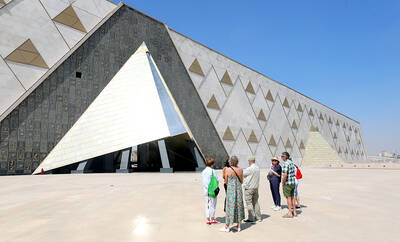
With much pomp and circumstance, Cairo is today to inaugurate the long-awaited Grand Egyptian Museum (GEM), widely presented as the crowning jewel on authorities’ efforts to overhaul the country’s vital tourism industry. With a panoramic view of the Giza pyramids plateau, the museum houses thousands of artifacts spanning more than 5,000 years of Egyptian antiquity at a whopping cost of more than US$1 billion. More than two decades in the making, the ultra-modern museum anticipates 5 million visitors annually, with never-before-seen relics on display. In the run-up to the grand opening, Egyptian media and official statements have hailed the “historic moment,” describing the

‘CHILD PORNOGRAPHY’: The doll on Shein’s Web site measure about 80cm in height, and it was holding a teddy bear in a photo published by a daily newspaper France’s anti-fraud unit on Saturday said it had reported Asian e-commerce giant Shein (希音) for selling what it described as “sex dolls with a childlike appearance.” The French Directorate General for Competition, Consumer Affairs and Fraud Control (DGCCRF) said in a statement that the “description and categorization” of the items on Shein’s Web site “make it difficult to doubt the child pornography nature of the content.” Shortly after the statement, Shein announced that the dolls in question had been withdrawn from its platform and that it had launched an internal inquiry. On its Web site, Le Parisien daily published a

China’s Shenzhou-20 crewed spacecraft has delayed its return mission to Earth after the vessel was possibly hit by tiny bits of space debris, the country’s human spaceflight agency said yesterday, an unusual situation that could disrupt the operation of the country’s space station Tiangong. An impact analysis and risk assessment are underway, the China Manned Space Agency (CMSA) said in a statement, without providing a new schedule for the return mission, which was originally set to land in northern China yesterday. The delay highlights the danger to space travel posed by increasing amounts of debris, such as discarded launch vehicles or vessel
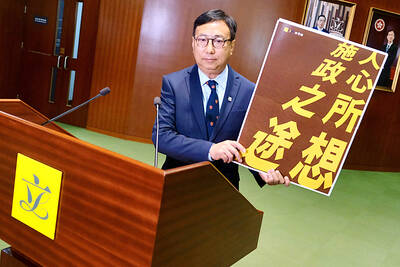
RUBBER STAMP? The latest legislative session was the most productive in the number of bills passed, but critics attributed it to a lack of dissenting voices On their last day at work, Hong Kong’s lawmakers — the first batch chosen under Beijing’s mantra of “patriots administering Hong Kong” — posed for group pictures, celebrating a job well done after four years of opposition-free politics. However, despite their smiles, about one-third of the Legislative Council will not seek another term in next month’s election, with the self-described non-establishment figure Tik Chi-yuen (狄志遠) being among those bowing out. “It used to be that [the legislature] had the benefit of free expression... Now it is more uniform. There are multiple voices, but they are not diverse enough,” Tik said, comparing it


 RSS
RSS