


Norway is preparing to criminalize the purchase of sex -- though not the sale of it -- a move that is proving highly controversial among prostitute support groups, who argue that the policy will make sex workers more vulnerable.
Men who buy sex could face up to six months in jail, pay a fine or face both, under proposed legislation currently under consultation with relevant interest groups.
The law will ban paying for sexual services, but not selling them. Procuring, or pimping, and human trafficking are already illegal.
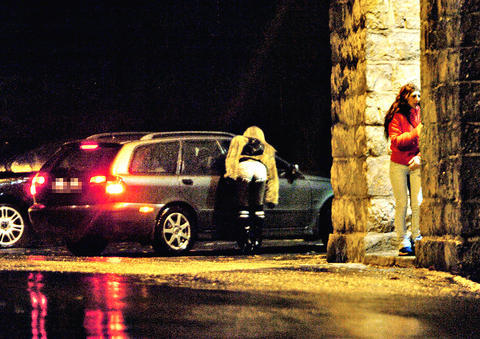
PHOTO: AFP
The bill, expected to be sent to parliament before the middle of next year, is certain to be adopted as all three parties in the governing coalition have said they will back it.
"We want to send a clear message to men that buying sex is unacceptable. Men who do it are taking part in an international crime involving human beings who are trafficked for sex," Norwegian Justice Minister Knut Storberget said.
"Criminalizing buying sex will make it more difficult for traffickers to organize themselves," he said, because they won't be able to find clients on the street, since the latter will be afraid of getting caught.
Prostitutes' support groups say the law will be ineffective.
"The law will end street prostitution but it won't stop women from working indoors or from going abroad" to work as prostitutes, said Liv Jessen, director of the Pro Center, an Oslo-based support group for prostitutes.
It is estimated that about 40 percent of deals between prostitutes and customers in Norway are made on the street, with the rest occurring indoors, for instance in hotels or at massage parlors.
Among prostitutes working on the street, about 80 percent come from countries such as Romania, Bulgaria and Nigeria, via trafficking. The rest are Norwegians who tend to be drug abusers.
In recent years, street prostitution in central Oslo has become more visible, prompting calls for a ban. But critics say the law will make sex workers more vulnerable.
"The girls will have to rely more on pimps than before to get clients," said Janni Wintherbauer, the leader of the Organization for the Interests of Prostitutes and a sex worker herself. "The pimps will organize everything: the flat where they live, the choice of clients and how much money they get."
"In the street, the girls can choose who they go with. If they don't like the look of a client, they can say no. In an apartment, they can't," Wintherbauer said.
She fears there will be more rapes and attacks on prostitutes.
"The client will think: `I've already broken the law, I've got nothing to lose.' And in an apartment, a girl will be alone" where no one will be able to help her, she said.
The planned law is modeled on legislation passed in 1999 in Sweden. There, men who buy sex face six months in jail or a fine, set in proportion to their income.
No one has yet gone to prison for the offense, but one person was fined, police said.

ROCKY RELATIONS: The figures on residents come as Chinese tourist numbers drop following Beijing’s warnings to avoid traveling to Japan The number of Chinese residents in Japan has continued to rise, even as ties between the two countries have become increasingly fractious, data released on Friday showed. As of the end of December last year, the number of Chinese residents had increased by 6.5 percent from the previous year to 930,428. Chinese people accounted for 22.6 percent of all foreign residents in Japan, making them by far the largest group, Japanese Ministry of Justice data showed. Beijing has criticized Tokyo in increasingly strident terms since Japanese Prime Minister Sanae Takaichi last year suggested that a military conflict around Taiwan could

A retired US colonel behind a privately financed rocket launch site in the Dominican Republic sees the project as a response to China’s dominance of the space race in Latin America. Florida-based Launch on Demand is slated to begin building a US$600 million facility in a remote region near the border with Haiti late this year. The project is designed to meet surging demand for the heavy-lift rockets needed to put clusters of satellites into orbit. It is also an answer to China’s growing presence in the region, said CEO Burton Catledge, a former commander of the US Air Force’s 45th Operations

Germany is considering Australia’s Ghost Bat robot fighter as it looks to select a combat drone to modernize its air force, German Minister of Defense Boris Pistorius said yesterday. Germany has said it wants to field hundreds of uncrewed fighter jets by 2029, and would make a decision soon as it considers a range of German, European and US projects developing so-called “collaborative combat aircraft.” Australia has said it will integrate the Ghost Bat, jointly developed by Boeing Australia and the Royal Australian Air Force, into its military after a successful weapons test last year. After inspecting the Ghost Bat in Queensland yesterday,

A pro-Iran hacking group claimed to breach FBI Director Kash Patel’s personal e-mail inbox and posted some of the contents online. The e-mails provided by the hacking group include travel details, correspondence with leasing agents in Washington and global entry, and loyalty account numbers. The e-mail address the hackers claim to have compromised has been previously tied to Patel’s personal details, and the leaked e-mails contain photos of Patel and others, in addition to correspondence with family members and colleagues. “The FBI is aware of malicious actors targeting Director Patel’s personal email information,” the agency said in a statement on


 RSS
RSS