


A tense standoff developed yesterday between police and Islamic radicals at a mosque in the Pakistani capital after four officers were held hostage overnight, officials said.
Dozens of students from a seminary attached to the Red Mosque late on Friday seized four policemen and took them inside, demanding the release of 10 colleagues picked by intelligence agencies recently.
Armed police took up positions yesterday close to the mosque, while students armed with batons blocked some nearby roads.
The situation represented the latest in a series of challenges facing Pakistani President Pervez Musharraf amid a political crisis over the suspension of the country's top judge.
"We have made it clear to the government that we will not free the policemen until the release on bail of our students, some of them arrested on false charges of burning video CDs," mosque deputy Abdul Rashid Ghazi said.
Witnesses said tension was high around the mosque, which is close to the city's main Aabpara market.
Ghazi threatened reprisals countrywide if any operation was launched against the mosque or the seminary.
"Any operation will have disastrous consequences," Ghazi said, as authorities considered their options over how to deal with the crisis.
An interior ministry official said the government wanted a "peaceful solution to the row through negotiations," although efforts throughout the night failed to break the impasse.
A high-level meeting at the interior ministry late on Friday decided "not to use force to free the police and continued the path of negotiations for the sake of public safety," a senior government official said.
Last month the Red Mosque set up a self-styled Islamic court, which issued a fatwa, or religious decree, against the female tourism minister for hugging a French paragliding instructor after a charity jump.
The mosque's male and female students have also launched anti-vice patrols, targeting music and video shops.
They briefly kidnapped two policemen and three women, including an alleged brothel owner.
And they have refused to vacate a government children's library that they occupied in January. They were protesting the demolition of several mosques that the authorities said were built on illegally-occupied land.
Commentators have seen the problems with the mosque in the heart of the capital as an example of the creeping "Talibanization" of Pakistan by Islamic militants.
Dozens of suspected Islamic militants, meanwhile, ambushed a vehicle carrying eight government officials and kidnapped them in a troubled northwestern tribal region of Pakistan, officials said yesterday.
The officials, including five women, were abducted late on Friday as they traveled to the North Waziristan tribal region bordering Afghanistan to inspect sites for development projects, said Arbab Mohammed Arif Khan, secretary for law and order in Pakistan's semiautonomous tribal regions.
"I can only confirm that a group of gunmen has kidnapped eight government officials and we are making efforts for their early recovery," he said, refusing to speculate who might have kidnapped the officials.

ACTIONABLE ADVICE: The majority of chatbots tested provided guidance on weapons, tactics and target selections, with Perplexity and Meta AI deemed to be the least safe From school shootings to synagogue bombings, leading artificial intelligence (AI) chatbots helped researchers plot violent attacks, according to a study published on Wednesday that highlighted the technology’s potential for real-world harm. Researchers from the nonprofit watchdog Center for Countering Digital Hate and CNN posed as 13-year-old boys in the US and Ireland to test 10 chatbots, including ChatGPT, Google Gemini, Perplexity, Deepseek and Meta AI. Eight of the chatbots assisted the make-believe attackers in more than half the responses, providing advice on “locations to target” and “weapons to use” in an attack, the study said. The chatbots had become a “powerful accelerant for

Australians were downloading virtual private networks (VPNs) in droves, while one of the world’s largest porn distributors said it was blocking users from its platforms as the country yesterday rolled out sweeping online age restriction. Australia in December became the first country to impose a nationwide ban on teenagers using social media. A separate law now requires artificial intelligence (AI)-powered chatbot services to keep certain content — including pornography, extreme violence and self-harm and eating disorder material — from minors or face fines of up to A$49.5 million (US$34.6 million). The country also joined Britain, France and dozens of US states requiring
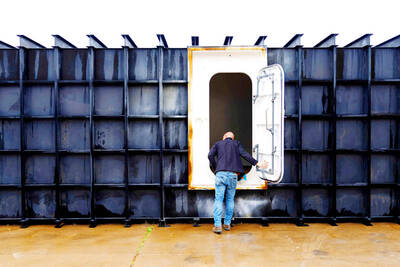
Since the war in the Middle East began nearly two weeks ago, the telephone at Ron Hubbard’s bomb shelter company in Texas has not stopped ringing. Foreign and US clients are rushing to buy his bunkers, seeking refuge in case of air raids, nuclear fallout or apocalypse. With the US and Israel pounding Iran, and Tehran retaliating with strikes across the region, Hubbard has seen demand for his product soar, mostly from Gulf nation customers in Bahrain, Qatar, Kuwait and the United Arab Emirates. “You can imagine how many people are thinking: ‘I wish I had a bomb shelter,’” Hubbard, 63, said in
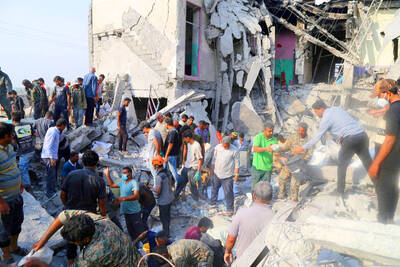
STILL IN POWER: US intelligence reports showed that the Iranian regime is not in danger of collapse and retains control of the public, casting doubt on Trump’s exit Nearly every US Senate Democrat on Wednesday signed a letter sent to US Secretary of Defense Pete Hegseth requesting a “swift investigation” of airstrikes on a girls’ school in Iran that killed scores of children and any other potential US military actions causing civilian harm. Reuters reported on Thursday last week that US military investigators believe it is likely that US forces were responsible for the Feb. 28 strike on the school, as US and Israeli forces launched attacks on Iran. “The results of this school attack are horrific. The majority of those killed in the strikes were girls between the ages


 RSS
RSS