


The Philippines said yesterday it would probe claims of vote fraud after national elections marred by violence and stolen ballots, with up to 100,000 people unable to participate in the polls.
Two people who were counting votes by hand from Monday's polls were killed yesterday, taking the death toll to 126 in election-related violence, which drew international criticism and scared many away from voting.
Millions cast ballots to elect thousands of local politicians, the entire 275-seat House of Representatives and half the 24-seat Senate, control of which could go to the opposition, exit polls suggested.
"We do not deny that there were many who were disenfranchised," said the head of the national election commission, Benjamin Abalos.
"It may not be a substantial amount but as long as there is disenfranchisement, even if it is just one or two people, we cannot close our eyes," he said.
The commission has set up a panel to look into reports of cheating, and 110 special courts have been opened nationwide to handle an expected flood of fraud claims, which are common in this Southeast Asian nation.
As many as 100,000 voters in the strife-torn south of the country were unable to cast their ballots due to the threat of violence or lack of ballot papers, some of which were stolen, the commission said.
Abalos insisted the elections had been generally fair and peaceful, rejecting reports of rampant irregularities.
"There have been no reported incidents of cheating" except for minor isolated incidents, he told reporters.
The Center for People Empowerment in Governance (CenPEG) a public policy group, however, said Monday's election could see the lowest turnout in six years.
Disputing Abalos' estimate of a 70 to 80 percent turnout among the country's 45 million registered voters, CenPEG's Bobby Tuazon said several precincts in Manila reported turnouts as low as 50 percent.
"If this is the case, Monday's elections could be the lowest in years, with 77 percent turnout in 2004 [presidential election] and 85 percent in 2001 [midterm elections]," Tuazon said.
He said reports showed that "possibly hundreds of thousands of voters" were directly disenfranchised with their names missing from voter lists.
As counting began around the country yesterday the focus is now on who will dominate the Senate.
President Gloria Arroyo's allies hold seven of the 12 Senate seats not contested, meaning the fragmented opposition would need to win eight of the seats up for grabs to take control of the upper house.
An opposition-controlled Senate would make it harder for Arroyo to pursue her economic reform agenda. Over the past three years, Congress has passed a set of tax bills which shored up the government's finances.
Despite the possible loss of the Senate, analysts expect Arroyo to maintain control of the House, where any efforts to impeach Arroyo over allegations she cheated to win the May 2004 ballot would originate. She denies wrong-doing.
Official results in the local elections are expected to be declared within a week, but it could be a month before results in the Senate and House are known.
As the vote count continued yesterday, so did the violence. Two election workers, both teachers, were killed when unidentified men burned down a school used as a polling place in the town of Taysan south of Manila, police said.
"We continue to receive field reports of isolated incidents of violence, some of which are directly related to politics," national police chief Oscar Calderon said.
"The first order of the day is to go hammer and tongs against those responsible for this election violence and give justice to the 126 killed," he said.

Crowds in Bangladesh are flocking to snap photographs with an unlikely social media star — an albino buffalo with flowing blond hair nicknamed “Donald Trump” that is due to be sacrificed within days. Owner Zia Uddin Mridha, 38, said his brother named the 700kg bull over its flowing helmet of hair resembling the signature look of the US president. “My younger brother picked this name because of the buffalo’s extraordinary hair,” he said at his farm in Narayanganj, just outside the capital, Dhaka. Mridha said that a constant stream of curious visitors — social media fans, onlookers and children — have come throughout

It began as a satirical online project. Now millions of young people in India are flocking to it as an outlet for their frustration. A parody political party called the Cockroach Janta Party, with the insect as its symbol, has exploded across India’s social media by turning absurdist humor into protest. Memes and short videos mocking corruption, joblessness and political dysfunction have flooded social media sites, where millions of users are embracing the cockroach — known for its ability to survive harsh conditions — as a tongue-in-cheek symbol of endurance. The online movement’s rise has been unusually rapid. The Cockroach Janta Party (CJP)
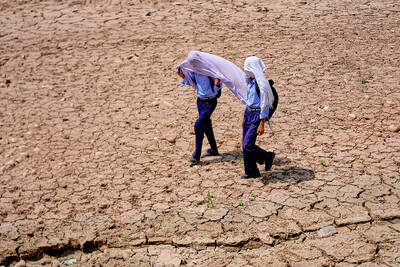
HOTTER: While Indians are accustomed to summer heat, climate change has caused northwestern India to warm faster than other parts of the country, an academic said Roads and markets have emptied during afternoons and some farmers have switched to nighttime work to avoid scorching temperatures as a heat wave grips large parts of India. The India Meteorological Department forecast maximum temperatures for yesterday of about 45°C in the capital, New Delhi, where authorities have opened temporary “cooling zones” to help people cope. The weather department warned that conditions would likely persist across several northern regions in the coming days, with temperatures staying well above seasonal averages. Authorities urged people to stay indoors during the hottest hours and take precautions against heat-related illnesses. India declares a heat wave whenever maximum temperatures
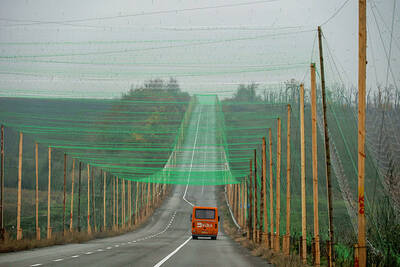
BIGGER ROLE: Beijing has said it maintains an impartial stance on the war in Ukraine, but by training Russian troops, China is far more involved than previously known China’s armed forces secretly trained about 200 Russian military personnel in China late last year, and some have since returned to fight in Ukraine, according to three European intelligence agencies and documents seen by Reuters. While China and Russia have held a number of joint military exercises since Moscow’s full-scale invasion of Ukraine in 2022, Beijing has repeatedly said that it is neutral in the conflict and presents itself as a peace mediator. The covert training sessions, which predominantly focused on the use of drones, were outlined in a dual-language Russian-Chinese agreement signed by senior Russian and Chinese officers in Beijing on


 RSS
RSS