


The US administration is willing to negotiate with Russia on limitations to proposed US missile defense bases in Europe, US Defense Secretary Robert Gates said on Tuesday.
No such negotiations have been set. But Washington is seeking to allay Russian concerns about the proposed system, which would be an extension of a network of radars, interceptors and command posts in the western US designed to shoot down a hostile long-range nuclear missile.
The system in Europe would be meant specifically to protect Europe from a missile launched from the Middle East. The US proposal has stirred controversy not only in Russia but also in Europe.
In Moscow, reviving Cold War-like rhetoric, the Russian military's chief of general staff warned that Russia might target elements of the system.
"If we see that the facilities pose a threat to Russia's security, the facilities will be objects for plans of our forces. Whether strategic, nuclear or otherwise -- that's a technical question," General Yuri Baluyevksy said.
His comments were among the harshest in months of Russian criticism of the US plans.
Gates, at a news conference with his Polish counterpart, ac-knowledged that Russia had concerns not only about an advanced missile-tracking radar the Pentagon wants to place in the Czech Republic, but also the associated missile interceptors that it would install in Poland.
The interceptors are intended to collide with a hostile missile during flight, destroying the target while still outside the Earth's atmosphere. The system's results during testing have been mixed.
Gates said the Russians' questions about the radar "are questions that we can answer." And he acknowledged Russian expressions of concern that the proposed interceptor base in Poland -- while not a threat to Russia now -- could later be changed in ways that would undermine the viability of Russia's offensive missile force.
"In terms of assurances that the system would not be changed years from now in a way that might be more threatening to the Russian deterrent [force], it seems to me that's a matter that could be negotiated," he said.
Gates met Polish Defense Minister Aleksander Szczyglo and later Polish President Lech Kaczynski. On Monday, he met Russian President Vladimir Putin and other government leaders in Moscow.
At the news conference, Szczyglo did not commit Poland to hosting a US missile defense base. He said Poland would have to be persuaded that the base would enhance Poland's security -- an apparent allusion to concern that it might trigger countermeasures by Russia.


Through the noise of rushing papers and whirring belts at a print factory in Kyoto, two creators watch their photo essay come to life in broadsheet form — part of an effort to win new audiences in the age of artificial intelligence (AI). Despite the decline of the publishing industry, self-publication and handmade “zine” magazines are growing in popularity in Japan, reflecting the nation’s enduring love of paper in the digital era. While speaking to Agence France-Presse at the plant, his hands black with ink, one of the creators, Kazuma Obara, said: “I think [paper] is a medium that engages all five
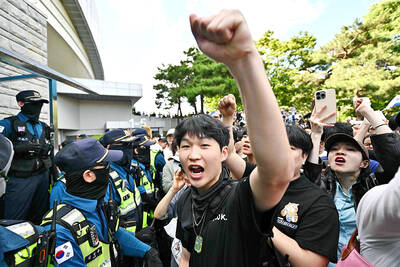
‘ABSURD MISTAKE’: The election commission said that there had been a failure to anticipate turnout after 14 polling stations ran short of ballot papers South Korean riot police yesterday cleared protesters from a Seoul polling station after a 35-hour blockade sparked by a shortage of ballot papers during local elections earlier this week. Wednesday’s election was the first nationwide vote since South Korean President Lee Jae-myung took office following the ouster of Yoon Suk-yeol over his short-lived martial law declaration. Lee’s ruling Democratic Party swept most races, but failed to flip the crucial Seoul mayoral seat. The South Korean National Election Commission apologized, blaming a failure to anticipate turnout after 14 polling stations in Seoul ran short of ballot papers. Some polling stations stayed open until 10pm to

France experienced its hottest spring on record, the French weather service said on Tuesday, after an exceptional early heat wave that also broke highs for the season in England and Wales. Meteo-France said the average nationwide temperature over March to May was 13.8°C — about 1.7°C above the norm, and surpassing records set in 2011 and 2020. “The warmest spring since records began in 1900,” it said in a bulletin. All three months were warmer than average, but the onset of an “unprecedented heatwave” late last month pushed the mercury to highs typically seen at the height of the summer. “Our country had never

A Sherpa guide was found crawling to base camp on Mount Everest a week after he went missing and was reunited with his family, who had given up hope he would return. Dawa Sherpa was last seen on Friday last week descending the mountain, but he did not reach base camp even though his client did. The pair were among the last climbers on the mountain as the climbing season came to an end and the route was dismantled. Dawa was located by a cleaning crew on Thursday morning as he was crawling down the snowy slopes around the Khumbu Icefall, just above


 RSS
RSS