


New York's oldest bartender learned early in his career not to be over-awed in the presence of celebrity.
Dean Martin and Jerry Lewis were "just regular people," and never gave him any trouble; Judy Garland was "sad," and sat in the corner drinking whisky, but was otherwise pleasant. John Lennon liked a scotch. And Marilyn Monroe?
"I'll tell you this about Marilyn," Hoy Wong said on Tuesday, leaning forward at a table in the bar of the Algonquin Hotel. "She always wore really low-cut dresses."
Mr Hoy, as he is universally known, turned 90 yesterday, and last night his colleagues in midtown Manhattan, were preparing to throw a party for him, along with 350 friends and customers.
After 58 years behind the bar, pouring some 750,000 drinks, the Hong Kong-born Hoy was enjoying the attention. But he had no plans to get drunk: He has not had a drink since a heart attack in 1982.
After coming to the US in 1940, Hoy served in the army for three years, seeing out the end of World War II in India and China, and learning, from his experiences as a mess sergeant, that he would not relish a career as a cook.
"Being a bartender, it's easy living, and you get to talk to people every day, pay attention to the customer," he said. "And it's good money."
Hoy met most of his star customers while at Freeman Chum, a Chinese restaurant that has long since closed. At another bar job, in 1961, he took an order from the Duke of Windsor, for a House of Lords gin martini "on toast."
The request baffled other staff, one of whom was ready to get the kitchen to prepare some toast. But Hoy knew he wanted a Martini with a lemon-peel spritz, set on fire. The former king ended up ordering two.
Hoy moved to the Algonquin in 1979. The wisecracking members of the 1920s Algonquin round table -- Dorothy Parker, Robert Benchley and others -- had long since moved on. But they had been replaced by other high-profile customers such as Anthony Quinn and Henry Kissinger.
"I'm not going to retire," Hoy said. "As long as I'm healthy like this, I'll keep going. You know why? I figured it out. President Bush -- he needs the money. So I've got to keep working to pay the tax."

Through the noise of rushing papers and whirring belts at a print factory in Kyoto, two creators watch their photo essay come to life in broadsheet form — part of an effort to win new audiences in the age of artificial intelligence (AI). Despite the decline of the publishing industry, self-publication and handmade “zine” magazines are growing in popularity in Japan, reflecting the nation’s enduring love of paper in the digital era. While speaking to Agence France-Presse at the plant, his hands black with ink, one of the creators, Kazuma Obara, said: “I think [paper] is a medium that engages all five
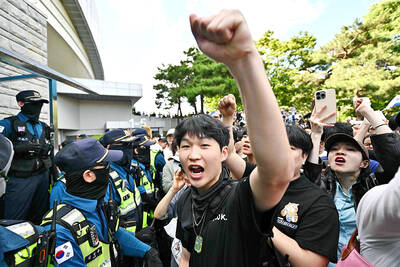
‘ABSURD MISTAKE’: The election commission said that there had been a failure to anticipate turnout after 14 polling stations ran short of ballot papers South Korean riot police yesterday cleared protesters from a Seoul polling station after a 35-hour blockade sparked by a shortage of ballot papers during local elections earlier this week. Wednesday’s election was the first nationwide vote since South Korean President Lee Jae-myung took office following the ouster of Yoon Suk-yeol over his short-lived martial law declaration. Lee’s ruling Democratic Party swept most races, but failed to flip the crucial Seoul mayoral seat. The South Korean National Election Commission apologized, blaming a failure to anticipate turnout after 14 polling stations in Seoul ran short of ballot papers. Some polling stations stayed open until 10pm to

Australian researchers have trained lab-grown brain cells on a silicon computer chip to play the 1990s shooter game Doom and said they are just scratching the surface of what the neurons could be capable of doing. It is the science-fiction work of biotech boffins at Cortical Labs, who researched and developed the technology that harnesses the workings of the brain’s networking system. Each so-called “biological computer” contains about 200,000 living human brain cells, grown from stem cells that were harvested from blood donations. Having mastered the simple computer game Pong, where a paddle is moved up and down to send a ball
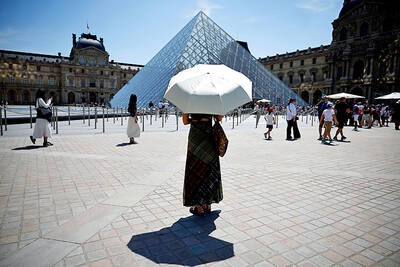
France experienced its hottest spring on record, the French weather service said on Tuesday, after an exceptional early heat wave that also broke highs for the season in England and Wales. Meteo-France said the average nationwide temperature over March to May was 13.8°C — about 1.7°C above the norm, and surpassing records set in 2011 and 2020. “The warmest spring since records began in 1900,” it said in a bulletin. All three months were warmer than average, but the onset of an “unprecedented heatwave” late last month pushed the mercury to highs typically seen at the height of the summer. “Our country had never


 RSS
RSS