


China is threatening to use its considerable economic strength to penalize Canada following the Canadian government's decision to bestow honorary citizenship on the Dalai Lama.
Canada's gesture toward the exiled Tibetan spiritual leader does not bode well for Canadian-Chinese relations, said Zang Weidong, a minister-counselor at the Chinese embassy in Ottawa.
He said China has relayed its disapproval to the government of Prime Minister Stephen Harper and demanded that Canada continue to recognize Tibet as a part of China.
"We said that Dalai Lama is a separatist, so I don't think he should be honored with that and that will harm the Canadian image and also harm the relationship between China and Canada," Zang told reporters at a news conference on Wednesday.
Parliament adopted a motion on June 22 conferring the honorary status on the Dalai Lama. The honor has been awarded only twice before, to South African leader Nelson Mandela and Swedish diplomat Raoul Wallenberg, who saved countless Jews from extermination during World War II.
The Dalai Lama won a Nobel peace prize for his lifelong struggle for Tibetan autonomy and his pursuit of peace. He fled into exile in northern India in 1959, following a failed uprising against Chinese rule, and is still widely revered in Tibet.
Amnesty International says freedom of religion and expression continue to be severely restricted in Tibet, with numerous arbitrary arrests and unfair trials.
China is Canada's second-largest trading partner, with annual trade worth C$30 billion (US$26.3 billion) in 2004, according to the Department of Foreign Affairs.
Zang hinted that Parliament's decision could bring economic repercussions.
"We have 1.3 billion population ... and the future for China is bright, and China has a big market and we hope we can cooperate with all the countries in the world," Zang said. "But if some problems or troubles always appear or emerge in the bilateral relationship, certainly the other relationships certainly will be hurt."
Asked if China was leveling a threat, Zang smiled and said: "I don't think it's a threat. I'm just trying to make things clearer."
The Department of Foreign Affairs said Canada recognizes China as the legitimate government of Tibet, but has great respect for the Dalai Lama, who has indicated that he would visit Canada in September.
"Canada does not recognize the Tibet government in exile, but Canada considers the Dalai Lama to be an important and widely supported spiritual leader," said spokeswoman Kim Girte.
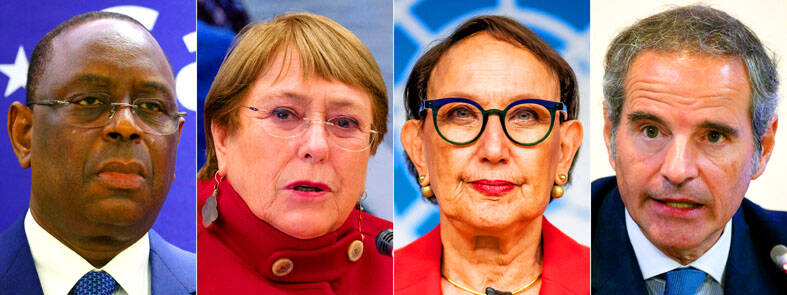
Four contenders are squaring up to succeed Antonio Guterres as secretary-general of the UN, which faces unprecedented global instability, wars and its own crushing budget crisis. Chile’s Michelle Bachelet, Argentina’s Rafael Grossi, Costa Rica’s Rebeca Grynspan and Senegal’s Macky Sall are each to face grillings by 193 member states and non-governmental organizations for three hours today and tomorrow. It is only the second time the UN has held a public question-and-answer, a format created in 2016 to boost transparency. Ultimately the five permanent members of the UN’s top body, the Security Council, hold the power, wielding vetoes over who leads the

South Korea’s air force yesterday apologized for a 2021 midair collision involving two fighter jets, a day after auditors said the pilots were taking selfies and filming during the flight and held them responsible for the accident. “We sincerely apologize to the public for the concern caused by the accident that occurred in 2021,” an air force spokesman told a news conference, adding that one of the pilots involved had been suspended from flying duties, received severe disciplinary action and has since left the military. The apology followed a report released on Wednesday by the South Korean Board of Audit and Inspection,

An earthquake registering a preliminary magnitude of 7.7 off northern Japan on Monday prompted a short-lived tsunami alert and the advisory of a higher risk of a possible mega-quake for coastal areas there. The Cabinet Office and the Japan Meteorological Agency said there was a 1% chance for a mega-quake, compared to a 0.1% chance during normal times, in the next week or so following the powerful quake near the Chishima and Japan trenches. Officials said the advisory was not a quake prediction but urged residents in 182 towns along the northeastern coasts to raise their preparedness while continuing their daily lives. Prime

About 240 Indians claiming descent from a Biblical tribe landed at Tel Aviv airport on Thursday as part of a government operation to relocate them to Israel. The newcomers passed under a balloon arch in blue and white, the colors of the Israeli flag, as dozens of well-wishers welcomed them with a traditional Jewish song. They were the first “bnei Menashe” (“sons of Manasseh”) to arrive in Israel since the government in November last year announced funding for the immigration of about 6,000 members of the community from the states of Manipur and Mizoram in northeast India. The community claims to descend from


 RSS
RSS