


Tonnes of drugs and medical equipment that have poured into Indonesia in the wake of a slew of major disasters are often damaged, out of date and unusable, aid workers said.
Donors jumped into action following disasters ranging from the 2004 Indian Ocean tsunami, which killed 168,000 people in Aceh Province, to a massive earthquake on Java in May that claimed some 5,800 lives.
But according to aid agency Pharmaciens Sans Frontihres (PSF), or Pharmacists Without Borders, donated medicines have created more headaches for the government than benefits for the victims.
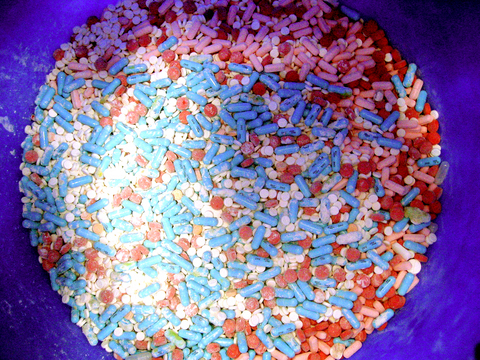
PHOTO: AFP
"It's a second tsunami, a huge wave of drugs donations that authorities are totally unable to handle," PSF pharmacist Laurence Boiron said, referring to some 600 tonnes of expired, damaged or inappropriate medicine pouring into Aceh.
Some 200 tonnes of unusable drugs taken from Nias Island, hit by a deadly earthquake in March last year, were to be incinerated yesterday at a cement factory in Bogor, south of Jakarta.
Early this month, 150 tonnes of drugs donated to Aceh were burned and PSF planned to destroy another 50 tonnes of donations made to victims of the May 27 Yogyakarta earthquake.
At Banda Aceh's Zainoel Abidin hospital, parcels from around the world cram the corridors of the once tsunami-devastated building and chief pharmacist Abu Saadi is puzzled.
"We are all victims of the tsunami and do thank the international community for its generous help," Saadi said. "But all these drugs take so much space. We would have rather had quality than quantity."
The WHO has established strict guidelines for donated drugs. They must comply with the WHO official list of approved medicine, be in use in the receiving country and have, upon arrival, a remaining shelf life of at least one year.
But the standards are frequently eschewed. In Aceh, 70 percent of donated drugs were labeled in a foreign language other than English or Indonesian, contrary to another WHO guideline.
Banda Aceh hospital's pharmacist Saadi recalled receiving cases of injectable Pantozol, a drug used to treat gastritis.
"But in Indonesia we only use it in tablets, so doctors had never seen these. We didn't use them in fear of killing patients," he said.
The eventual cost of dealing with the drugs can easily outstrip their usefulness.
"With a cost of US$250 per tonne to incinerate, we could [instead] be building a health center," said Astrid Kartika, a health adviser for the UN Development Program, which was organizing and footing the bill for yesterday's incineration.
The drugs also pose a threat to the environment if stored over a long period of time -- and many end up fueling the local black market, experts said.

School bullies in Singapore are to face caning under new guidelines, but the education minister on Tuesday said it would be meted out only as a last resort with strict safeguards. Human rights groups regularly criticize Singapore for the use of corporal punishment, which remains part of the school and criminal justice systems, but authorities have defended it as a deterrent to crime and serious misconduct. Caning was discussed in the parliament after legislators asked how it would be used in relation to bullying in schools. The debate followed stricter guidelines on serious student misconduct, including bullying, unveiled by the Singaporean Ministry of

As evening falls in Fiji’s capital, a steady stream of people approaches a makeshift clinic that is a first line of defense against one of the world’s fastest-growing HIV epidemics. In the South Pacific nation — a popular tourist destination of just under a million people — more than 2,000 new HIV cases were recorded last year, a 26 percent increase from 2024. The government has declared an HIV outbreak and described it as a national crisis. “It’s spreading like wildfire,” said Siteri Dinawai, 46, who came to be tested. The Moonlight Clinic, a converted minibus parked in a suburban cul-de-sac in Suva, is

Jailed media entrepreneur Jimmy Lai (黎智英) has been awarded Deutsche Welle’s (DW) freedom of speech award for his contribution to Hong Kong’s pro-democracy movement. The German public broadcaster on Thursday said Lai would be presented in absentia with the 12th iteration of the award on June 23 at the DW Global Media Forum in Bonn. Deutsche Welle director-general Barbara Massing praised the 78-year-old founder of the now-shuttered news outlet Apple Daily for standing “unwaveringly for press freedom in Hong Kong at great personal risk.” “With Apple Daily, he gave journalists a platform for free reporting and a voice to the democracy movement in

A MESSAGE: Japan’s participation in the Balikatan drills is a clear deterrence signal to China not to attack Taiwan while the US is busy in the Middle East, an analyst said The Japan Self-Defense Forces yesterday fired a Type 88 anti-ship missile during a joint maritime exercise with US, Australian and Philippine forces, hitting a decommissioned Philippine Navy ship in waters facing the disputed South China Sea, in drills that underscore Tokyo’s rising willingness to project military power on China’s doorstep. The drill took place as Manila and Tokyo began talks on a potential defense equipment transfer, made possible by Japan’s decision to scrap restrictions on military exports. The discussions include the possible early transfer of Abukuma-class destroyers and TC-90 aircraft to the Philippines, Japanese Minister of Defense Shinjiro Koizumi said. Philippine Secretary of


 RSS
RSS