


Kenyan police have arrested a British aristocrat who shot a man dead on his family's ranch a little over a year after killing a game warden on the premises, police said yesterday.
They said Thomas Cholmondeley, son of the fifth Baron Delamere and great-grandson of Kenya's most prominent early British settler, was arrested along with a friend overnight after he told authorities he fired at a suspected poacher on the ranch in the central Rift Valley.
"We have arrested Tom and his colleague and they are currently being held at the Central Police Station in Nakuru and investigations are going on," said a senior police official in Naivasha, about 90km northwest of Nairobi.
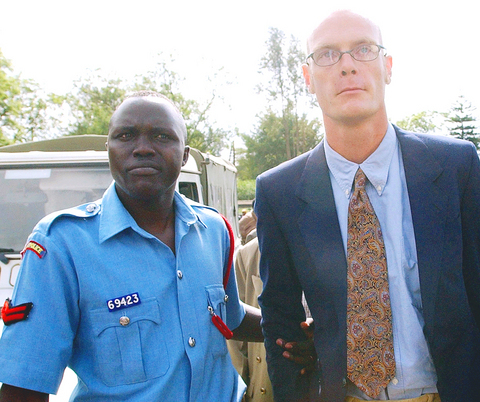
PHOTO: AP
"We have recovered a 0.303 rifle and five rounds of 0.308mm bullets from the suspect," he added.
Former Safari Rally driver Carl Jean-Pierre Tundo was arrested along with Cholmondeley, who last year escaped murder charges after killing a game warden on his 40,500 hectare Delamere estate.
Cholmondeley said they were taking an evening walk late on Wednesday when they encountered five armed men carrying dead impala, according to police.
"When the men armed with machetes, arrows and bows were challenged to stop, they released two dogs onto the duo, and in the process, Tom shot dead two dogs and shot one suspect on the pelvic bone and the rest fled," police said.
After the incident, he reported the matter to police.
The as yet unidentified man died of his wounds en route to a hospital, just over a year after Cholmondeley shot and killed an undercover Kenya Wildlife Service (KWS) officer on the same ranch.
"Tom claims the man was a poacher who was slaughtering a wild animal on his farm when he shot him deep in the bush," Naivasha police commander Simon Kiragu said, adding that Cholmondeley had admitted to using an assault rifle.
The shooting is likely to spark major controversy in the Rift Valley where resentment over the dropping of murder charges against Cholmondeley last year still runs high among the region's indigenous Maasai community.
On April 19 last year, Cholmondeley, 48, shot and killed KWS ranger Simon Ole Sasina, a Maasai, who had gone to the Delamere's Soysambu ranch to investigate charges that it was involved in the illegal bushmeat trade.
He admitted to the shooting but insisted he acted in self-defense. He was initially charged with murder, but prosecutors dropped the case, prompting nationwide outrage and mass protests by members of the Maasai tribe.
At the time, some Maasai threatened to attack the Delamere ranch and other European-owned farms in the region that was once known as "Happy Valley" for its eccentric, decadent and often controversial colonial-era residents.
A commission of inquiry formed after the charge was dropped has yet to deliver a ruling in the matter, which ripped open festering resentments and highlighted growing security fears among expatriates, at least four of whom have been killed in apparent robberies in the Rift Valley since 2004.
Cholmondeley's case has received particular attention due to his family history. His great-grandfather Hugh was a major player in the British colonization of Kenya in the late 19th and early 20th centuries.
His grandfather achieved notoriety in 1955 when he married Diana Broughton, the central figure in the murder of her lover, Josslyn Hay, the 22nd Earl of Errol, on the outskirts of Nairobi in 1941.
Diana's first husband, Jock Broughton, was tried for the murder but acquitted. The saga was recounted by James Fox in his book White Mischief, which was later made into a film.
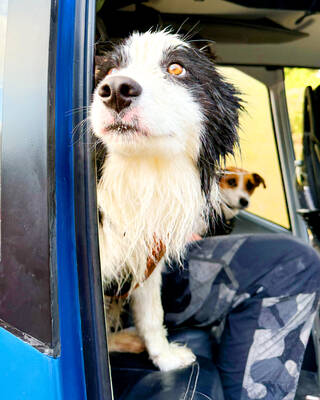
When a hiker fell from a 55m waterfall in wild New Zealand bush, rescuers were forced to evacuate the badly hurt woman without her dog, which could not be found. After strangers raised thousands of dollars for a search, border collie Molly was flown to safety by a helicopter pilot who was determined to reunite the pet and the owner. A week earlier, an emergency rescue helicopter found the woman with bruises and lacerations after a fall at a rocky spot at the waterfall on the South Island’s West Coast. She was airlifted on March 24, but they were forced to

CONFIDENCE BOOSTER: ’After parkour ... you dare to do a lot of things that you think only young people can do,’ a 67-year-old parkour enthusiast said In a corner of suburban Singapore, Betty Boon vaults a guardrail, crawls underneath a slide, executes forward shoulder rolls and scales a steep slope, finishing the course to applause. “Good job,” the 69-year-old’s coach cheers. This is “geriatric parkour,” where about 20 retirees learned to tackle a series of relatively demanding exercises, building their agility and enjoying a sense of camaraderie. Boon, an upbeat grandmother, said learning parkour has aided her confidence and independence as she ages. “When you’re weak, you will be dependent on someone,” she said after sweating it out with her parkour classmates in suburban Toa Payoh,

HIGH HOPES: The power source is expected to have a future, as it is not dependent on the weather or light, and could be useful for places with large desalination facilities A Japanese water plant is harnessing the natural process of osmosis to generate renewable energy that could one day become a common power source. The possibility of generating power from osmosis — when water molecules pass from a less salty solution to a more salty one — has long been known. However, actually generating energy from that has proved more complicated, in part due the difficulty of designing the membrane through which the molecules pass. Engineers in Fukuoka, Japan, and their private partners think they might have cracked it, and have opened what is only the world’s second osmotic power plant. It generates
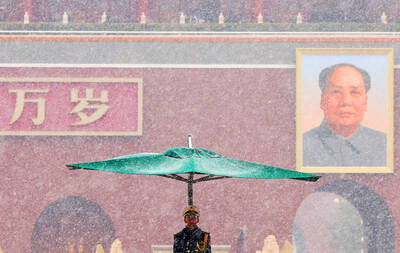
Chinese dissident artist Gao Zhen (高兟), famous for making provocative satirical sculptures of former Chinese leader Mao Zedong (毛澤東), was tried on Monday over accusations of “defaming national heroes and martyrs,” his wife and a rights group said. Gao, 69, who was detained in 2024 during a visit from the US, faces a maximum three-year prison sentence, said his wife, Zhao Yaliang (趙雅良), and Shane Yi, a researcher at the Chinese Human Rights Defenders group which operates outside the nation. The closed-door, one-day trial took place at Sanhe City People’s Court in Hebei Province neighboring the capital, Beijing, and ended without a


 RSS
RSS