


Government incompetence and "wicked collusion" between a ferry owner and a government agency resulted in the drowning of more than 1,000 people in the Red Sea in February when an Egyptian passenger ship sank, according to the findings of a preliminary parliamentary investigation released on Wednesday.
Touching the highest levels of government, including Egyptian President Hosni Mubarak and the military command, though without directly naming either, the report crushed the government's earlier efforts to blame the captain alone for the sinking of the ferry, al Salam Boccaccio 98. The captain, Sayyed Omar, left the ship before it sank, witnesses said, but has not been accounted for.
The report, by a committee of 23 members of Parliament, directly attributed the disaster to the Egyptian Authority on Maritime Safety and to the ship's owner, al Salam Maritime Transport Co., which is controlled by Mamdouh Ismail, a member of the upper house of Parliament appointed by Mubarak.
The report's authors vowed "to beat with an iron fist on everyone who allowed himself to tamper with the standards, laws, and rules for the sake of achieving cheap worldly gains, even if the cost was to kill people, drowning and destroying the lives of many Egyptian families and spreading calamity and catastrophe across Egypt."
The document found fault at many levels: with a political system that allowed Ismail to run a ferry service while also serving in Parliament; with the maritime authority responsible for overseeing the ports; and with a military-affiliated command that began a rescue operation hours after receiving a distress signal with the location of the ship.
The committee also castigated the government for failing to provide facilities for family members who showed up at the port.
After bodies were recovered, the report said, "it was up to those who wanted to identify the body of a relative for burial to roam between hospitals and morgues across 10 different cities and thousands of kilometers to go through the faces of the dead."
The government did not respond to the report. Magdy Rady, the government's chief spokesman, did not return calls or text messages asking for comment.
"We are not going to let go, because this is a country's reputation and people's lives," said Muhammad Anwar Essmat el-Sadat, a member of Parliament who helped write the report. "We insist on following this."
The ferry went down in the Red Sea just after midnight on Feb. 3, en route from Duba, Saudi Arabia, to Safaga, Egypt. The ship was about 35 years old and packed with more than 1,400 passengers when it sank. Most of those on board were Egyptians working in Saudi Arabia.
The report was forthright in linking the tragedy to an overall atmosphere of cronyism and corruption. But the findings only confirmed what human rights organizations, families of those lost at sea, and members of Parliament have been saying since the ship sank: that it was overcrowded and in poor condition, and that the government agencies responsible for ensuring public safety had failed in their mandates.
"Even though this is only the initial report, it is very disturbing because it says that there is collusion and corruption," said Muhammad Saad el-Katatny, a member of Parliament who represents the largest opposition bloc, made up of independents linked to the Muslim Brotherhood.
The ship's owner, Ismail, left Egypt and has been staying in London, where he could not be reached for comment. He has steadfastly insisted that he and his company are innocent of any wrongdoing.
In a full-page advertisement earlier this month in al Ahram, the semi-official Egyptian newspaper, he said a British insurer had concluded that the ship was fitted with all necessary safety equipment.
Hesham Kassem, a human rights worker and opposition leader, said that in spite of the report, he had little hope that those responsible would be held accountable. He questioned the government's allowing Ismail to leave Egypt before asking Parliament to lift his parliamentary immunity so he could be questioned.
Kassem said he doubted anyone would be prosecuted because, he noted, the prosecutor was appointed by the president.
"I wouldn't dare to call it a step toward accountability," Kassem said of the report. "The minimum is, something like this should come out. We have seen many cases like this that should have been prosecuted properly, and they are shelved."

Crowds in Bangladesh are flocking to snap photographs with an unlikely social media star — an albino buffalo with flowing blond hair nicknamed “Donald Trump” that is due to be sacrificed within days. Owner Zia Uddin Mridha, 38, said his brother named the 700kg bull over its flowing helmet of hair resembling the signature look of the US president. “My younger brother picked this name because of the buffalo’s extraordinary hair,” he said at his farm in Narayanganj, just outside the capital, Dhaka. Mridha said that a constant stream of curious visitors — social media fans, onlookers and children — have come throughout

It began as a satirical online project. Now millions of young people in India are flocking to it as an outlet for their frustration. A parody political party called the Cockroach Janta Party, with the insect as its symbol, has exploded across India’s social media by turning absurdist humor into protest. Memes and short videos mocking corruption, joblessness and political dysfunction have flooded social media sites, where millions of users are embracing the cockroach — known for its ability to survive harsh conditions — as a tongue-in-cheek symbol of endurance. The online movement’s rise has been unusually rapid. The Cockroach Janta Party (CJP)
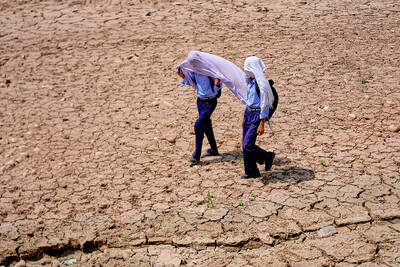
HOTTER: While Indians are accustomed to summer heat, climate change has caused northwestern India to warm faster than other parts of the country, an academic said Roads and markets have emptied during afternoons and some farmers have switched to nighttime work to avoid scorching temperatures as a heat wave grips large parts of India. The India Meteorological Department forecast maximum temperatures for yesterday of about 45°C in the capital, New Delhi, where authorities have opened temporary “cooling zones” to help people cope. The weather department warned that conditions would likely persist across several northern regions in the coming days, with temperatures staying well above seasonal averages. Authorities urged people to stay indoors during the hottest hours and take precautions against heat-related illnesses. India declares a heat wave whenever maximum temperatures

BIGGER ROLE: Beijing has said it maintains an impartial stance on the war in Ukraine, but by training Russian troops, China is far more involved than previously known China’s armed forces secretly trained about 200 Russian military personnel in China late last year, and some have since returned to fight in Ukraine, according to three European intelligence agencies and documents seen by Reuters. While China and Russia have held a number of joint military exercises since Moscow’s full-scale invasion of Ukraine in 2022, Beijing has repeatedly said that it is neutral in the conflict and presents itself as a peace mediator. The covert training sessions, which predominantly focused on the use of drones, were outlined in a dual-language Russian-Chinese agreement signed by senior Russian and Chinese officers in Beijing on


 RSS
RSS