


The women, some trembling, grasped the assault rifles handed to them and awkwardly lowered themselves spread-eagled into sniper positions as they took aim and fired at white targets in the distance.
These women -- jeans-and-sneaker-clad housewives and students -- are the unlikely heart of a new civilian militia being trained as Venezuelan President Hugo Chavez warns his country must be ready for a ``war of resistance'' against the US.
"Those who come here have never fired a shot in their lives," said Lieutenant Colonel Rafael Angel Faria Villalobos, who led training for the Territorial Guard volunteers on Saturday in Charallave, just west of Caracas.
The volunteers included construction workers, social workers and many unemployed. Faria said 20 consecutive Saturdays of training through June will turn them into resistance fighters prepared to defend their communities in the event of a conflict.
The US government dismisses Chavez's claims of a possible invasion as ridiculous. But the president insists Venezuelans must be prepared for anything, citing a short-lived 2002 coup that briefly unseated him.
Faria led more than 900 volun-teers who began their first day of boot camp after finishing classroom training. He said 3,000 people have volunteered for his training camp, while 42 other camps are holding similar weekend drills nationwide.
Ten at a time, the volunteers lined up as officers coached them to fire the military's standard-issue Belgian FAL assault rifles from standing, kneeling and prone positions at numbered targets in an open field.
"It was exciting, too good," gushed Yomaira Alas, a 28-year-old housewife, after firing for the first time.
The Territorial Guard won't be issued weapons; commanders said guns would be made available only in emergency situations, at designated neighborhood locations.
Volunteers receive a 16,000 bolivar (US$7.45) stipend per training session, but most said that barely covered transportation and a meal.
"I'm here voluntarily and because I adore my president," said Marasierra Diaz, 40, who helps promote neighborhood social programs.
But soldiers who led Saturday's drills made clear US troops were the hypothetical enemy as men and women swarmed across an obstacle course of barbed wire, burning tires and concrete fortifications.
"Kill the gringo! That gringo is taking away your women," yelled a soldier as he tossed a man a rifle to butt a target -- a military uniform stuffed with straw -- swaying in the wind. A siren wailed while the acrid smell of smoke hung in the air.
In addition to the Territorial Guard, Chavez has called for an army reserve of 1 million fighters and has sealed arms deals to supply regular soldiers with 100,000 new Kalashnikov assault rifles and helicopters from Russia.
Despite Chavez's warnings of a possible US invasion, many trainees said they feel that is a remote possibility. There were light moments during the drills as some snapped photos, stumbled on the obstacle course amid laughter, and talked excitedly after target practice.
"I feel good, great. I'm having a great time," said Sujeidy Pereira, 25.
"Fatherland or death," she giggled as an afterthought.


Through the noise of rushing papers and whirring belts at a print factory in Kyoto, two creators watch their photo essay come to life in broadsheet form — part of an effort to win new audiences in the age of artificial intelligence (AI). Despite the decline of the publishing industry, self-publication and handmade “zine” magazines are growing in popularity in Japan, reflecting the nation’s enduring love of paper in the digital era. While speaking to Agence France-Presse at the plant, his hands black with ink, one of the creators, Kazuma Obara, said: “I think [paper] is a medium that engages all five
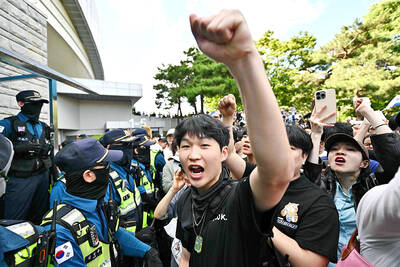
‘ABSURD MISTAKE’: The election commission said that there had been a failure to anticipate turnout after 14 polling stations ran short of ballot papers South Korean riot police yesterday cleared protesters from a Seoul polling station after a 35-hour blockade sparked by a shortage of ballot papers during local elections earlier this week. Wednesday’s election was the first nationwide vote since South Korean President Lee Jae-myung took office following the ouster of Yoon Suk-yeol over his short-lived martial law declaration. Lee’s ruling Democratic Party swept most races, but failed to flip the crucial Seoul mayoral seat. The South Korean National Election Commission apologized, blaming a failure to anticipate turnout after 14 polling stations in Seoul ran short of ballot papers. Some polling stations stayed open until 10pm to

France experienced its hottest spring on record, the French weather service said on Tuesday, after an exceptional early heat wave that also broke highs for the season in England and Wales. Meteo-France said the average nationwide temperature over March to May was 13.8°C — about 1.7°C above the norm, and surpassing records set in 2011 and 2020. “The warmest spring since records began in 1900,” it said in a bulletin. All three months were warmer than average, but the onset of an “unprecedented heatwave” late last month pushed the mercury to highs typically seen at the height of the summer. “Our country had never
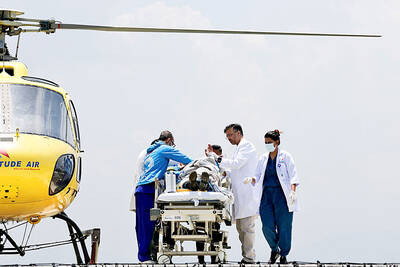
A Sherpa guide was found crawling to base camp on Mount Everest a week after he went missing and was reunited with his family, who had given up hope he would return. Dawa Sherpa was last seen on Friday last week descending the mountain, but he did not reach base camp even though his client did. The pair were among the last climbers on the mountain as the climbing season came to an end and the route was dismantled. Dawa was located by a cleaning crew on Thursday morning as he was crawling down the snowy slopes around the Khumbu Icefall, just above


 RSS
RSS