


Depleted by a wave of arrests, Belarus' opposition movement is seeking ways to regroup after week-long protests were broken up by a state apparatus determined to defend President Alexander Lukashenko.
Authorities at a detention center outside Minsk finally confirmed that they had in detention Alexander Kozulin, an opposition candidate in the March 19 presidential election, who was arrested on Saturday when security forces violently broke up a protest march, Kozulin's wife Irina said.
About 100 youths attended a vigil on Sunday evening to honor the marchers beaten by police, lighting candles at a monument to 53 young people who were crushed to death in a May 1999 stampede at a Minsk metro station.
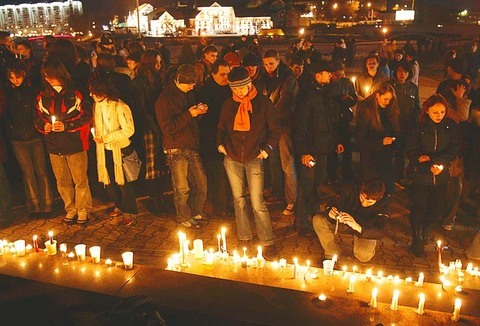
PHOTO: AP
Lukashenko "won't last five years," said Liliya, a 21-year-old teacher, referring to the length of a presidential term. "He's only got a little while left -- he's very afraid."
The arrest of Kozulin as he and others tried to visit a jail holding fellow opposition supporters came amid a wave of detentions of those who have tried to protest against Lukashenko's re-election to a third term in office.
The main opposition candidate, Alexander Milinkevich, attempted to visit Kozulin on Sunday but when he rang at the entrance to the detention center in the town of Zhodino he was turned away by a metallic voice telling him to come back yesterday.
"I came to check if Kozulin is here. I want to bring him my moral support," he told journalists.
Milinkevich promised to launch an information campaign that would counter the authorities' claims that the opposition had resorted to violence.
A stepson of Milinkevich is among up to 250 opposition supporters said by human-rights groups to be held in Zhodino in connection with Saturday's clash with police and with the days-long protest on Minsk's October Square. Most of those who camped out on the square were handed sentences of up to two weeks for hooliganism.
"The country doesn't know what happened due to the propaganda of the state media," Milinkevich said.
Among others being held was the leader of the United Civic Party, Anatoly Lebedko. The head of the Belarussian Popular Front, Vintsuk Vyachorka, is reportedly in hiding.
Despite the blow dealt to the opposition, Vyachorka's deputy, Viktor Ivashkevich, said progress had been made on forming a new united opposition movement called For Freedom.
"Many are now in prison but were convicted for 10 to 15 days and will come out and continue work," Ivashkevich said.

‘CROSSING THE LINE’: China’s embassy in Seoul criticized US Forces Korea Commander General Xavier Brunson, asking if his ‘hostile’ remarks were authorized by Washington South Korea and the US are in talks over recent public remarks by the commander of US Forces Korea, Seoul’s presidential office said yesterday, after the comments drew sharp criticism from China. In a recent podcast interview, US Forces Korea Commander General Xavier Brunson described South Korea as “the dagger in the heart of Asia” from China’s east coast, prompting the Chinese embassy in Seoul to say that he had “truly crossed the line.” The interview came amid growing speculation that Washington might seek to expand the role of US Forces Korea in countering the growing regional influence of China, a key

SEEKING ORDER: Rodrigo Paz said that ‘anyone who wants to destroy the nation will have to deal with this president and the full force of the constitution’ Bolivian President Rodrigo Paz on Wednesday said that the nation was at a “breaking point” after nearly a month of protests that have caused shortages of food, fuel and medicine. Paz, who took office six months ago amid the worst economic crisis there in four decades, is battling a groundswell of fury over his policies. The political capital, La Paz, has been besieged by low-income workers and members of the indigenous majority calling for his resignation. “The country needs order and is reaching breaking point,” the 58-year-old said at a public event in La Paz, renewing his appeal for dialogue. On Tuesday, the Bolivian

Through the noise of rushing papers and whirring belts at a print factory in Kyoto, two creators watch their photo essay come to life in broadsheet form — part of an effort to win new audiences in the age of artificial intelligence (AI). Despite the decline of the publishing industry, self-publication and handmade “zine” magazines are growing in popularity in Japan, reflecting the nation’s enduring love of paper in the digital era. While speaking to Agence France-Presse at the plant, his hands black with ink, one of the creators, Kazuma Obara, said: “I think [paper] is a medium that engages all five

Australian researchers have trained lab-grown brain cells on a silicon computer chip to play the 1990s shooter game Doom and said they are just scratching the surface of what the neurons could be capable of doing. It is the science-fiction work of biotech boffins at Cortical Labs, who researched and developed the technology that harnesses the workings of the brain’s networking system. Each so-called “biological computer” contains about 200,000 living human brain cells, grown from stem cells that were harvested from blood donations. Having mastered the simple computer game Pong, where a paddle is moved up and down to send a ball


 RSS
RSS