


Riot police arrested hundreds of protesters and destroyed their tent camp in central Minsk early yesterday, ending an act of unprecedented defiance against Belarusian President Alexander Lukashenko.
About 100 black-helmeted riot police arrived at October Square in the dead of night, and proceeded swiftly to carry or herd some 300 to 400 protesters into green trucks with barred windows. There was no violence or resistance.
Colonel Yury Podobed, who headed the operation, was quoted by Echo Moscow radio saying: "The revolution is over."
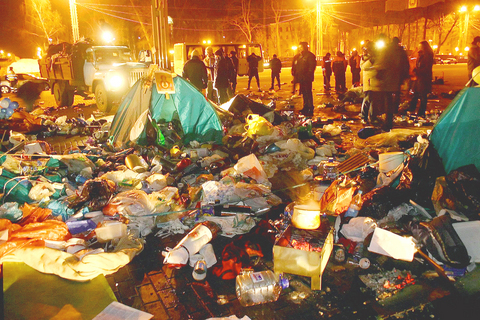
PHOTO: EPA
But top opposition leader Alexander Milinkevich accused the government of speaking "in the language of repression" and vowed to continue his fight to have Lukashenko's landslide re-election victory last Sunday annulled.
He said that a major rally planned for today would go ahead.
In Washington, the US State Department said it was "disturbed by the breakup of the demonstration and the detention of protesters."
The dramatic raid came on the fourth consecutive night that opposition activists -- mostly students -- peacefully occupied their tent camp on the vast, icy central square.
They had stood day and night in a protective human shield around their cluster of 35 tents, chanting slogans such as "Freedom!" and waving banners and flags, including that of the EU.
Only minutes before riot police arrived they were dancing to music and chanting: "Long live Belarus!"
The riot police disembarked at 3:07am from seven green trucks with barred windows and surrounded the tiny camp, a reporter at the scene said.
There was a palpable sense of fear and all noise stopped, except for occasional, weak cries of opposition slogans, such as: "Police are with the people!"
The demonstrators were then ordered to sit and riot police moved in, grabbing or simply guiding people to the backs of trucks. There was no violence visible.
By 3:20am it was all over.
The trucks sped away and all that remained of the protest camp -- the most brazen pro-democracy demonstration in Lukashenko's 12-year rule -- was a heap of broken tents, spilled food, dozens of Thermos flasks and clothing.
Among the wreckage were also all the banners that the protesters had been waving before the world's media most of that week.
"Freedom for us, freedom for you," read one. "Belarus in Europe!" read another.
Among those detained in the police raid was a stepson of Milinkevich. Also detained was a Polish diplomat and former ambassador to Minsk, Mariusz Maszkewicz, the Polish consulate and witnesses said.
"They are not giving any information. They won't let us see him. That's a violation of the Geneva Convention," Poland's consul, Krzysztof Swiderek, told reporters outside the prison where the demonstrators were being held.
The raid leaves Belarus' opposition in crisis. Already, more than 250 people had been arrested since Sunday, according to human rights organizations.
State television has been running hours of reports daily aimed at discrediting Milinkevich and the demonstrators as Western agents and social deviants.
Early news broadcasts yesterday showed footage of syringes, vodka bottles and pornography that the state channel claimed had been found in tents at the camp.
But Milinkevich, who according to official results won only 6.1 percent of Sunday's vote, compared with 83 percent for Lukashenko, remained defiant.
"We will continue with what we planned for [Saturday]," Milinkevich told reporters.
"These authorities can only speak one language, that of repression. They showed that again. I had been expecting this each night," Milinkevich said.
Fellow opposition leader and defeated presidential candidate, Alexander Kozulin, said: "The authorities' nerve didn't hold -- for them to have sent the police here at night when there were as few witnesses as possible."

A US YouTuber who caused outrage for filming himself kissing a statue commemorating Korean wartime sex slaves has been sentenced to six months in prison, a court in Seoul said yesterday. Johnny Somali, 25, gained notoriety several years ago for recording himself doing a series of provocative stunts in South Korea and Japan, and streaming them on platforms such as YouTube and Twitch. South Korean authorities indicted Somali — whose real name is Ramsey Khalid Ismael — in 2024 on public order violations and obstruction of business, and banned him from leaving the country. “The court has sentenced him to six months in

Former Lima mayor Rafael Lopez Aliaga, a Peruvian presidential hopeful, gathered hundreds of supporters in Lima on Tuesday and gave authorities 24 hours to annul the first round of the country’s election over allegations of fraud. Lopez Aliaga is locked in a tight three-way race with two other candidates for second place in Sunday’s vote. The election runner-up wins a ticket to June’s presidential run-off against front-runner Keiko Fujimori. “I am giving them 24 hours to declare this electoral fraud null and void,” said Lopez Aliaga, surrounded by a crowd of several hundred supporters. “If it is not declared null and void tomorrow,

PAPAL RETORT: Pope Leo told reporters that he has ‘no fear, neither of the Trump administration nor speaking out loudly about the message of the Gospel’ US President Donald Trump has feuded with Pope Leo XIV over the Iran conflict — setting off an unholy row that could have serious political implications for the Republican leader back in the US. Trump has drawn barbs even from some allies over the attacks on the US-born pontiff, who has criticized the Trump administration over its immigration crackdown, the intervention in Venezuela and the Iran war. The president risks alienating the religious right in November’s crucial US midterm elections. So far the unprecedented clash between the leader of the most powerful military on Earth and the head of the world’s 1.4 billion

A 16-year-old boy has been charged with murder and aggravated sexual abuse in Florida in the death of his 18-year-old stepsister on a Carnival Cruise ship, the US Department of Justice said on Monday. Timothy Hudson was initially charged in February and subsequently indicted on March 10, but the breadth of the case was not known until a seal was lifted on Friday last week, weeks after US District Judge Beth Bloom in Miami said that he would be prosecuted as an adult at the request of the government. Anna Kepner had been traveling on the Carnival Horizon ship in November last


 RSS
RSS