


Heliborne US and Iraqi troops pressed their sweep through a 260km2 swath of central Iraq yesterday in a bid to break up a center of insurgent resistance, the US military said. No casualties were reported on either side.
"We believe we achieved tactical surprise," Lieutenant Colonel Edward Loomis, spokesman for the 101st Airborne Division, said of the day-old Operation Swarmer, the biggest air assault in Iraq in three years.
He said about 40 suspects were detained, 10 of whom were later released.
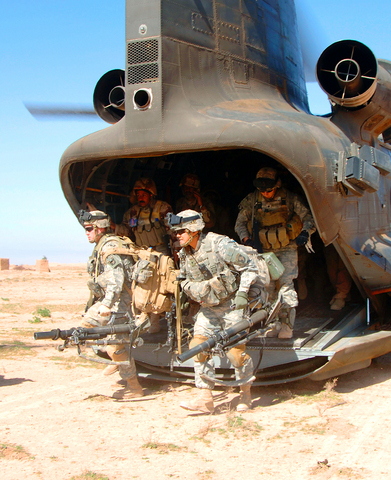
PHOTO: AP
In tense Baghdad, meanwhile, drive-by gunmen who were targeting streams of Shiite Muslim pilgrims killed three people and wounded five in Sunni areas of the city, police reported.
Devout Shiites were headed south to the holy city of Karbala for a religious holiday, a pilgrimage that authorities feared would present "soft" targets in the continuing Sunni-Shiite violence roiling Iraq.
A standoff between the Shiite majority and Sunni minority underlies the political impasse blocking formation of a new government of national unity in Iraq. An all-party meeting was scheduled for late Friday to try to move those negotiations forward.
Joint forces
The joint US-Iraqi air assault on Thursday focused on an area some 100km north of Baghdad and northeast of the city of Samarra, where an insurgent bombing on Feb. 22 badly damaged a major Shiite shrine, an attack that ignited days of sectarian bloodshed across Iraq in which more than 500 people died.
Fifty US transport and attack helicopters ferried in and gave cover to some 1,500 US and Iraqi troops taking part in Operation Swarmer -- units of the 101st Airborne Division and the Iraqi 4th Division.
On Friday morning, Loomis said, the forces "continue to move'' through the area."
Approximately 40 suspected insurgents were detained without resistance,'' he said. "Tactical interviews began immediately, and 10 detainees have been released."
The sweep also uncovered six weapons caches, the US military spokesman said.
The operation was aimed at disrupting "terrorist activity in and around Samarra, Adwar and Salahuddin province,'' he said, an area that was a stronghold of Sunni support for former Iraqi president Saddam Hussein's ousted Baathist party regime.
The deputy governor of Salahuddin Province, Abdullah Hussein, told reporters on Friday that 48 alleged insurgents had been detained, men accused of bombings and kidnappings.
He said intelligence indicated about 200 insurgents were in the area, including people linked to the Baathist group Jaish Muhammad and to the al-Qaeda in Iraq terror group, led by Abu Musab al-Zarqawi.
The sweep was aimed particularly at capturing two local leaders of the Zarqawi group, said a police official, speaking on condition of anonymity. He said they had not yet been located.
Killings
Meanwhile, yesterday's Baghdad bloodshed began as groups of Shiite faithful, many parents with children in tow, trekked down city streets in the morning, headed for the southbound highway and Karbala, a shrine city 80km south of Baghdad.
At about 7:30am, a BMW sedan driving alongside pilgrims in the western district of Adil opened fire, killing three and wounding two, said police Lieutenant Thair Mahmoud. Further details, including identities and ages of the victims, were not immediately available.
Police later reported a second incident, also in western Baghdad, in which armed men riding in a car fired on pilgrims near Um al-Tuboul Square, wounding three.
Marines trial
Meanwhile, in Washington, about a dozen US Marines are being investigated for possible war crimes in connection with the deaths last year of 15 Iraqi civilians who were initially reported killed by a roadside bomb.
The Navy has opened a criminal investigation into last November's bombing and subsequent gun battle between Marines and insurgents that led to the deaths of the Iraqi citizens, defense officials said on Thursday.
The inquiry will attempt to determine whether the Marines acted appropriately when they fired back at insurgents following a roadside bomb attack in Haditha, 220km northwest of Baghdad, said a military official.

SPEAKING OUT: After Siranudh Scott’s allegations surfaced, celebrities and public figures took to social media to share their own experiences of sexual misconduct and abuse A high-profile alleged sexual abuse case within a wealthy Thai beer brewing family has prompted a wave of painful accounts from survivors of unconnected abuse in the conservative nation. Siranudh Scott, a member of the billionaire Thai family that founded the ubiquitous Singha beer brand, posted an emotional video this month accusing his elder brother Sunit of repeatedly abusing him when he was a teenager. Sunit, who is in his 30s, later denied the allegations in a video posted online, but Singha parent Boonrawd dismissed him from his executive role with the company on Tuesday last week. “I felt I needed to speak

SEEKING ORDER: Rodrigo Paz said that ‘anyone who wants to destroy the nation will have to deal with this president and the full force of the constitution’ Bolivian President Rodrigo Paz on Wednesday said that the nation was at a “breaking point” after nearly a month of protests that have caused shortages of food, fuel and medicine. Paz, who took office six months ago amid the worst economic crisis there in four decades, is battling a groundswell of fury over his policies. The political capital, La Paz, has been besieged by low-income workers and members of the indigenous majority calling for his resignation. “The country needs order and is reaching breaking point,” the 58-year-old said at a public event in La Paz, renewing his appeal for dialogue. On Tuesday, the Bolivian
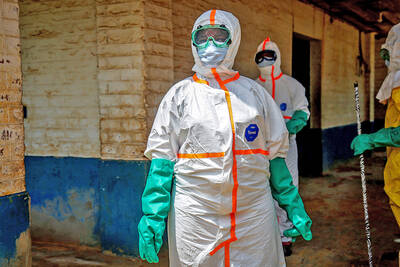
COMMUNITY CONFLICT: Concerns about disease spread from corpses has run up against friends and families’ desire to bury their dead as infection spreads in the area Angry residents of a town at the epicenter of the Ebola outbreak in the Democratic Republic of the Congo (DR Congo) attacked and burned a tent that was part of a health center where people are being treated for the virus, the staff there said Saturday. It was the second such attack in the region in a week. No one was hurt in the attack, according to reports but as patients ran out to escape the fire, 18 people with suspected Ebola infections fled the facility and are unaccounted for, a hospital director said. Angry residents arrived at the clinic in the

Forecasters in Europe yesterday warned of exceptional heat as record temperatures driven by a “heat dome” push temperatures well above seasonal norms across the continent. The surge follows a record-breaking Monday, with France logging its hottest day in the month of May on record, its weather agency said, and the UK also posting unprecedented highs. A so-called “heat dome” of warm air from northern Africa trapped under a high-pressure system over western Europe is behind the high temperatures not usually seen until high summer. Restrictions on outdoor work were imposed in parts of Italy, beaches in southwest France filled earlier than usual and


 RSS
RSS