


Troops patrolling the Indonesian city of Jayapura rounded up suspects yesterday after a frenzied mob bludgeoned to death four security officers during a protest over the world's largest gold and copper mine.
National police spokesman Brigadier General Anton Bachrul Alam told reporters 57 people had been arrested, though only five were named suspects, including one of the alleged protest organizers. They could face charges of assault, murder or destroying public property, he said.
Thursday's demonstration in Jayapura, Papua's provincial capital, was the most violent in a series targeting the US-owned Freeport-McMoRan Copper & Gold Inc in recent weeks -- and the killings of three policemen and one air force officer underscored the deep hatred many Papuans feel toward Indonesian security forces.
A decades-long separatist rebellion in the remote province has left more than 100,000 dead, many of them civilians who suffered from mistreatment, starvation and other consequences of the war.
Protesters demanded that Freeport's massive gold mine be shut, saying that while it has earned the New Orleans-based company billions of dollars in revenue, the local community has received little or no benefit.
They went on a rampage after gun-toting security forces fired tear gas in an effort to break up the rally, charging demonstrators with their batons. Hundreds of shots were fired, though police insisted they did not use live ammunition.
"Indonesia should respect the Papuans," resident Robi Kubi said yesterday, as a tense calm returned to the provincial capital. "We have huge natural resources, but why are they extracted by foreigners while the Papuans are still poor?"
President Susilo Bambang Yudhoyono sent top security chiefs to the region to probe the unrest, and warned that some people were trying to manipulate anger over Freeport into a push for independence. They would not succeed, he said.
Hundreds of paramilitary police stood guard near the state-run university, the site of Thursday's demonstration. The campus was largely deserted yesterday.
London-based Human Rights Watch called on authorities to determine why the rally spiraled out of control.
The group's Asia director, Brad Adams, said it appeared that police may have opened fire first on the demonstrators, wounding several of them, who then responded by attacking the officers with rocks and knives.
One resident, Marcus, said he was walking by the university when he heard gun shots.
"I was chased by plainclothes police and then beaten up," the 31-year-old man said from Jayapura Public Hospital, his face badly bruised. "I didn't know anything about the protest, but I was a victim. My face hurts. I lost my money. And my family does not know where I am."

SPEAKING OUT: After Siranudh Scott’s allegations surfaced, celebrities and public figures took to social media to share their own experiences of sexual misconduct and abuse A high-profile alleged sexual abuse case within a wealthy Thai beer brewing family has prompted a wave of painful accounts from survivors of unconnected abuse in the conservative nation. Siranudh Scott, a member of the billionaire Thai family that founded the ubiquitous Singha beer brand, posted an emotional video this month accusing his elder brother Sunit of repeatedly abusing him when he was a teenager. Sunit, who is in his 30s, later denied the allegations in a video posted online, but Singha parent Boonrawd dismissed him from his executive role with the company on Tuesday last week. “I felt I needed to speak

SEEKING ORDER: Rodrigo Paz said that ‘anyone who wants to destroy the nation will have to deal with this president and the full force of the constitution’ Bolivian President Rodrigo Paz on Wednesday said that the nation was at a “breaking point” after nearly a month of protests that have caused shortages of food, fuel and medicine. Paz, who took office six months ago amid the worst economic crisis there in four decades, is battling a groundswell of fury over his policies. The political capital, La Paz, has been besieged by low-income workers and members of the indigenous majority calling for his resignation. “The country needs order and is reaching breaking point,” the 58-year-old said at a public event in La Paz, renewing his appeal for dialogue. On Tuesday, the Bolivian
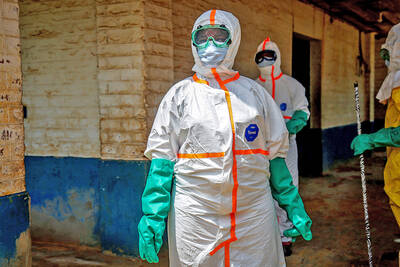
COMMUNITY CONFLICT: Concerns about disease spread from corpses has run up against friends and families’ desire to bury their dead as infection spreads in the area Angry residents of a town at the epicenter of the Ebola outbreak in the Democratic Republic of the Congo (DR Congo) attacked and burned a tent that was part of a health center where people are being treated for the virus, the staff there said Saturday. It was the second such attack in the region in a week. No one was hurt in the attack, according to reports but as patients ran out to escape the fire, 18 people with suspected Ebola infections fled the facility and are unaccounted for, a hospital director said. Angry residents arrived at the clinic in the

Forecasters in Europe yesterday warned of exceptional heat as record temperatures driven by a “heat dome” push temperatures well above seasonal norms across the continent. The surge follows a record-breaking Monday, with France logging its hottest day in the month of May on record, its weather agency said, and the UK also posting unprecedented highs. A so-called “heat dome” of warm air from northern Africa trapped under a high-pressure system over western Europe is behind the high temperatures not usually seen until high summer. Restrictions on outdoor work were imposed in parts of Italy, beaches in southwest France filled earlier than usual and


 RSS
RSS