


US President George W. Bush said yesterday the greatest threat to US troops -- and to the future of a peaceful Iraq -- are remote-controlled, homemade bombs that terrorists hide in cars or set along roads.
In his weekly radio address, Bush said terrorists in Iraq know they cannot defeat the US military so they have resorted to using lethal improvised explosive devices, which are the leading killer of US troops in Iraq.
The president was receiving a briefing yesterday about the devices from Montgomery Meigs, a retired general who is heading a Pentagon organization with a multibillion-dollar budget to find ways to counter the threat.
"We're harnessing every available resource, the ingenuity of our best scientists and engineers, and the determination of our military to defeat this threat -- and we're not going to rest until this danger to our troops has been removed," Bush said in his broadcast.
Troops are receiving more extensive training on how to spot the bombs, which sometimes are buried or hidden inside animal carcasses. But Bryan Whitman, a spokesman for US Defense Secretary Donald Rumsfeld, who also will be at the briefing, said on Friday there are no new technological breakthroughs to report to the president at this time.
Bush's radio broadcast comes ahead of his speech tomorrow on Iraq, the first in a series of talks he will give to mark the three-year anniversary of the US-led invasion. In the speech, Bush will discuss US strategy in defeating terrorists and training Iraqi security forces.
He said Iraqi security forces performed well after the Feb. 22 bombing of a Shiite mosque, which led to the killing of 500 people and pushed Iraq to the brink of civil war.
"Immediately after the attack, Iraq's leaders came together and acted to restore calm and end the violence," Bush said.
"They deployed Iraqi security forces to Baghdad and other areas threatened by violence. These forces moved rapidly and effectively to protect religious sites, enforce a curfew and re-establish civil order where necessary," he said.
Bush said the goal is to have Iraqis control more territory than US-led coalition forces by the end of the year. As Iraqis assume responsibility over more territory, coalition forces will be able to concentrate on hunting down top terrorists, he said.
Bush advisers say the upcoming speeches -- three this month and possibly more next month -- will be similar in tone to a series of talks the president made back in December to help turn public opinion on the war in his favor.
With nearly daily reports of car bombings, kidnappings and executions, Bush said he understands why many Americans wonder whether the mission was worth it.
According to the latest AP-Ipsos poll 77 percent say they think a civil war is likely in Iraq. Seventy percent of Republicans and 90 percent of Democrats felt that way.
People are evenly split on whether they think a stable, democratic government will be formed in Iraq, according to the poll taken earlier this month.

SPEAKING OUT: After Siranudh Scott’s allegations surfaced, celebrities and public figures took to social media to share their own experiences of sexual misconduct and abuse A high-profile alleged sexual abuse case within a wealthy Thai beer brewing family has prompted a wave of painful accounts from survivors of unconnected abuse in the conservative nation. Siranudh Scott, a member of the billionaire Thai family that founded the ubiquitous Singha beer brand, posted an emotional video this month accusing his elder brother Sunit of repeatedly abusing him when he was a teenager. Sunit, who is in his 30s, later denied the allegations in a video posted online, but Singha parent Boonrawd dismissed him from his executive role with the company on Tuesday last week. “I felt I needed to speak

SEEKING ORDER: Rodrigo Paz said that ‘anyone who wants to destroy the nation will have to deal with this president and the full force of the constitution’ Bolivian President Rodrigo Paz on Wednesday said that the nation was at a “breaking point” after nearly a month of protests that have caused shortages of food, fuel and medicine. Paz, who took office six months ago amid the worst economic crisis there in four decades, is battling a groundswell of fury over his policies. The political capital, La Paz, has been besieged by low-income workers and members of the indigenous majority calling for his resignation. “The country needs order and is reaching breaking point,” the 58-year-old said at a public event in La Paz, renewing his appeal for dialogue. On Tuesday, the Bolivian
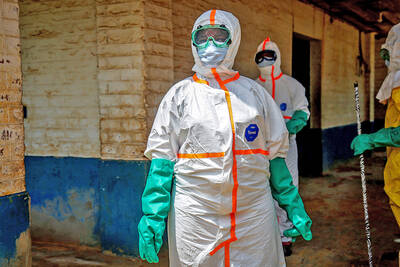
COMMUNITY CONFLICT: Concerns about disease spread from corpses has run up against friends and families’ desire to bury their dead as infection spreads in the area Angry residents of a town at the epicenter of the Ebola outbreak in the Democratic Republic of the Congo (DR Congo) attacked and burned a tent that was part of a health center where people are being treated for the virus, the staff there said Saturday. It was the second such attack in the region in a week. No one was hurt in the attack, according to reports but as patients ran out to escape the fire, 18 people with suspected Ebola infections fled the facility and are unaccounted for, a hospital director said. Angry residents arrived at the clinic in the

Forecasters in Europe yesterday warned of exceptional heat as record temperatures driven by a “heat dome” push temperatures well above seasonal norms across the continent. The surge follows a record-breaking Monday, with France logging its hottest day in the month of May on record, its weather agency said, and the UK also posting unprecedented highs. A so-called “heat dome” of warm air from northern Africa trapped under a high-pressure system over western Europe is behind the high temperatures not usually seen until high summer. Restrictions on outdoor work were imposed in parts of Italy, beaches in southwest France filled earlier than usual and


 RSS
RSS