

The new Palestinian prime minister, Ismail Haniyeh, has accused the US and Europe of hypocrisy in threatening to slash aid to the occupied territories unless Hamas meets Western demands, while failing to hold Israel to a similar standard.
Hamas leaders describe pressure to recognize Israel, respect accords and renounce violence as "cheap blackmail" aimed at corralling them into a "peace process" they describe as a trap. Haniyeh said that Israel had been allowed to repudiate peace accords and to lay the ground to unilaterally redraw its borders, without sanction from foreign powers.
"They are not asking anything of Israel, that they recognize the 1967 borders or even the choice of the Palestinian people [in January's election]. They should be making the same demands of them that they make of us. There is a double standard," Haniyeh said.
The "Quartet" of peace mediators -- Washington, Moscow, Brussels and the UN -- laid down the conditions to be met by "all members of a future Palestinian government" shortly after Hamas's landslide election victory.
But Haniyeh said Israel would fail to meet these requirements if they were applied to its dealings with the Palestinians.
While the Quartet demands the Palestinian government publicly embraces the Oslo peace accords and the "roadmap" peace process, Hamas says Israel has been permitted to shun both.
Ariel Sharon, the Israeli prime minister who has been in a coma for two months, called the Oslo accords "null and void." His administration attached 14 "reservations" to the roadmap and later declared the process "frozen" on the grounds that there was no partner for peace despite Palestinian pleas for negotiation. Israel used inaction on the roadmap to justify unilateral moves, including settlement expansion as part of its plan to annex large parts of the West Bank.
The Quartet said that neither side should take action that prejudges final status talks, but has not threatened sanctions against Israel.
The Quartet wants each Palestinian cabinet minister to personally commit to recognition of Israel when some members of Sharon's coalition governments campaigned against the creation of a Palestinian state and even advocated the ethnic cleansing of Arabs.
The charter of Likud, the main ruling party until last autumn, effectively denies a Palestinian state by calling for "persistence in settling and developing all parts of the Land of Israel" -- which includes the occupied territories -- "and annexing them."
"America sees with only one eye and hears with only one ear," said Salah Bardawil, Hamas' leader in the new Palestinian parliament.
"There was never any pressure on Israel when it ignored agreements. The PLO recognized Israel and what did it get for it? Now we are being asked to recognize Israel when it is annexing half of the West Bank behind the isolation wall," he said.
There is a deep wariness about engaging with a "peace process" that many Palestinians regard as a labyrinth in which they are forced to meet a series of tests while Israel expands its main West Bank colonies and lays the ground for a border deep inside the occupied territories.
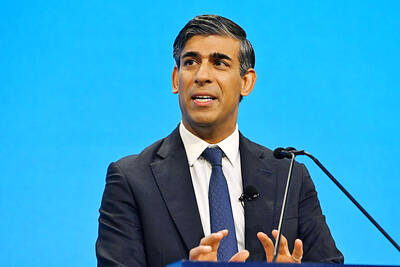
Former British prime minister Rishi Sunak on Wednesday urged so-called middle powers to become a “poisonous shrimp” to carve out strategic economic leverage in a more turbulent global environment. Sunak drew from a metaphor by former Singaporean prime minister Lee Kuan Yew (李光耀): A big fish will eat a smaller fish, and the smaller fish will eat the shrimp. Lee made the point a year after the Asian nation’s independence in 1966 that the city-state needed to build up its defense mechanisms — like a shrimp that stings — so it would be left alone by predators. “He was thinking about what Singapore’s

POLL POSITION: Democrats criticized the timing of the raid, saying that the US justice department historically avoids public investigations within 60 days of an election Federal agents on Monday searched the home of Democratic US Representative Ilhan Omar, a startling escalation in a criminal investigation that brings renewed focus to the frequent target of White House derision in the final weeks of her re-election bid. The search of the Minnesota congresswoman’s home so close to next month’s midterm contests that would determine control of the US House and the Senate was swiftly condemned by top Democrats in Congress, who raised questions about the timing given longstanding US Department of Justice (DOJ) protocol to avoid overt investigative steps involving political candidates in the direct run-up to an

A Rhode Island pumpkin grower appears to have broken the world record for the heaviest pumpkin, with his giant squash topping the record by nearly 136kg. Ron Wallace of Greene, Rhode Island, weighed his pumpkin on Saturday at a contest in New England and is waiting for the Guinness World Records to confirm he smashed the record, set about a week earlier by a grower in England. Wallace said he has been in contact with Guinness officials who say his record is on track to be verified. “It’s truly massive, it was a pleasure to grow,” Wallace said on Monday. Guinness World Records lists

BUILDUP: The report comes as Japanese Prime Minister Sanae Takaichi boosts defense spending in the face of China’s military expansion and the North Korean threat French defence contractor Thales will establish a maintenance and operational support base in Japan in what is seen as the first such move by a foreign firm in the country, a report said yesterday. Thales chairman and CEO Patrice Caine told the Nikkei business daily that the base “will mark a milestone toward Thales’ long-term engagement in Japan.” It is believed to be the first time a foreign defense company has established a dedicated base in Japan for the maintenance and operation of Japanese defense equipment, the Nikkei said. It added that Thales might also expand its Japan-based business to


 RSS
RSS