


The CIA's independent watchdog is investigating fewer than 10 cases where terror suspects may have been mistakenly swept away to foreign countries by the spy agency, a figure lower than published reports but enough to raise misgivings.
After the terror attacks of Sept. 11, 2001, President George W. Bush gave the CIA authority to conduct the contentious operations, called "renditions," and permitted the agency to act without case-by-case approval from the White House or other administration offices.
The highly classified practice involves grabbing terror suspects off the street in one country and flying them to their home country or another where they are wanted for crimes or questioning.
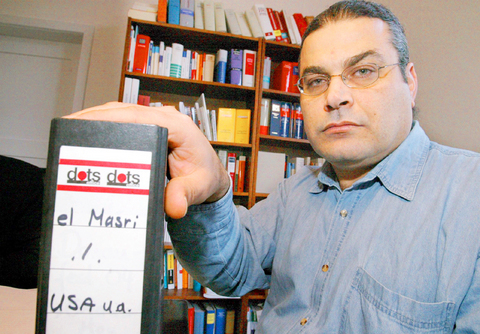
PHOTO: EPA
Some 100 to 150 people have been snatched up since Sept. 11. Government officials say the action is reserved for those considered by the CIA to be the most serious terror suspects.
Bush has said that the transfers to other countries -- with assurances the terror suspects won't be tortured -- are a way to protect the US and its allies from attack.
"That was the charge we have been given," he said in March.
Still, some operations are being questioned.
The CIA's inspector general, John Helgerson, is looking into fewer than 10 cases of potentially "erroneous renditions," according to a current intelligence official who spoke on condition of anonymity because the investigations are classified. Others in the agency believe the number under investigation is many fewer than 10, the official added.
For instance, someone may be grabbed wrongly or, after further investigation, may not be as directly linked to terrorism as first believed.
Human-rights groups consider the practice of rendition a strategy to avoid the judicial processes long championed by the US.
With the help of the American Civil Liberties Union, Khaled al-Masri, a German citizen of Lebanese descent, has sued the CIA for arbitrarily detaining him and other alleged violations after he was captured in Macedonia in December 2003 and taken to Afghanistan by a team of operatives in an apparent case of mistaken identity.
Speaking to reporters by video hookup from Germany, al-Masri said he was ``dragged off the plane and thrown into the trunk of a car'' and beaten by his captors in Afghanistan. Five months later, he was dropped off on a hill in Albania.

‘CROSSING THE LINE’: China’s embassy in Seoul criticized US Forces Korea Commander General Xavier Brunson, asking if his ‘hostile’ remarks were authorized by Washington South Korea and the US are in talks over recent public remarks by the commander of US Forces Korea, Seoul’s presidential office said yesterday, after the comments drew sharp criticism from China. In a recent podcast interview, US Forces Korea Commander General Xavier Brunson described South Korea as “the dagger in the heart of Asia” from China’s east coast, prompting the Chinese embassy in Seoul to say that he had “truly crossed the line.” The interview came amid growing speculation that Washington might seek to expand the role of US Forces Korea in countering the growing regional influence of China, a key

SEEKING ORDER: Rodrigo Paz said that ‘anyone who wants to destroy the nation will have to deal with this president and the full force of the constitution’ Bolivian President Rodrigo Paz on Wednesday said that the nation was at a “breaking point” after nearly a month of protests that have caused shortages of food, fuel and medicine. Paz, who took office six months ago amid the worst economic crisis there in four decades, is battling a groundswell of fury over his policies. The political capital, La Paz, has been besieged by low-income workers and members of the indigenous majority calling for his resignation. “The country needs order and is reaching breaking point,” the 58-year-old said at a public event in La Paz, renewing his appeal for dialogue. On Tuesday, the Bolivian

Through the noise of rushing papers and whirring belts at a print factory in Kyoto, two creators watch their photo essay come to life in broadsheet form — part of an effort to win new audiences in the age of artificial intelligence (AI). Despite the decline of the publishing industry, self-publication and handmade “zine” magazines are growing in popularity in Japan, reflecting the nation’s enduring love of paper in the digital era. While speaking to Agence France-Presse at the plant, his hands black with ink, one of the creators, Kazuma Obara, said: “I think [paper] is a medium that engages all five

Australian researchers have trained lab-grown brain cells on a silicon computer chip to play the 1990s shooter game Doom and said they are just scratching the surface of what the neurons could be capable of doing. It is the science-fiction work of biotech boffins at Cortical Labs, who researched and developed the technology that harnesses the workings of the brain’s networking system. Each so-called “biological computer” contains about 200,000 living human brain cells, grown from stem cells that were harvested from blood donations. Having mastered the simple computer game Pong, where a paddle is moved up and down to send a ball


 RSS
RSS