


Millionaire Vijaypat Singhania yesterday broke the world record for the highest flight in a hot air balloon and reached the fringes of space, his son claimed.
Singhania, 67, surpassed 21,000m a little more than two hours after taking off in his 40-tonne balloon, and has started his descent, his son Gautam said.
"We have the world record at 69,000 feet," said Gautam Singhania. "We're bringing him down now."
The previous world record was 19,811m, set by Sweden's Per Lindstrand in Plano, Texas, in June 1988.
"The exact height reached was 21,290.89 meters. This is subject to certification," said Colin Prescott, one of two British designers of the balloon.
The record could not be independently verified immediately.
A sealed altimeter, a GPS (global positioning system) unit and a barograph were installed inside the capsule to determine the balloon's height, Prescott said. On landing, the seals will be broken and the instruments submitted to the Guinness Book of World Records for verification.
Singhania lifted off from downtown Mumbai at 6:45am, enclosed in a pressurized cabin suspended from the 50m-tall multicolored balloon.
He was expected to take more than two hours to get back to Earth, probably landing in Nashik, a town about 100km northeast of Mumbai, depending on wind speed and direction.
Singharia's wife said she would not be able to relax until he was safely back on the ground.
"I was really scared, am still scared until he lands. When I heard that he had broken the record, I became numb in mind and heart," said Asha Singharia.
Prescott said the enormous size of the balloon could pose a problem.
"Now the challenge is to land it safely. The lighter the wind, the easier it will be to land," he said.
Before taking off in downtown Bombay cheered by hundreds of residents and a marching band, Singhania said he expected to break the record.
"I'm very excited but very nervous and confident I'll make it," Singhania said.
Vedant Kumar, 7, watched the balloon's ascent through a pair of binoculars until it became a just speck in the sky.
"I wish I could follow him in a helicopter," he exclaimed, hopping from foot to foot with excitement. A helicopter was following the balloon to monitor wind direction for the landing. Kumar said he was trying to persuade his parents to take him to the landing site.
The entire voyage was broadcast live on national television using cameras on board the helicopter, inside the balloon's cabin and on the ground.
The temperature outside the balloon was expected to fall as low as minus 93?C and oxygen was negligible. Before taking off, Singhania stressed the importance of the pressurized cabin, saying that if he was exposed to such temperatures his "blood would boil."
A unit on the ground was monitoring oxygen levels and other life support systems inside the cabin.
Singhania, the chairman emeritus of the Raymond Group, one of India's leading textile companies, also set a record for ultralight aviation 17 years ago when he flew 9,655km from Britain to India in 23 days.
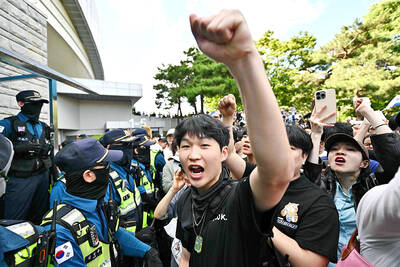
‘ABSURD MISTAKE’: The election commission said that there had been a failure to anticipate turnout after 14 polling stations ran short of ballot papers South Korean riot police yesterday cleared protesters from a Seoul polling station after a 35-hour blockade sparked by a shortage of ballot papers during local elections earlier this week. Wednesday’s election was the first nationwide vote since South Korean President Lee Jae-myung took office following the ouster of Yoon Suk-yeol over his short-lived martial law declaration. Lee’s ruling Democratic Party swept most races, but failed to flip the crucial Seoul mayoral seat. The South Korean National Election Commission apologized, blaming a failure to anticipate turnout after 14 polling stations in Seoul ran short of ballot papers. Some polling stations stayed open until 10pm to

France experienced its hottest spring on record, the French weather service said on Tuesday, after an exceptional early heat wave that also broke highs for the season in England and Wales. Meteo-France said the average nationwide temperature over March to May was 13.8°C — about 1.7°C above the norm, and surpassing records set in 2011 and 2020. “The warmest spring since records began in 1900,” it said in a bulletin. All three months were warmer than average, but the onset of an “unprecedented heatwave” late last month pushed the mercury to highs typically seen at the height of the summer. “Our country had never
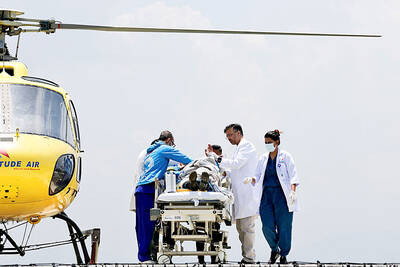
A Sherpa guide was found crawling to base camp on Mount Everest a week after he went missing and was reunited with his family, who had given up hope he would return. Dawa Sherpa was last seen on Friday last week descending the mountain, but he did not reach base camp even though his client did. The pair were among the last climbers on the mountain as the climbing season came to an end and the route was dismantled. Dawa was located by a cleaning crew on Thursday morning as he was crawling down the snowy slopes around the Khumbu Icefall, just above
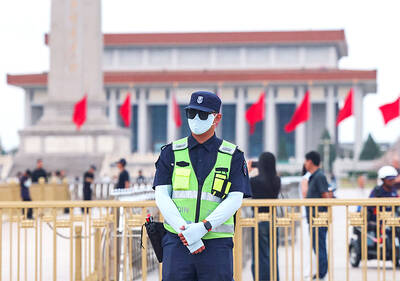
Chinese authorities are snuffing out any remembrance of the deadly 1989 military crackdown on student-led pro-democracy protests in Tiananmen Square, which happened 37 years ago yesterday, in a further tightening of a years-long campaign to erase what happened from public memory. Police told relatives of the victims they would not be allowed to visit a cemetery in Beijing on the anniversary of the crackdown, a person with knowledge of the matter said. Relatives of the victims visited the cemetery on the anniversary for more than 30 years to read memorial statements with police keeping watch, Amnesty International said. Hundreds of people,


 RSS
RSS