


President Jacques Chirac has called for a collective fight against racism in response to France's worst unrest in almost 40 years, saying discrimination poisons society.
Addressing the nation on Monday for the first time since the unrest erupted nearly three weeks ago, Chirac said he had asked parliament to extend a state of emergency declared on Nov. 9 beyond 12 days to three months. Lawmakers were to debate the issue yesterday.
Chirac also announced the creation of national volunteer corps to provide job training for 50,000 youths by 2007. The president said in the coming days he would meet business and labor leaders to discuss work force diversity and more jobs for youths from tough neighborhoods.
"We can build nothing lasting if we allow racism, intolerance and abuse," Chirac said in a televised speech. "We can build nothing lasting unless we fight this poison for society that is discrimination."
The crisis has led to collective soul-searching about France's failure to integrate its African and Muslim minorities. Anger about high unemployment and discrimination has fanned frustration among the French-born children of immigrants from France's former colonies.
Chirac appealed for all to help eliminate attitudes that lead to youths not being considered for jobs because they have a non-French name, a suburban postal code, or the wrong skin color.
"It's about giving young people the same job opportunities," Chirac said. "How many CVs end up in the trash bin because of the applicant's name or address?"
Even as Chirac spoke, the violence continued for a 19th night with at least one attack targeting Muslims.
Vandals threw three firebombs at mosque in Saint-Chamond in the Loire region, causing minor damage, the national police said yesterday. It was the third attack of its kind on a mosque since Friday.
However, the number of incidents continued to drop overnight, with youths setting fire to 162 vehicles by 4am yesterday, compared with 271 at the same time a day earlier, the national police said. Forty-two people were arrested compared with 112 at the same time the previous night.
The numbers have fallen steadily since vandals burned 1,408 vehicles across France in one night on Nov. 6 at the peak of the violence. Police say French youths burn about 100 cars on an average Saturday night.
The state of emergency gives regional authorities the power to call curfews, conduct day-and-night searches of homes or deport foreigners convicted in the violence. About 40 towns, including France's third-largest city, Lyon, have used the measure, imposing curfews on minors.
The decision to extend the state of emergency until mid-February made clear that authorities fear the riots could flare up again.
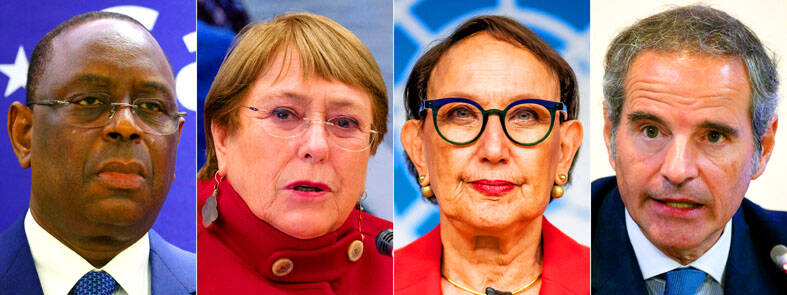
Four contenders are squaring up to succeed Antonio Guterres as secretary-general of the UN, which faces unprecedented global instability, wars and its own crushing budget crisis. Chile’s Michelle Bachelet, Argentina’s Rafael Grossi, Costa Rica’s Rebeca Grynspan and Senegal’s Macky Sall are each to face grillings by 193 member states and non-governmental organizations for three hours today and tomorrow. It is only the second time the UN has held a public question-and-answer, a format created in 2016 to boost transparency. Ultimately the five permanent members of the UN’s top body, the Security Council, hold the power, wielding vetoes over who leads the

A humanoid robot that won a half-marathon race for robots in Beijing on Sunday ran faster than the human world record in a show of China’s technological leaps. The winner from Honor, a Chinese smartphone maker, completed the 21km race in 50 minutes and 26 seconds, said a WeChat post by the Beijing Economic-Technological Development Area, also known as Beijing E-Town, where the race began. That was faster than the human world record holder, Ugandan Jacob Kiplimo, who finished the same distance in about 57 minutes in March at the Lisbon road race. The performance by the robot marked a significant step forward

An earthquake registering a preliminary magnitude of 7.7 off northern Japan on Monday prompted a short-lived tsunami alert and the advisory of a higher risk of a possible mega-quake for coastal areas there. The Cabinet Office and the Japan Meteorological Agency said there was a 1% chance for a mega-quake, compared to a 0.1% chance during normal times, in the next week or so following the powerful quake near the Chishima and Japan trenches. Officials said the advisory was not a quake prediction but urged residents in 182 towns along the northeastern coasts to raise their preparedness while continuing their daily lives. Prime
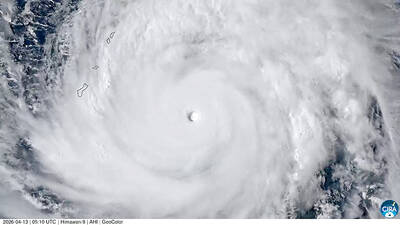
HAZARDOUS CONDITION: The typhoon’s sheer size, with winds extending 443km from its center, slowed down the ability of responders to help communities, an official said The US Coast Guard was searching for six people after losing contact with their disabled boat off the coast of Guam following Typhoon Sinlaku. The crew of the 44m dry cargo vessel, the US-registered Mariana, on Wednesday notified the coast guard that the boat had lost its starboard engine and needed assistance, Petty Officer 3rd Class Avery Tibbets said yesterday. The coast guard set up a one-hour communication schedule with the vessel, but lost contact on Thursday. A Coast Guard HC-130 Hercules aircraft was launched to search for the six people on board, but it had to return to Guam because of


 RSS
RSS