


Indonesia's president defended a decision to raise fuel prices beginning today as the only way to stave off an economic crisis, while calling on thousands of demonstrators who have taken to the streets to refrain from violence.
"Anarchy will only deter investment," President Susilo Bambang Yudhoyono said hours before the size of the hike was to be announced.
Ministers said the cost of gasoline, diesel fuel and kerosene could climb by as much as 50 percent -- pushing up the price of everything from rice to cigarettes in the sprawling country of 220 million people, half of whom live on less than US$2 a day.
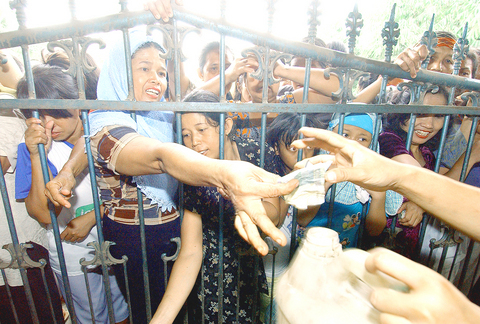
PHOTO: AFP
Demonstrations in 17 cities were small and scattered, though numbers swelled in the predominantly Muslim nation after Friday prayers, with thousands turning out.
Soldiers and riot police patrolled major traffic intersections and strategic locations across the capital, including the presidential palace, parliament and some gas stations.
The price hikes follow Yudhoyono's decision to slash fuel subsidies that have helped protect Indonesia's poorest from spiraling global prices for years, but also threatened to blow the cash-strapped government's budget. Last year, the government doled out US$7.4 billion for the subsidies -- more than the international community has pledged on rebuilding efforts in countries hit by last year's tsunami.
"I realize that this is not a popular policy, a bitter pill that we have to swallow, but we have to do it to save the nation's budget and the future of the country," Yudhoyono said at the opening of a new Honda motor plant outside of Jakarta.
Motorists hoping to fill their tanks with cheap gas formed long lines at gas stations nationwide. Some stations were closed, hanging up signs that said "Sorry, we've run out." So far the demonstrations have been smaller than expected, given the size of the country and its history of massive street rallies, cheering investors. The Indonesian stock market and the local currency have taken a hit recently amid the economic uncertainty.
"Investors are just relieved the fuel price hike demonstrations haven't happened," one dealer said on condition of anonymity. "There really isn't much other news to boost the market," the dealer added.
Despite being Southeast Asia's only member of OPEC, Indonesia has to import oil because of decades of declining investment in exploration and extraction due to corruption and a weak legal system that makes people wary of doing business here. Everyone agrees that the current level of subsidies -- which allow Indonesian motorists to fill up for less than US$0.25 per liter -- are unsustainable. Still, raising prices is a sensitive issue in Indonesia, where a massive hike in 1998 triggered rioting that helped topple former dictator Suharto.
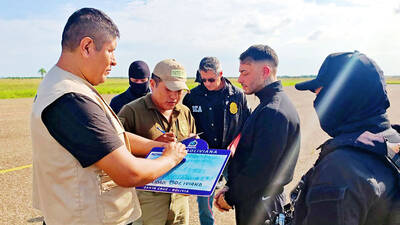
KINGPIN: Marset allegedly laundered the proceeds of his drug enterprise by purchasing and sponsoring professional soccer teams and even put himself in the starting lineups Notorious Latin American narco trafficker Sebastian Marset, who eluded police for years, was handed over to US authorities after his arrest on Friday in Bolivia. Marset, a Uruguayan national who was on the US most-wanted list, was passed to agents of the US Drug Enforcement Administration at Santa Cruz airport in Bolivia, then put on a US airplane, Bolivian state television showed. “The arrest and deportation were carried out pursuant to a court order issued by the US justice system,” Bolivian Minister of Government Marco Antonio Oviedo told reporters. The alleged kingpin was arrested in an upscale neighborhood of Santa
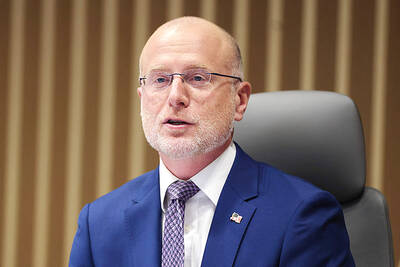
FAKE NEWS? ‘When the government demands the press become a state mouthpiece under the threat of punishment, something has gone very wrong,’ a civic group said The top US broadcast regulator on Saturday threatened media outlets over negative coverage of the Middle East war, after US President Donald Trump slammed critical headlines from the “Fake News Media.” The US president since his first term has derided mainstream media as “fake news” and has sued major outlets over what he sees as unfair coverage. Brendan Carr, head of the US Federal Communications Commission — which oversees the nation’s radio, television and Internet media — said broadcasters risked losing their licenses over news coverage. “The law is clear. Broadcasters must operate in the public interest, and they will
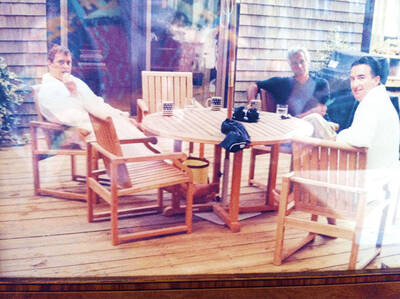
SCANDAL: Other images discovered earlier show Andrew bent over a female and lying across the laps of a number of women, while Mandelson is pictured in his underpants A photograph of former British prince Andrew and veteran politician Peter Mandelson sitting in bathrobes alongside late sex offender Jeffrey Epstein was unearthed on Friday in previously published documents. The image is believed to be the first known photograph of the two men with Epstein. They are currently engulfed in scandal in the UK over their ties to their mutual friend. The undated photograph, first reported by ITV News, shows King Charles III’s disgraced brother and former British ambassador to the US sitting barefoot outside on a wooden deck. They appear to have mugs with a US flag on them
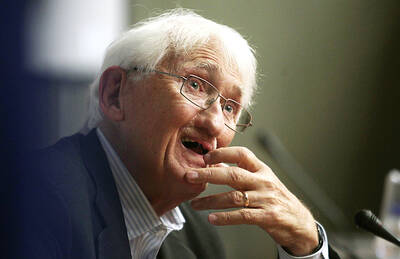
INFLUTENTIAL THEORIST: Habermas was particularly critical of the ‘limited interest’ shown by German politicians in ‘shaping a politically effective Europe Jurgen Habermas, whose work on communication, rationality and sociology made him one of the world’s most influential philosophers and a key intellectual figure in his native Germany, has died. He was 96. Habermas’ publisher, Suhrkamp, said he died on Saturday in Starnberg, near Munich. Habermas frequently weighed in on political matters over several decades. His extensive writing crossed the boundaries of academic and philosophical disciplines, providing a vision of modern society and social interaction. His best-known works included the two-volume Theory of Communicative Action. Habermas, who was 15 at the time of Nazi Germany’s defeat, later recalled the dawn of


 RSS
RSS