


A gunbattle between Muslim militants and Indian troops in the heart of Kashmir's main city entered a second day yesterday amid concerns for the safety of about 40 people trapped in nearby buildings.
Two soldiers have been killed and 24 people, including seven journalists, wounded in the fighting. Witnesses said the area had been cordoned off by hundreds of troops, who were backed by armored jeeps and trucks mounted with machine guns.
An unspecified number of militants had positioned themselves in two buildings in central Srinagar after they raided the city's main business center on Friday afternoon, sparking a fierce battle with troops.
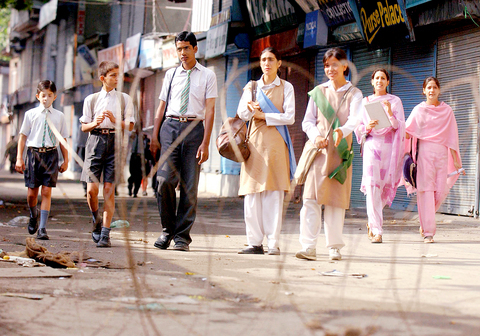
PHOTO: AFP
Police and witnesses said some 40 people were trapped in a newspaper office, the Daily Aftab, and in a hotel next to a building where the militants were holed up.
"They are all scared but safe," Zahoor Ahmad, an editor on the Urdu language newspaper, said by phone from the office.
Yesterday morning, police and soldiers rescued at least 20 civilians, including some children, who had been stranded in a bank in the area as shots were exchanged between the guerrillas and troops, a police officer said.
``We have cordoned off the entire area and evacuated everybody,'' K. Srinivasan, the Border Security Force's intelligence chief in Kashmir, said yesterday.
Two or three militants were firing from the two buildings' windows, Srinivasan said.
Two policemen and three paramilitary soldiers were wounded yesterday when security forces tried to storm one of the buildings where the militants were thought to be hiding, a senior police officer said.
``They [the militants] fired heavily as a group of police and paramilitary soldiers tried to storm one of the buildings,'' he said.
Security officials said they planned to flush out the militants, armed with grenades and automatic rifles, soon but were being careful to avoid civilian casualties.
"On the backside of the building, we are drilling a hole to push soldiers in to flush out the terrorists," a Border Security Force officer, who asked not to be named, said without elaborating.
Television cameramen and photographers who had rushed to cover Friday's firefight got caught in the crossfire. Seven were hurt, including a cameraman who was in a critical condition.
In Srinagar, streets were quieter than usual as many people stayed indoors to keep out of the way.
"Incidents like this make me feel hopeless. Peace for Kashmir is like a mirage," Abdul Ahad, a 50-year-old businessman, said.
Two Islamic groups fighting New Delhi's rule over Kashmir, Al-Mansuriyan and Jamiat-ul-Mujahideen, claimed responsibility for the raid although officials have not named any group suspected in the attack.
"Four mujahidin of Al-Mansuriyan and Jamiat-ul-Mujahideen groups who have engaged Indian forces in a fierce gunbattle are safe and have inflicted heavy casualties on the security forces," a statement of Jamiat-ul-Mujahideen said.
More than a dozen Islamic rebel groups have been fighting security forces in India's portion of Muslim-majority Kashmir for the territory's independence or its merger with mostly Muslim Pakistan. The 15-year insurgency has claimed more than 66,000 lives, mostly civilians.

PHISHING: The con might appear convincing, as the scam e-mails can coincide with genuine messages from Apple saying you have run out of storage For a while you have been getting messages from Apple saying “your iCloud storage is full.” They say you have exceeded your storage plan, so documents are no longer being backed up, and photos you take are not being uploaded. You have been resisting Apple’s efforts to get you to pay a minimum of £0.99 (US$1.33) a month for more storage, but it seems that you cannot keep putting off the inevitable: You have received an e-mail which says your iCloud account has been blocked, and your photos and videos would be deleted very soon. To keep them you need
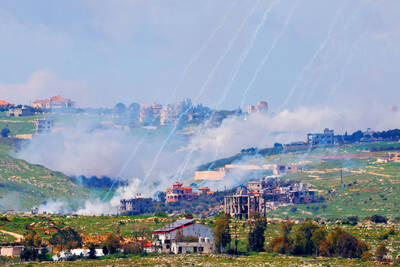
The Israeli military has demolished entire villages as part of its invasion of south Lebanon, rigging homes with explosives and razing them to the ground in massive remote detonations. The Guardian reviewed three videos posted by the Israeli military and on social media, which showed Israel carrying out mass detonations in the villages of Taybeh, Naqoura and Deir Seryan along the Israel-Lebanon border. Lebanese media has reported more mass detonations in other border villages, but satellite imagery was not readily available to verify these claims. The demolitions came after Israeli Minister of Defense Israel Katz called for the destruction of

A US YouTuber who caused outrage for filming himself kissing a statue commemorating Korean wartime sex slaves has been sentenced to six months in prison, a court in Seoul said yesterday. Johnny Somali, 25, gained notoriety several years ago for recording himself doing a series of provocative stunts in South Korea and Japan, and streaming them on platforms such as YouTube and Twitch. South Korean authorities indicted Somali — whose real name is Ramsey Khalid Ismael — in 2024 on public order violations and obstruction of business, and banned him from leaving the country. “The court has sentenced him to six months in
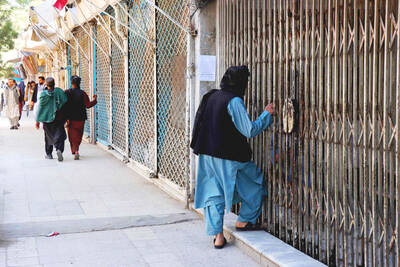
The death toll from a shooting in western Afghanistan rose to 11 on Saturday, after gunmen targeted civilians at a picnic spot in Herat, the provincial authority said. Bullet marks were visible on a wall of the Sayed Mohammad Agha Shia shrine, while bloodstains marked a blanket abandoned at the scene. “Eleven people have been recorded dead and eight others wounded from Friday’s incident, with the condition of two of the wounded reported as critical,” Herat’s information office said in a statement. The update raises a toll of seven killed provided on Friday by the Afghan Ministry of Interior Affairs


 RSS
RSS