


Rescuers searched with bare hands yesterday for survivors buried under debris and rushed aid to villages cut off by record-breaking rains that paralyzed Mumbai and its surrounding state, leaving more than 450 dead.
Officials said 267 people died in Mumbai, India's financial capital as well as the capital of Maharashtra state, after being crushed by falling walls, trapped in cars or electrocuted when the most intense rains on record swept through the city Tuesday evening. Phone networks collapsed, highways were blocked and the city's airports, among the nation's busiest, were closed.
At least 452 people were reported dead in different parts of Maharashtra, said B.M. Kulkarni, the deputy secretary in charge of the state's emergency control room in Mumbai.
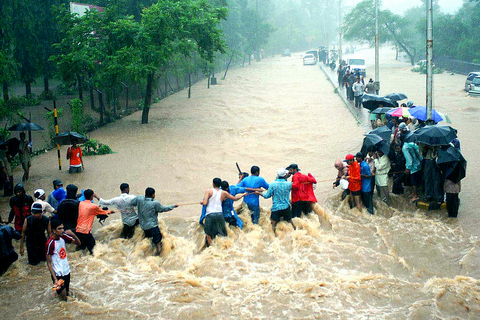
PHOTO: AP
In the northern Mumbai suburb of Saki Naka, relief workers and survivors sifted through rubble yesterday after a small hill crashed on a group of huts, leaving more than 45 people missing and presumed dead.
"I was scared the hill would fall. I kept telling my cousin, `lets leave,'" sobbed Aslam Khan. "But he wouldn't listen. Now it's too late."
Bodies were piled onto trucks and private cars were flagged down to carry several dozen injured to hospitals.
"People ran as soon as the hill started crumbling. But the old people had no chance," said Shabana Shaikh, who lost her parents in the landslide. She said authorities had asked shanty dwellers each year to vacate their decrepit homes.
"But we didn't really expect it to fall," said Shaikh, her clothes caked with mud.
Officials said parts of Mumbai had been hit by up to 94.4cm (37.1 inches) of rain Tuesday, the highest one-day total in India's history. Much of it came over a few evening hours. Photos showed the sprawling city covered with water, with cars choking almost every main road. Mumbai's residents responded by opening up their homes and distributing food to motorists stuck in traffic and people wading through water.
"They were just angels. Women and children were giving food, biscuits to people on the road and even assuring us that it was homecooked," said G. Sawant, a manager at a private infrastructure company.
Residents tied ropes across flooded roads to help people wade through waist-deep water as workers repaired communication networks and towed away abandoned cars and buses to clear the city's gridlocked highways. Train services had resumed and flights were to begin later in the day.
Hundreds of Mumbai residents began returning to their homes early yesterday in the worst-affected parts of the city's suburbs after spending two nights stranded in offices, buses, cars or trains.
State police officials said rescue teams had begun distributing food packets and water to people marooned in villages cut off by flood waters. They were also recovering bodies floating in murky swirling water.
The deluge was unprecedented in Mumbai, a hectic, cosmopolitan city that is home to India's financial and movie industries, as well as some of its worst poverty.
Every year, Mumbai comes to a halt for a day or two due to heavy monsoon rains, which pound the country between June and September and often leave hundreds dead across India. But this week's downpours left the city paralyzed.
"Most places in India don't receive this kind of rainfall in a year. This is the highest ever recorded in India's history," R.V. Sharma, director of the meteorological department in Mumbai, told reporters.
India's previous heaviest rainfall, recorded in the northeastern town of Cherrapunji -- one of the rainiest places on Earth -- was 83.82cm (33 inches) on July 12, 1910, Sharma said.

SPEAKING OUT: After Siranudh Scott’s allegations surfaced, celebrities and public figures took to social media to share their own experiences of sexual misconduct and abuse A high-profile alleged sexual abuse case within a wealthy Thai beer brewing family has prompted a wave of painful accounts from survivors of unconnected abuse in the conservative nation. Siranudh Scott, a member of the billionaire Thai family that founded the ubiquitous Singha beer brand, posted an emotional video this month accusing his elder brother Sunit of repeatedly abusing him when he was a teenager. Sunit, who is in his 30s, later denied the allegations in a video posted online, but Singha parent Boonrawd dismissed him from his executive role with the company on Tuesday last week. “I felt I needed to speak

SEEKING ORDER: Rodrigo Paz said that ‘anyone who wants to destroy the nation will have to deal with this president and the full force of the constitution’ Bolivian President Rodrigo Paz on Wednesday said that the nation was at a “breaking point” after nearly a month of protests that have caused shortages of food, fuel and medicine. Paz, who took office six months ago amid the worst economic crisis there in four decades, is battling a groundswell of fury over his policies. The political capital, La Paz, has been besieged by low-income workers and members of the indigenous majority calling for his resignation. “The country needs order and is reaching breaking point,” the 58-year-old said at a public event in La Paz, renewing his appeal for dialogue. On Tuesday, the Bolivian
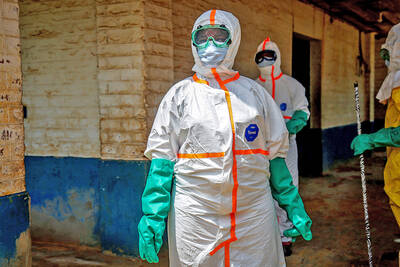
COMMUNITY CONFLICT: Concerns about disease spread from corpses has run up against friends and families’ desire to bury their dead as infection spreads in the area Angry residents of a town at the epicenter of the Ebola outbreak in the Democratic Republic of the Congo (DR Congo) attacked and burned a tent that was part of a health center where people are being treated for the virus, the staff there said Saturday. It was the second such attack in the region in a week. No one was hurt in the attack, according to reports but as patients ran out to escape the fire, 18 people with suspected Ebola infections fled the facility and are unaccounted for, a hospital director said. Angry residents arrived at the clinic in the

Forecasters in Europe yesterday warned of exceptional heat as record temperatures driven by a “heat dome” push temperatures well above seasonal norms across the continent. The surge follows a record-breaking Monday, with France logging its hottest day in the month of May on record, its weather agency said, and the UK also posting unprecedented highs. A so-called “heat dome” of warm air from northern Africa trapped under a high-pressure system over western Europe is behind the high temperatures not usually seen until high summer. Restrictions on outdoor work were imposed in parts of Italy, beaches in southwest France filled earlier than usual and


 RSS
RSS