


Muslims all over Britain, in small towns and big cities, are beginning to feel the repercussions of Thursday's terrorist attack on London, confirming widespread concerns that resentment over the bombings would spill over into harassment and violence.
In the span of a few days, at least four mosques across England, including one here, have been either partially set on fire or firebombed, according to the police, and others have had their windows smashed and their doors vandalized.
Still others have had racist graffiti scrawled on their walls. In one case, a mosque was hit by bloody pig parts, a particular offense to a religion that eschews eating pork, said Azad Ali, the chairman of the Muslim Safety Forum, which serves as an advisory group for the police and has been tracking incidents from police reports and community groups.
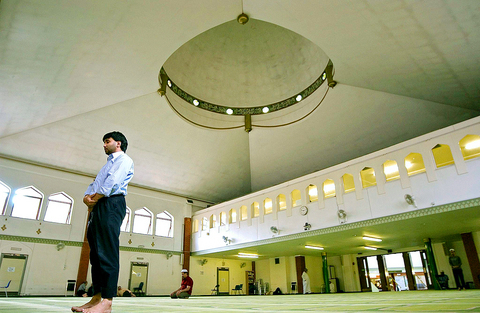
PHOTO: EPA
The good news, the police say, is that there has been no major damage nor any serious injuries. But across the country, there have been reports of vandalism of businesses, homes and cars, police say.
Sitting on a downtrodden block of boarded-up shops, the Shahjalal Mosque is no more than a small room off the street, with an apartment above; it is as unassuming as it is popular among Muslims in Wirral, an area just across the Mersey River from Liverpool.
ATTACKS
But early Saturday morning, long after the assistant imam upstairs had gone to bed, someone tried to set it on fire. The attempt did not succeed, mostly because the fire department responded quickly. But the fire still scorched the front door, smoked out the inside and drove out the imam, who was rescued by firefighters.
Now a police officer patrols outside the tiny mosque, just to be safe.
"We are facing two fronts," said a Bengali worshiper at the mosque, who like the other men who came to pray, said he was too fearful to provide his name. "We are facing the terrorists and also the backlash. We were surprised by this. This is a nice community, a small community."
Many mosques now have police officers posted outside, particularly during prayer hours. Others have rejected the offer, fearful of appearing more conspicuous.
People, too, have been attacked and harassed. A Muslim man in London was beaten by two passersby, according to Ali. A young boy in Barking, East London, was attacked by a gang. Some bus drivers say they have been spat upon. In a few cases, women say they have been ridiculed and had their hijabs -- the head scarves worn by many Muslim women as a display of piety -- pulled from their heads.
Lord Nazir Ahmed, the first Muslim to join the House of Lords, said that his title gives him no immunity from the racist sentiment. Just after stepping outside on Friday with his 85-year-old grandmother and 3-year-old granddaughter, a carload of men slowed down, shouted obscenities at them and made an obscene gesture.
"I did not respond," he said in an interview. "We must have patience. We must report it to the police. But we must not fight back. Under any other circumstances, we would fight back. But not now. We must try to understand the hurt and the pain and not give the opportunity to those thugs."
HOLY WAR
Racist e-mail messages have poured into the Web site of the Muslim Council of Britain, one of Britain's largest Muslim groups, shutting its system down for a time. One warned, "It's time for war on Muslims throughout Britain."
While acknowledging that many incidents go unreported, most that the police know about have been sporadic, isolated and appear not to be getting worse as days pass, reported the Association of Chief Police Officers of England, Wales and Northern Ireland.
"We are encouraged by the overall calm community response, locally and nationally, to these terrible events," said Chris Fox, president of the association.
"I am cautiously optimistic that common sense and the best instincts of everyone are prevailing," Fox said.

SPEAKING OUT: After Siranudh Scott’s allegations surfaced, celebrities and public figures took to social media to share their own experiences of sexual misconduct and abuse A high-profile alleged sexual abuse case within a wealthy Thai beer brewing family has prompted a wave of painful accounts from survivors of unconnected abuse in the conservative nation. Siranudh Scott, a member of the billionaire Thai family that founded the ubiquitous Singha beer brand, posted an emotional video this month accusing his elder brother Sunit of repeatedly abusing him when he was a teenager. Sunit, who is in his 30s, later denied the allegations in a video posted online, but Singha parent Boonrawd dismissed him from his executive role with the company on Tuesday last week. “I felt I needed to speak

SEEKING ORDER: Rodrigo Paz said that ‘anyone who wants to destroy the nation will have to deal with this president and the full force of the constitution’ Bolivian President Rodrigo Paz on Wednesday said that the nation was at a “breaking point” after nearly a month of protests that have caused shortages of food, fuel and medicine. Paz, who took office six months ago amid the worst economic crisis there in four decades, is battling a groundswell of fury over his policies. The political capital, La Paz, has been besieged by low-income workers and members of the indigenous majority calling for his resignation. “The country needs order and is reaching breaking point,” the 58-year-old said at a public event in La Paz, renewing his appeal for dialogue. On Tuesday, the Bolivian
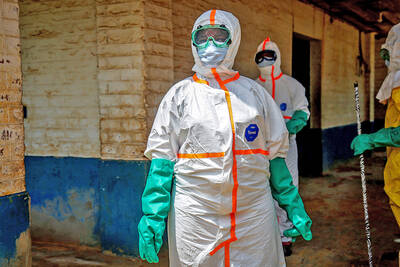
COMMUNITY CONFLICT: Concerns about disease spread from corpses has run up against friends and families’ desire to bury their dead as infection spreads in the area Angry residents of a town at the epicenter of the Ebola outbreak in the Democratic Republic of the Congo (DR Congo) attacked and burned a tent that was part of a health center where people are being treated for the virus, the staff there said Saturday. It was the second such attack in the region in a week. No one was hurt in the attack, according to reports but as patients ran out to escape the fire, 18 people with suspected Ebola infections fled the facility and are unaccounted for, a hospital director said. Angry residents arrived at the clinic in the
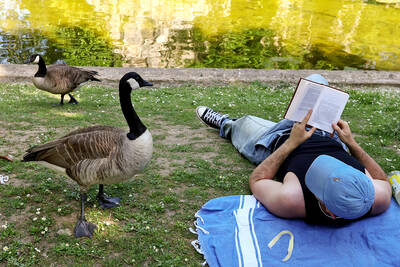
Forecasters in Europe yesterday warned of exceptional heat as record temperatures driven by a “heat dome” push temperatures well above seasonal norms across the continent. The surge follows a record-breaking Monday, with France logging its hottest day in the month of May on record, its weather agency said, and the UK also posting unprecedented highs. A so-called “heat dome” of warm air from northern Africa trapped under a high-pressure system over western Europe is behind the high temperatures not usually seen until high summer. Restrictions on outdoor work were imposed in parts of Italy, beaches in southwest France filled earlier than usual and


 RSS
RSS