


The upcoming six-party talks on North Korean disarmament will fail unless Pyongyang makes a commitment to abandon its nuclear weapons, US Secretary of State Condoleezza Rice said yesterday.
"What we really need is a strategic decision on the part of the North that they are indeed ready to give up their nuclear weapons program," Rice told reporters after the meeting with Japanese Foreign Minister Nobutaka Machimura in Tokyo.
"Without that, these talks cannot be successful," she said.
She also said Washington strongly supports Japan's efforts to resolve the cases of Japanese kidnapped decades ago by North Korean agents. The North has released five of the victims, but Japan believes other victims may still remain.
"We agreed that there must be an actual progress in the next round of talks, and we expect North Korea's serious and constructive handling," Machimura said. "We also confirmed the importance of close cooperation among Japan, the United States and South Korea on the issue."
Rice also expressed no objections to a South Korean donation of 453,592 tonnes tons of rice to the North, saying the gesture will not undercut the US negotiating position heading into the six-party talks.
Rice said South Korea was responding to "miserable conditions" in North Korea and noted that the US itself in recent days offered 45,395 tonnes of food aid to Pyongyang.
Rice was also scheduled to meet with Prime Minister Junichiro Koizumi later in the day before heading to South Korea.
Despite the call for concessions from the North, Rice pledged the US' commitment to the upcoming talks, which are scheduled to resume the week of July 25 in Beijing.
"We're ready to negotiate seriously. We are prepared to roll up our sleeves and do everything we can to make these talks a success," she said, adding that all of the partners in the talks -- China, South Korea, Russia, Japan and the US -- were aiming toward the common goal of a nuclear-free North Korea.
Ahead of the talks, Japanese officials said Japan, South Korea and the US were trying to arrange three-way talks on North Korea before the broader meetings.
"We believe we should have Japan-US-South Korea talks as soon as possible, and we are currently arranging a date and a venue," said Chief Cabinet Secretary Hiroyuki Hosoda said. "We are hoping to have a meeting by the weekend."
North Korea announced over the weekend that it would end its yearlong boycott of the six-party talks on its nuclear weapons programs.
Meanwhile, South Korea said yesterday that it offered energy aid to the North as an incentive to encourage it to return to nuclear disarmament talks.
Unification Minister Chung Dong-young said Seoul would provide electricity to the North if it agrees to give up nuclear weapons at the revived six-nation arms talks. South Korean officials had previously refused to give details of the aid proposal, which apparently pushed the North to agree over the weekend to end its boycott of the nuclear negotiations.
Senior North Korean officials told a visiting columnist from The New York Times that one of two nuclear reactors the North resumed constructing this year -- which could potentially generate more weapons-grade plutonium -- could be completed this year or next.
"To defend our sovereignty and our system ... we cannot but increase our number of nuclear weapons as a deterrent force," Nicholas Kristof quoted Li Chan-bok, a North Korean army general, as saying.
If the US carries out a military strike to destroy the reactors, Li said the result would be "all-out war" and didn't rule out the use of nuclear weapons, Kristof wrote in a column yesterday.

PHISHING: The con might appear convincing, as the scam e-mails can coincide with genuine messages from Apple saying you have run out of storage For a while you have been getting messages from Apple saying “your iCloud storage is full.” They say you have exceeded your storage plan, so documents are no longer being backed up, and photos you take are not being uploaded. You have been resisting Apple’s efforts to get you to pay a minimum of £0.99 (US$1.33) a month for more storage, but it seems that you cannot keep putting off the inevitable: You have received an e-mail which says your iCloud account has been blocked, and your photos and videos would be deleted very soon. To keep them you need

The Israeli military has demolished entire villages as part of its invasion of south Lebanon, rigging homes with explosives and razing them to the ground in massive remote detonations. The Guardian reviewed three videos posted by the Israeli military and on social media, which showed Israel carrying out mass detonations in the villages of Taybeh, Naqoura and Deir Seryan along the Israel-Lebanon border. Lebanese media has reported more mass detonations in other border villages, but satellite imagery was not readily available to verify these claims. The demolitions came after Israeli Minister of Defense Israel Katz called for the destruction of

A US YouTuber who caused outrage for filming himself kissing a statue commemorating Korean wartime sex slaves has been sentenced to six months in prison, a court in Seoul said yesterday. Johnny Somali, 25, gained notoriety several years ago for recording himself doing a series of provocative stunts in South Korea and Japan, and streaming them on platforms such as YouTube and Twitch. South Korean authorities indicted Somali — whose real name is Ramsey Khalid Ismael — in 2024 on public order violations and obstruction of business, and banned him from leaving the country. “The court has sentenced him to six months in
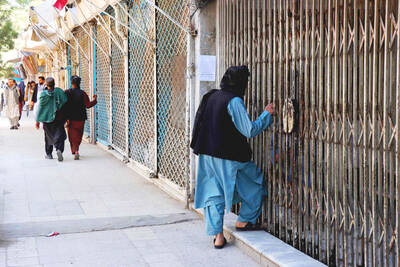
The death toll from a shooting in western Afghanistan rose to 11 on Saturday, after gunmen targeted civilians at a picnic spot in Herat, the provincial authority said. Bullet marks were visible on a wall of the Sayed Mohammad Agha Shia shrine, while bloodstains marked a blanket abandoned at the scene. “Eleven people have been recorded dead and eight others wounded from Friday’s incident, with the condition of two of the wounded reported as critical,” Herat’s information office said in a statement. The update raises a toll of seven killed provided on Friday by the Afghan Ministry of Interior Affairs


 RSS
RSS