


North Korea says it has agreed with the US to return to nuclear talks to be held on July 25, the South Korean KCNA news agency reported late yesterday.
In related news, US Secretary of State Condoleezza Rice sent a message Friday to North Korea that Washington has no intention of attacking the hardline communist nation as she embarked on an Asian trip to ease a nuclear crisis in the Korean peninsula.
North Korea has persistently cited "US hostility" as a key reason for boycotting the six-party talks -- among the US, Japan, China, the two Koreas and Russia -- and had demanded a clear security guarantee from Washington.
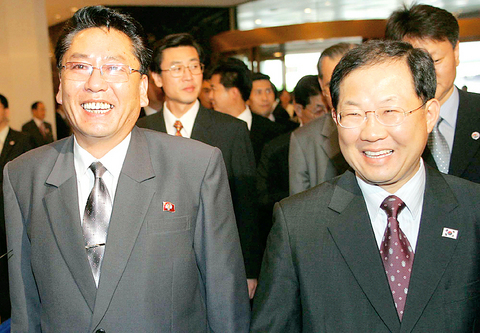
PHOTO: AP
"The key here is that there were some important things to say -- important to reiterate [President George W. Bush's] pledge given back in 2002 in South Korea that the US has no intention of attacking or invading" North Korea, Rice said.
The US also considers North Korea a sovereign nation, she told reporters accompanying her on the plane to China, Thailand, South Korea and Japan.
"It was important to state what we consider to be a statement of fact that the US considers North Korea a sovereign state -- after all, the North Koreans are members of the UN and held negotiations along with other sovereign states," she said.
Last month, North Korean leader Kim Jong-il said his country would come back to the six-party talks if the US "recognizes and respects" his country as a dialogue partner.
In other developments, North Korean government officials arrived in Seoul yesterday ahead of four days of talks with their South Korean counterparts aimed at building closer inter-Korean economic cooperation. North Korea's five-member delegation, headed by deputy minister for construction and building Choe Yong-gon, kickstarted the visit with a dinner hosted by South Korea's Unification Minister Chung Dong-Young.
During the talks set to begin today, the two sides will discuss North Korea's request for 500,000 tonnes of rice to supplement a reduction in World Food Program assistance.
North Korea had rejected a US-led aid-for-disarmament proposal at the last round of the talks in June 2004 that required Pyongyang to give an upfront pledge to dismantle all its nuclear programs before receiving any energy and other assistance. Pyongyang wants a step by step approach to weaning away from its nuclear program, fearing it could come under attack by the US if it loses the nuclear card.
The US was part of the security guarantee given to North Korea by the five other parties at the nuclear talks but Pyongyang had complained there was no individual guarantee from Washington. As if to address this concern, Rice said Friday: "There are principles on the table that the US has no intention to invade or attack North Korea.
"I think if they heard from the US, they would certainly believe that would be in the security assurances of any of the other parties," she said.
Efforts to break the impasse in the nuclear crisis that had gripped the Korean peninsula for some two and a half years is clearly expected to dominate Rice's Asian trip. She will first visit China, the host of the six-party talks, and then to tsunami-hit Thailand before returning to Northeast Asia for talks with key Asian allies Japan and South Korea.
This is Rice's second trip to China, South Korea and Japan in some three months and analysts see it as a reflection of Washington's eagerness to see an end to the nuclear turmoil, viewed as Asia's biggest security problem.

PHISHING: The con might appear convincing, as the scam e-mails can coincide with genuine messages from Apple saying you have run out of storage For a while you have been getting messages from Apple saying “your iCloud storage is full.” They say you have exceeded your storage plan, so documents are no longer being backed up, and photos you take are not being uploaded. You have been resisting Apple’s efforts to get you to pay a minimum of £0.99 (US$1.33) a month for more storage, but it seems that you cannot keep putting off the inevitable: You have received an e-mail which says your iCloud account has been blocked, and your photos and videos would be deleted very soon. To keep them you need

The Israeli military has demolished entire villages as part of its invasion of south Lebanon, rigging homes with explosives and razing them to the ground in massive remote detonations. The Guardian reviewed three videos posted by the Israeli military and on social media, which showed Israel carrying out mass detonations in the villages of Taybeh, Naqoura and Deir Seryan along the Israel-Lebanon border. Lebanese media has reported more mass detonations in other border villages, but satellite imagery was not readily available to verify these claims. The demolitions came after Israeli Minister of Defense Israel Katz called for the destruction of

A US YouTuber who caused outrage for filming himself kissing a statue commemorating Korean wartime sex slaves has been sentenced to six months in prison, a court in Seoul said yesterday. Johnny Somali, 25, gained notoriety several years ago for recording himself doing a series of provocative stunts in South Korea and Japan, and streaming them on platforms such as YouTube and Twitch. South Korean authorities indicted Somali — whose real name is Ramsey Khalid Ismael — in 2024 on public order violations and obstruction of business, and banned him from leaving the country. “The court has sentenced him to six months in

The death toll from a shooting in western Afghanistan rose to 11 on Saturday, after gunmen targeted civilians at a picnic spot in Herat, the provincial authority said. Bullet marks were visible on a wall of the Sayed Mohammad Agha Shia shrine, while bloodstains marked a blanket abandoned at the scene. “Eleven people have been recorded dead and eight others wounded from Friday’s incident, with the condition of two of the wounded reported as critical,” Herat’s information office said in a statement. The update raises a toll of seven killed provided on Friday by the Afghan Ministry of Interior Affairs


 RSS
RSS