


Al-Qaeda in Iraq said in an Internet statement yesterday that it killed Egypt's top envoy to Iraq who it had kidnapped, saying he represented a "tyrannical" government allied to the enemies of Islam.
"We, al-Qaeda in Iraq, announce that the judgement of God has been implemented against the ambassador of the infidels, the ambassador of Egypt. Oh enemy of God, Ihab el-Sherif, this is your punishment in this life," said the group, led by Abu Musab al-Zarqawi.
The group posted a video showing the hostage speaking but did not show the actual killing. The threat to kill al-Sherif, seized by gunmen in western Baghdad on Saturday, marks a dramatic escalation in a campaign to isolate Iraq diplomatically in the Arab and Muslim worlds. On Tuesday, gunmen fired on envoys from Bahrain and Pakistan in apparent kidnap attempts.
PHOTO: EPA
"Terrorism is trying to strike not only against Iraqis," Iraqi Prime Minister Ibrahim al-Jaafari told reporters earlier after meeting with Senator Carl Levin, ranking Democrat on the Senate Foreign Relations Committee and a critic of US policy in Iraq.
"We hope that all countries of the world will stand by us, strengthen the democratic work and carry out political functions, keeping in mind the security regulations," al-Jaafari said.
The original threat on al-Sherif's life also came in a statement on a Web site linked to al-Qaeda.
The statement condemned Egypt for allying itself with "Jews and Christians" -- in other words, it linked the kidnapping to Egypt's announcement last month that it would be the first Arab government to upgrade its mission here to a full embassy headed by an ambassador. Egyptian officials say no ambassador has been designated although al-Sherif was posted here a few weeks before the announcement.
More than a dozen Arab nations have diplomatic missions in Baghdad, but none has a full ambassador -- in part because of security fears and in part because governments are hesitant to take a step that could be seen as condoning the US military presence in Iraq.
Jordan's deputy prime minister, Marwan Muasher, said his country was "determined" to send an ambassador "but we are awaiting measures to be put in place to ensure his safety in Iraq."
Pakistani ambassador Mohammed Younis Khan flew to Jordan a day after his convoy was fired on in west Baghdad. Bahraini envoy Hassan Malallah al-Ansari, slightly wounded in a separate shooting, was expected to depart within a few days, and Bahraini officials said that it was not known when he would return.
In the first Web statement, the kidnappers said al-Qaeda in Iraq's religious court had decided to hand over al-Sherif, 51, to its fighters "to carry out the punishment of apostasy against him." Al-Qaeda considers cooperating with Americans as apostasy, or the abandoning of the religion, which is punishable by death under Islam.
The statement was chilling because al-Qaeda in Iraq, the country's most feared terror group led by Abu Musab al-Zarqawi, has been responsible for beheading several foreign hostages, including American Nicholas Berg. Al-Zarqawi's group also has claimed responsibility for numerous car-bombings in Iraq -- many against Iraqi civilians.
Some insurgent groups have threatened to kill hostages only to release them later, but al-Qaeda normally carries out its threats. The Web statement was titled, "The sharp [sword] against the ambassador of infidels."
Initial pictures posted on the site showed the front and back of five ID cards in al-Sherif's name. His Egyptian driver's license and a Foreign Ministry card showed his photograph. The material appeared on the same site as an audiotape in which a speaker purported to be al-Zarqawi said Iraq's security forces were as great an enemy as the Americans.
Also, two Iraqis accidentally blew themselves up overnight yesterday while preparing a car bomb in a home garage in Iraq's northern city of Kirkuk, police said.
"One man was killed and another, who was injured, tried to escape but was arrested," police Colonel Anwar Abdallah said.
A child sleeping on the rooftop of a nearby house was injured in the blast, he added.
"The explosion occurred around 4am in the al-Askari district as the rebels worked on booby-trapping a car which exploded," Abdallah said.
Explosives and weapons were found in the house and the area in the eastern part of the town, some 250km north of Baghdad, was cordoned off by Iraqi police and US forces, he added.

SPEAKING OUT: After Siranudh Scott’s allegations surfaced, celebrities and public figures took to social media to share their own experiences of sexual misconduct and abuse A high-profile alleged sexual abuse case within a wealthy Thai beer brewing family has prompted a wave of painful accounts from survivors of unconnected abuse in the conservative nation. Siranudh Scott, a member of the billionaire Thai family that founded the ubiquitous Singha beer brand, posted an emotional video this month accusing his elder brother Sunit of repeatedly abusing him when he was a teenager. Sunit, who is in his 30s, later denied the allegations in a video posted online, but Singha parent Boonrawd dismissed him from his executive role with the company on Tuesday last week. “I felt I needed to speak

SEEKING ORDER: Rodrigo Paz said that ‘anyone who wants to destroy the nation will have to deal with this president and the full force of the constitution’ Bolivian President Rodrigo Paz on Wednesday said that the nation was at a “breaking point” after nearly a month of protests that have caused shortages of food, fuel and medicine. Paz, who took office six months ago amid the worst economic crisis there in four decades, is battling a groundswell of fury over his policies. The political capital, La Paz, has been besieged by low-income workers and members of the indigenous majority calling for his resignation. “The country needs order and is reaching breaking point,” the 58-year-old said at a public event in La Paz, renewing his appeal for dialogue. On Tuesday, the Bolivian
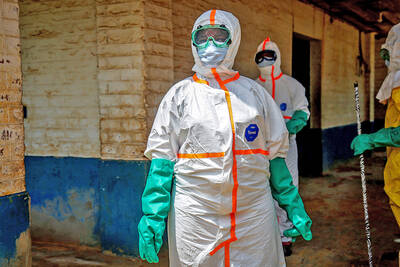
COMMUNITY CONFLICT: Concerns about disease spread from corpses has run up against friends and families’ desire to bury their dead as infection spreads in the area Angry residents of a town at the epicenter of the Ebola outbreak in the Democratic Republic of the Congo (DR Congo) attacked and burned a tent that was part of a health center where people are being treated for the virus, the staff there said Saturday. It was the second such attack in the region in a week. No one was hurt in the attack, according to reports but as patients ran out to escape the fire, 18 people with suspected Ebola infections fled the facility and are unaccounted for, a hospital director said. Angry residents arrived at the clinic in the

Forecasters in Europe yesterday warned of exceptional heat as record temperatures driven by a “heat dome” push temperatures well above seasonal norms across the continent. The surge follows a record-breaking Monday, with France logging its hottest day in the month of May on record, its weather agency said, and the UK also posting unprecedented highs. A so-called “heat dome” of warm air from northern Africa trapped under a high-pressure system over western Europe is behind the high temperatures not usually seen until high summer. Restrictions on outdoor work were imposed in parts of Italy, beaches in southwest France filled earlier than usual and


 RSS
RSS