


Amid tense relations with Tokyo, China yesterday marked the 68th anniversary of the start of World War II fighting against Japanese invaders with commemorations that mixed defiant official comments and the release of doves symbolizing peace.
A senior Communist Party leader, Li Changchun (
The event also was attended by several hundred soldiers and students who held a moment of silence for millions of Chinese war dead and released 3,000 gray doves.
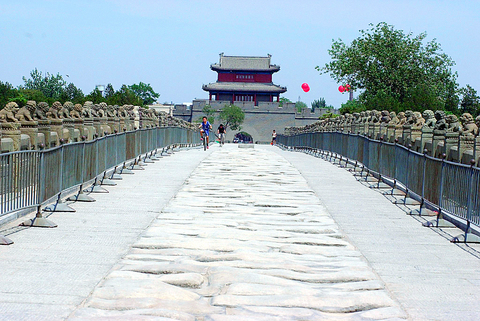
PHOTO: EPA
"The Chinese people, who refused to become slaves, rose up in arms and fought hard and tenaciously against Japanese aggressor troops, and won the complete victory against foreign aggression in modern times," Liu Yunshan, another senior party figure, said in a speech.
Commemorations this year come at a time when Beijing's relations with Tokyo are at their lowest point in decades. They have been soured by disputes over Japanese history textbooks, Tokyo's campaign for a permanent UN Security Council seat and rivalry over undersea oil and gas resources.
Beijing regards Tokyo as its main rival for status as the region's military power. The communist government regularly marks war anniversaries and keeps alive memories of Japanese aggression through schoolbooks and state media.
"The peace situation of today may not last forever," said Leng Jian, a soldier at the war memorial. "We should do good work in our positions and improve our physical capabilities and get ready for all kinds of changes in the world arena."
Beijing and Tokyo are linked by billions of dollars in trade, investment and aid. But many Chinese believe Japan has never properly atoned for suffering inflicted on its neighbors during Tokyo's conquest of Asia that began in the early 1930s and ended with its defeat in 1945.
"History is a mirror of present-day realities, and also a textbook teeming with philosophical wisdom," said Liu, the party official.
Beijing wants better relations with Tokyo, a Foreign Ministry official said.
"Harmony benefits both. Strife harms both," a ministry spokesman, Liu Jianchao (劉建超), said at a regular news briefing. However, he added: "We hope Japan takes a correct attitude toward history."
The 1937 fighting is regarded by historians as the start of World War II in China although Japan had controlled the country's northeast, then known as Manchuria, since 1933.
The ceremony yesterday included a ribbon-cutting for a new exhibition at the memorial hall with photos of Japanese wartime atrocities and a display of simulated Japanese chemical weapons.
"The exhibition will help rally national togetherness, boost national self-esteem, confidence and sense of pride and encourage Chinese sons and daughters of all ethnic groups at home and abroad to work relentlessly for China's great rejuvenation," Liu said.
Also yesterday, state media reported that two survivors of a 1937 massacre of civilians by Japanese soldiers in the eastern Chinese city of Nanjing have been found living in Spain and New Zealand.
Japanese forces killed as many as 300,000 people after Nanjing, then China's capital, fell to the invaders in December 1937.
"It's the first time we have found survivors outside China," Zhu Chengshan, curator of the Nanjing Memorial Hall for Compatriots Murdered in the Nanjing Massacre, said.
Lu Anli, 85, and Li Daokui, 73, live in Spain and New Zealand, respectively, and were among some 400 survivors believed to be alive.
"Their memories are the best evidence for the Japanese invaders' brutality," Zhu said.

PHISHING: The con might appear convincing, as the scam e-mails can coincide with genuine messages from Apple saying you have run out of storage For a while you have been getting messages from Apple saying “your iCloud storage is full.” They say you have exceeded your storage plan, so documents are no longer being backed up, and photos you take are not being uploaded. You have been resisting Apple’s efforts to get you to pay a minimum of £0.99 (US$1.33) a month for more storage, but it seems that you cannot keep putting off the inevitable: You have received an e-mail which says your iCloud account has been blocked, and your photos and videos would be deleted very soon. To keep them you need
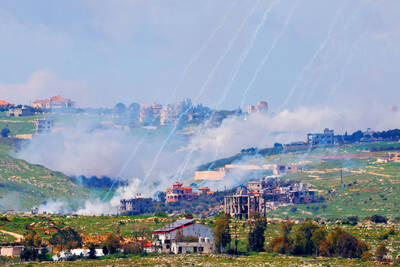
The Israeli military has demolished entire villages as part of its invasion of south Lebanon, rigging homes with explosives and razing them to the ground in massive remote detonations. The Guardian reviewed three videos posted by the Israeli military and on social media, which showed Israel carrying out mass detonations in the villages of Taybeh, Naqoura and Deir Seryan along the Israel-Lebanon border. Lebanese media has reported more mass detonations in other border villages, but satellite imagery was not readily available to verify these claims. The demolitions came after Israeli Minister of Defense Israel Katz called for the destruction of

A US YouTuber who caused outrage for filming himself kissing a statue commemorating Korean wartime sex slaves has been sentenced to six months in prison, a court in Seoul said yesterday. Johnny Somali, 25, gained notoriety several years ago for recording himself doing a series of provocative stunts in South Korea and Japan, and streaming them on platforms such as YouTube and Twitch. South Korean authorities indicted Somali — whose real name is Ramsey Khalid Ismael — in 2024 on public order violations and obstruction of business, and banned him from leaving the country. “The court has sentenced him to six months in
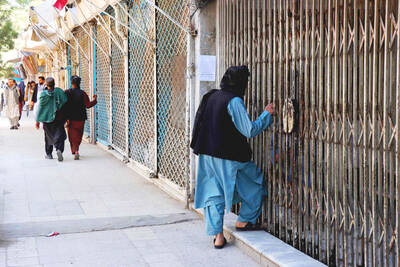
The death toll from a shooting in western Afghanistan rose to 11 on Saturday, after gunmen targeted civilians at a picnic spot in Herat, the provincial authority said. Bullet marks were visible on a wall of the Sayed Mohammad Agha Shia shrine, while bloodstains marked a blanket abandoned at the scene. “Eleven people have been recorded dead and eight others wounded from Friday’s incident, with the condition of two of the wounded reported as critical,” Herat’s information office said in a statement. The update raises a toll of seven killed provided on Friday by the Afghan Ministry of Interior Affairs


 RSS
RSS