


A surge in extortion rackets organized by foreign gangs has substantially increased the number of kidnappings in the capital, with the average now running at almost one a day.
The rate of kidnappings has risen sharply in the past seven or eight years. Half of all kidnappers and victims in the capital are foreign nationals, usually from the same ethnic group. Detective Chief Superintendent Sharon Kerr, who heads Scotland Yard's serious and organized crime unit, said the growing number of foreign criminal networks carrying out kidnaps in the city led to increasingly complex and high risk situations.
"They are bringing their criminal enterprises with them and their different methodologies," she said. It was vital to gain immigrant communities' trust to help combat gangsters in their midst.
A total of 358 kidnaps were reported in London last year, according to figures released by London's Metropolitan police (Met) on Tuesday. The Met's specialist kidnap unit -- the only one in the UK -- works on about 50-80 "live" kidnaps a year. There have been 31 cases this year, 55 last year, 85 in 2003 and 79 in 2002.
In the other 300 or so cases, police are only notified after a ransom has been paid and the victim freed, and the true figure could be much higher, as many underworld-linked crimes go unreported.
The involvement of so many foreign nationals in kidnaps means the Met often works with police forces in several different jurisdictions. For example, someone might be kidnapped in London and a ransom demand made in Pakistan.
Kidnapping is particularly prevalent in the Chinese, Afro-Caribbean, South Asian and Eastern European communities, where extreme violence and torture is common, often over relatively small amounts of money. Last year, a group of Lithuanian men seized a young Lithuanian after overhearing his accent in the pub. They beat him senseless and then scrolled down the numbers in his mobile phone, calling friends and relatives to demand ?200 (US$364).
Police rescued the critically injured victim, who spent weeks on a life support machine.
So far, the Met kidnap unit, set up in 2001, has had a 100 percent success rate in recovering people alive. Skilled negotiators work round the clock to try to secure victims' safe release. In as many as 80 percent of cases, armed officers storm the kidnappers' stronghold and rescue the victim. But bringing the kidnappers to justice is difficult, often because victims are too frightened to testify. The prosecution rate for kidnap is just 20 percent, although many perpetrators are jailed for related offenses.
However, Sir Ian Blair, the Scotland Yard commissioner, said yesterday the Met is talking to the Home Office and Crown Prosecution Service to try to get more kidnap cases to court without the victims having to give evidence, in line with recent policy changes on domestic violence.
Most kidnaps are crime-related -- 29 percent are clearly linked to drugs, and another 36 percent are motivated by drugs or other crime.
But the vast majority of victims are usually innocent parties. For instance, a drug supplier may get his gang of "enforcers" to seize the younger brother of a drug dealer who owes him money.
Another 19 percent of kidnaps the Met deals with involve human trafficking, often of young east European or Asian women brought into the country illegally and then sold as sex slaves. In some cases, money is extorted from their families in China, Europe or elsewhere.

SPEAKING OUT: After Siranudh Scott’s allegations surfaced, celebrities and public figures took to social media to share their own experiences of sexual misconduct and abuse A high-profile alleged sexual abuse case within a wealthy Thai beer brewing family has prompted a wave of painful accounts from survivors of unconnected abuse in the conservative nation. Siranudh Scott, a member of the billionaire Thai family that founded the ubiquitous Singha beer brand, posted an emotional video this month accusing his elder brother Sunit of repeatedly abusing him when he was a teenager. Sunit, who is in his 30s, later denied the allegations in a video posted online, but Singha parent Boonrawd dismissed him from his executive role with the company on Tuesday last week. “I felt I needed to speak

A Hong Kong astronaut is to join a Chinese space mission for the first time as part of a three-person crew launching today, as Beijing edges closer to its goal of landing people on the moon. The Tiangong space station — crewed by teams of three astronauts that are typically rotated every six months — is the crown jewel of China’s space program, boosted by billions in state investment in a bid to catch up with the US and Russia. The Shenzhou-23 mission is to blast off at 11:08pm from the Jiuquan Satellite Launch Center in northwestern China, carrying three astronauts to
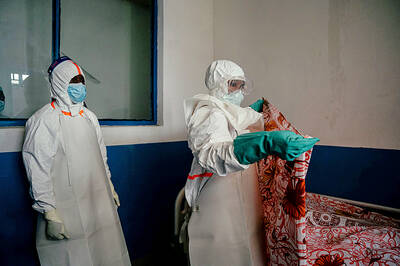
UPGRADED ALERT: The risk inside DR Congo is now considered ‘very high,’ while neighboring countries face a ‘high’ threat as the outbreak continues, the WHO said Ebola is spreading faster than responders can track it in eastern Congo, where health workers managed to follow up with barely one in five identified contacts in a single day. Authorities in the Democratic Republic of the Congo (DR Congo) reported 83 confirmed infections, 746 suspected cases and 1,603 identified contacts as of Thursday, but health workers were able to follow up on only 342 contacts that day — about 21 percent of the total under monitoring — data released by the DR Congo Ministry of Public Health on Friday showed. The figures suggest the response is falling behind the outbreak itself,

SEEKING ORDER: Rodrigo Paz said that ‘anyone who wants to destroy the nation will have to deal with this president and the full force of the constitution’ Bolivian President Rodrigo Paz on Wednesday said that the nation was at a “breaking point” after nearly a month of protests that have caused shortages of food, fuel and medicine. Paz, who took office six months ago amid the worst economic crisis there in four decades, is battling a groundswell of fury over his policies. The political capital, La Paz, has been besieged by low-income workers and members of the indigenous majority calling for his resignation. “The country needs order and is reaching breaking point,” the 58-year-old said at a public event in La Paz, renewing his appeal for dialogue. On Tuesday, the Bolivian


 RSS
RSS