


Uzbekistan's autocratic leader Islam Karimov faced increasing international pressure yesterday as the reported toll from a military crackdown in the eastern town of Andizhan rose to 745.
Four days after soldiers fired into crowds protesting against Karimov's iron-fisted rule over this Central Asian nation, the Soviet-era leader found himself facing rare tough words from the US, which considers him an ally in its war on terror.
US State Department spokesman Richard Boucher said late Monday that the US was "deeply disturbed" by the reported violence.
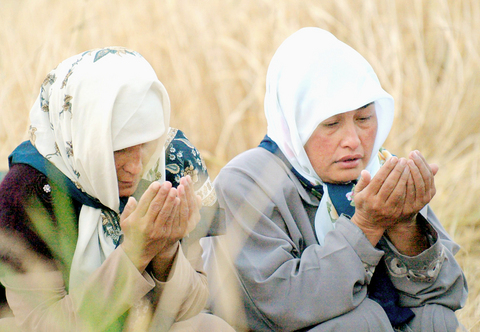
PHOTO: AFP
"We had urged and continue to urge the Uzbek government to exercise restraint, stressing that violence cannot lead to long-term stability," Boucher told reporters.
The comments came on the heels of two days of statements by Britain's Foreign Minister Jack Straw, which called the Andizhan violence "a clear abuse of human rights" and "totally condemned" the alleged firing on civilians by Uzbek soldiers.
The UN has also called for restraint following the clashes. The Swiss government said it would review its development aid contributions for Tashkent, some 11.5 million Swiss francs (US$9.4 million) for this year.
In one of the first public protests following the violence, 15 supporters of the Free Farmers party, a secular opposition group, gathered in front of the US embassy in Tashkent yesterday.
"The United States is partly to blame for the situation in Uzbekistan because they supported, and support, the Uzbek regime," said Akhtam Shaimadanov, one of the organizers.
However, he added that the protesters had chosen the site of the US embassy because they had less reason to fear retribution from the Uzbek authorities, in full view of their US allies.
"We would be beaten if we had this protest near a government building -- we had it here because the Uzbek authorities don't want to spoil their reputation," he said.
The Free Farmers party yesterday said that as many as 745 people had been killed in Friday's clashes in Andizhan, based on a survey of residents in the city and its suburbs, the highest toll so far from the violence.
"We started house-to-house checks two days ago and this figure of 745 was for yesterday [Monday]. Today we're checking again and it might be more," the group's leader Nigara Hidoyatova said.
The latest official government toll, given by Karimov last Saturday, suggested as few as 30 people had died in the clashes.
In Andizhan, where the authorities have stepped up security measures, renewed gunfire was heard for several hours overnight.
The bloodshed in Andizhan started early Friday, when weeks of demonstrations over the trial of 23 local businessmen accused of belonging to an outlawed Islamic group boiled over. After armed backers of the accused stormed a prison and freed them, along with some 2,000 other prisoners, troops opened fire into the crowds at an anti-government rally.
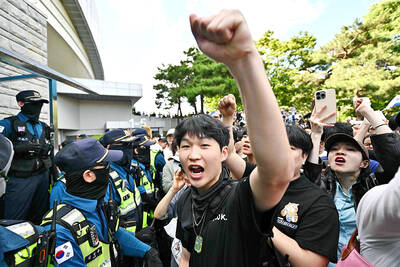
‘ABSURD MISTAKE’: The election commission said that there had been a failure to anticipate turnout after 14 polling stations ran short of ballot papers South Korean riot police yesterday cleared protesters from a Seoul polling station after a 35-hour blockade sparked by a shortage of ballot papers during local elections earlier this week. Wednesday’s election was the first nationwide vote since South Korean President Lee Jae-myung took office following the ouster of Yoon Suk-yeol over his short-lived martial law declaration. Lee’s ruling Democratic Party swept most races, but failed to flip the crucial Seoul mayoral seat. The South Korean National Election Commission apologized, blaming a failure to anticipate turnout after 14 polling stations in Seoul ran short of ballot papers. Some polling stations stayed open until 10pm to

France experienced its hottest spring on record, the French weather service said on Tuesday, after an exceptional early heat wave that also broke highs for the season in England and Wales. Meteo-France said the average nationwide temperature over March to May was 13.8°C — about 1.7°C above the norm, and surpassing records set in 2011 and 2020. “The warmest spring since records began in 1900,” it said in a bulletin. All three months were warmer than average, but the onset of an “unprecedented heatwave” late last month pushed the mercury to highs typically seen at the height of the summer. “Our country had never
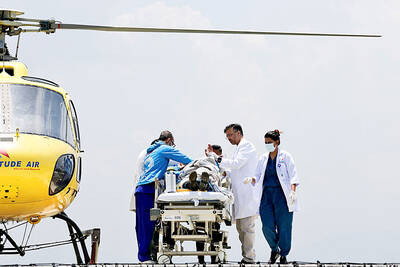
A Sherpa guide was found crawling to base camp on Mount Everest a week after he went missing and was reunited with his family, who had given up hope he would return. Dawa Sherpa was last seen on Friday last week descending the mountain, but he did not reach base camp even though his client did. The pair were among the last climbers on the mountain as the climbing season came to an end and the route was dismantled. Dawa was located by a cleaning crew on Thursday morning as he was crawling down the snowy slopes around the Khumbu Icefall, just above
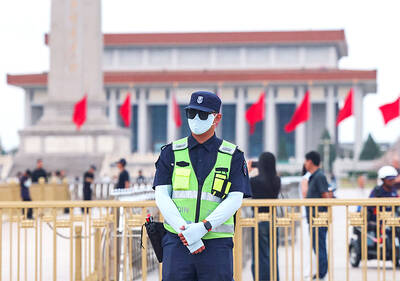
Chinese authorities are snuffing out any remembrance of the deadly 1989 military crackdown on student-led pro-democracy protests in Tiananmen Square, which happened 37 years ago yesterday, in a further tightening of a years-long campaign to erase what happened from public memory. Police told relatives of the victims they would not be allowed to visit a cemetery in Beijing on the anniversary of the crackdown, a person with knowledge of the matter said. Relatives of the victims visited the cemetery on the anniversary for more than 30 years to read memorial statements with police keeping watch, Amnesty International said. Hundreds of people,


 RSS
RSS