


Syria's troop presence in Lebanon reached its lowest level in three decades as 2,000 more soldiers returned home in recent days, the Lebanese military said on Monday. The move puts Damascus on track to have all its forces out before Lebanese parliamentary elections in May -- a key US and UN demand.
Despite the continued troop withdrawal, pressure mounted against Syria and its allied Lebanese government.
Lebanon's acting Foreign Ministry chief, Butros Asaker, flew to New York to attend a UN Security Council session aimed at forming an international inquiry into former Lebanese premier Rafik Hariri's Feb. 14 assassination.
Lebanon has grudgingly agreed to go along with a UN-led inquiry, which has the potential to embarrass both Syrian and Lebanese authorities, who many here believe were involved in Hariri's death. Both governments deny such claims.
A UN fact-finding mission has already criticized Syria for creating the conditions for Hariri's death and poured scorn on the Lebanese investigation into the killing.
Some 5,000 female activists staged a noisy march in downtown Beirut demanding Syria end its control over Lebanon, which stretches back to the early stages of this country's 1975-'90 civil war.
"Syria get out of Lebanon," shouted the women while walking about 1km from the seafront street where Hariri's motorcade was blown up to his grave in Martyrs' Square.
Syria is believed to have about 8,000 troops in eastern Lebanon following the return home of 2,000 soldiers during recent days, a Lebanese military official said on condition of anonymity. Immediately before Hariri's death, about 14,000 Syrian troops were in Lebanon. At their peak they numbered about 40,000.
Also Monday, Syrian soldiers dismantled eight positions near the eastern city of Baalbek, while about 25km to the north in Chaat, more troops loaded goods into 10 trucks, each towing an anti-aircraft gun.
The official said the Lebanese-Syrian Military Commission will meet next week to agree on the second phase of the military withdrawal, which is expected to see the complete removal of Syrian forces from Lebanon. About 4,000 soldiers left in the withdrawal's first phase that ended on March 17.
Pro-Syrian Lebanese Defense Minister Abdul Rahim Murad said the pullout will continue "until all the Syrian army has entered Syrian territory."
The UN and Washington are demanding a full Syrian withdrawal before Lebanese parliamentary elections due to begin in April and go through May.
"The full pullout from Lebanon will remove any pretext claiming that Syria influences Lebanese elections," Syrian political analyst Imad Fawzi al-Shueibi said.
"Syria wants to push away any possibility of being a target" for US or international pressures, he added.
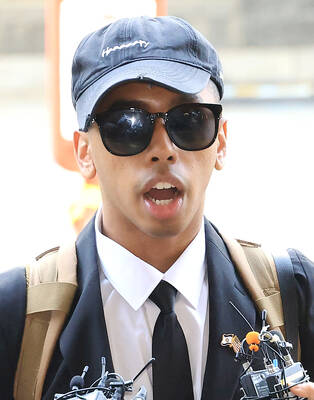
A US YouTuber who caused outrage for filming himself kissing a statue commemorating Korean wartime sex slaves has been sentenced to six months in prison, a court in Seoul said yesterday. Johnny Somali, 25, gained notoriety several years ago for recording himself doing a series of provocative stunts in South Korea and Japan, and streaming them on platforms such as YouTube and Twitch. South Korean authorities indicted Somali — whose real name is Ramsey Khalid Ismael — in 2024 on public order violations and obstruction of business, and banned him from leaving the country. “The court has sentenced him to six months in

Former Lima mayor Rafael Lopez Aliaga, a Peruvian presidential hopeful, gathered hundreds of supporters in Lima on Tuesday and gave authorities 24 hours to annul the first round of the country’s election over allegations of fraud. Lopez Aliaga is locked in a tight three-way race with two other candidates for second place in Sunday’s vote. The election runner-up wins a ticket to June’s presidential run-off against front-runner Keiko Fujimori. “I am giving them 24 hours to declare this electoral fraud null and void,” said Lopez Aliaga, surrounded by a crowd of several hundred supporters. “If it is not declared null and void tomorrow,

PAPAL RETORT: Pope Leo told reporters that he has ‘no fear, neither of the Trump administration nor speaking out loudly about the message of the Gospel’ US President Donald Trump has feuded with Pope Leo XIV over the Iran conflict — setting off an unholy row that could have serious political implications for the Republican leader back in the US. Trump has drawn barbs even from some allies over the attacks on the US-born pontiff, who has criticized the Trump administration over its immigration crackdown, the intervention in Venezuela and the Iran war. The president risks alienating the religious right in November’s crucial US midterm elections. So far the unprecedented clash between the leader of the most powerful military on Earth and the head of the world’s 1.4 billion

A 16-year-old boy has been charged with murder and aggravated sexual abuse in Florida in the death of his 18-year-old stepsister on a Carnival Cruise ship, the US Department of Justice said on Monday. Timothy Hudson was initially charged in February and subsequently indicted on March 10, but the breadth of the case was not known until a seal was lifted on Friday last week, weeks after US District Judge Beth Bloom in Miami said that he would be prosecuted as an adult at the request of the government. Anna Kepner had been traveling on the Carnival Horizon ship in November last


 RSS
RSS