

Militants carried out a string of deadly attacks, including four car bombings that alone killed 19 people and the assassination of a senior Iraqi military official. Shiite and Kurdish officials were trying to undermine the insurgency by stepping up talks with Sunnis and others to bring them on board for a new government.
On Saturday, the US military said a Marine was killed in action in a restive central province.
The interim government's deputy prime minister, Barham Saleh, said Friday that negotiators are intensifying efforts to bring in the country's Sunni Arabs, believed to form the core of Iraq's rebellion. That has caused delays, leading to public frustration with the nascent political process.
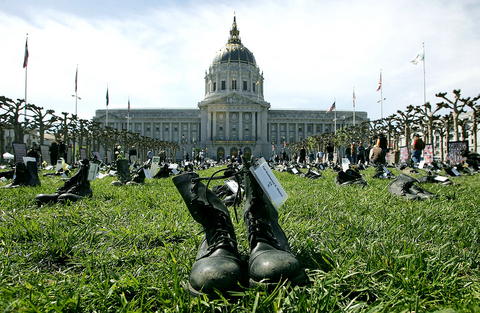
PHOTO: AFP
"It is not acceptable that two months on from the elections, that Iraq does not have a transitional government yet," Saleh said. "We are under pressure, and we have to respond to public sentiment and have a government established as soon as possible."
He said the next National Assembly meeting would likely be Monday to elect a speaker, although it hadn't been decided yet if the president -- expected to be Kurdish leader Jalal Talabani -- would be announced.
Later, Jawad al-Maliki, a negotiator from the Shiite-led United Iraqi Alliance, said Shiite and Kurdish officials agreed to hold the second National Assembly session on Tuesday.
Insurgents trying to undermine the formation of a new government, meanwhile, seemed to intensify their attacks, carrying out four suicide car bombings across Iraq that killed 17 Iraqi security officials and two civilians. Militants have stepped up attacks against Iraqi police and soldiers who are key to an eventual US withdrawal.
Twin suicide car bombings Friday in Iskandriyah, targeted an Iraqi army convoy and police barracks and killed four policemen, two civilians and an Iraqi soldier, police said.
Another suicide car bombing Friday targeted an Iraqi convoy south of Baghdad and left one Iraqi soldier dead and four others injured.
Late Thursday at a checkpoint in the central city of Ramadi, a white sedan was blown up, killing 11 Iraqi soldiers and injuring 14 people -- including two US Army soldiers, nine Iraqi security forces, and three civilians -- the US military said. The Islamic Army in Iraq posted a statement on the Ansar Web site claiming responsibility.
Another car bomb exploded Friday in the city's center. It targeted a US-Iraqi convoy, but only killed the two attackers in the car.
In Baghdad on Friday, unknown gunmen killed Colonel Salman Muhammad Hassan and injured two of his sons as they left a relative's funeral in Baghdad, security officials said. Police also said Friday they found two decapitated bodies clad in Iraqi army uniforms a day earlier on a road north of Baghdad.
The US military announced Saturday that US Marine was killed in action during a "security and stability" operation in a restive central Iraq province.
As of Friday, at least 1,524 members of the US military have died since the beginning of the Iraq war in March 2003, according to an Associated Press count.
On a road near Kirkuk, attackers ambushed a Defense Ministry officer, identified only as Colonel Sarajeddin, and kidnapped him, Iraqi army Major General Anwar Mohammed Amin said.
Thursday in the capital, five female translators who worked for the US military were gunned down by insurgents as they returned home from work, police Captain Ahmed Aboud said.
Near Abu Ghraib, firefighters worked to extinguish an oil-pipeline blaze ignited by insurgents' bombs. The conduit connects Iraq's northern oil fields with a Baghdad-area refinery.

A Chinese artificial intelligence (AI) cybersecurity tool called ARTEX was used in a spate of recent hacks of Japanese companies, the subsidiary of a major Tokyo-based Internet company yesterday. Dozens of Japanese companies, from restaurant chains to a car hire operator, have disclosed unauthorized access or data breaches in the past weeks — potentially impacting millions of customers. The information security arm of GMO Internet Group Inc said it had “confirmed ARTEX was used” having investigated the attacks in collaboration with external organizations. “It also became clear ... the attacks were almost exclusively targeting Japan,” GMO cybersecurity center director Daiki

China’s first fully artificial intelligence (AI)-generated feature film opened in cinemas yesterday in what promised to be a tough box-office test for the country’s booming tech industry as advance ticket sales lag. More than 10,000 screenings of the sci-fi thriller Sanxingdui: Future Past were scheduled yesterday, according to ticketing platform Maoyan. However, public reception has been less than enthusiastic. Presale revenue as of yesterday morning was 80,000 yuan (US$11,992), while total box-office takings were forecast to remain below 150,000 yuan, only a fraction of the reported production cost, Maoyan said. Ticket prices range from 20 to 90 yuan, bringing the number sold to a
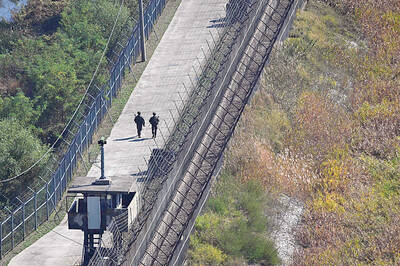
A STEP UP: The moving of small military positions forward should be taken seriously amid the North’s recent demonstrations of its firepower, an analyst said North Korea has moved new units into “firing positions,” the sister of leader Kim Jong-un said yesterday, days after Pyongyang warned it was considering deploying additional strike means to its border with South Korea. Tensions between Seoul and Pyongyang have soared since the South last month blamed an explosion inside the heavily fortified demilitarized zone (DMZ) separating the two countries on landmines laid by North Korea, an accusation it has rejected. “Our military leadership underlined the need to make those rogues aware that our new firepower units have taken their firing positions,” state media cited Kim Yo-jong as saying. Her statement came a
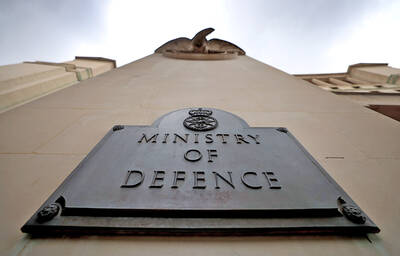
Thousands of British and French troops have taken part in a military training exercise that included one of Britain’s largest airborne operations in two decades, the British government said yesterday. The war game is designed to show how NATO countries could be defended against a modern-day attack and comes during fears about Russian aggression in Europe amid Moscow’s war against Ukraine. About 2,500 troops were involved in the seven-week exercise, in which 600 British and French paratroopers dropped from four RAF A400M Atlas transport aircraft over Germany. The exercise called Rhino Titan, held at the Sennelager military training center in


 RSS
RSS