


A UN report into the killing of former Lebanese Prime Minister Rafik Hariri demanded a new international investigation after determining that Lebanon's authorities bungled, if not outright manipulated, their probe of the killing.
The report did not directly blame Syria for the assassination of Hariri, an opponent of the Syrian presence in Lebanon, but said Damascus was behind the political tension and weak security that led to his death with 17 other people in a huge explosion on Feb. 14.
Power struggle
"Clearly, Mr. Hariri's assassination took place on the backdrop of his power struggle with Syria, regardless of who carried out the assassination and with what aim," the report said.
The UN-backed investigation, led by deputy Irish police commissioner Peter Fitzgerald, was launched to help get to the bottom of Hariri's killing.
Opposition leaders and foreign officials had feared he was killed for opposing pro-Syrian President Emile Lahoud, who was allowed to stay in office for another term after Parliament rewrote the constitution with Syria's approval.
Hariri had also supported Security Council Resolution 1559, which demanded Syria withdraw its forces from Lebanon. It also said the council hoped Lebanon's upcoming elections would be free of foreign influence -- a reference to Syria, which has held enormous political influence in Lebanon since its troops entered the country in 1976.
Withering criticism
While Fitzgerald's report accuses Syria of creating the conditions for Hariri's death, it reserves withering criticism for Lebanese authorities who handled the case.
The report says there was a "distinct lack of commitment" by the authorities to investigate the crime, and the probe was not carried out "in accordance with acceptable international standards."
It detailed a host of flaws, including the disappearance of crucial evidence and tampering with the scene of the blast that killed Hariri and at least 17 others.
Parts of a pickup truck were brought to the scene, placed in the crater and photographed as evidence, it said.
The report alleged investigative judges had no control over the probe and even faulted police for not turning off a water main that flooded the blast crater and washed away vital evidence.
Studying the aftermath of the bombing, Fitzgerald's team also cast serious doubts on the legitimacy of a suspect in the bombing.
Fitzgerald also faulted Syria for interfering in the governing of Lebanon "in a heavy-handed and inflexible manner."
Physical harm
He said his investigators also received testimony that Syrian President Bashar Assad had threatened Hariri and leading opposition figure Walid Jumblatt with physical harm.
Syria's UN Ambassador Fayssal Mekdad rejected the report, saying it contained "too much rhetoric."
He denied his country had any role in Hariri's assassination.
Fayssal called Hariri a "great ally of Syria" and instead blamed the UN Security Council for passing Resolution 1559.
"We think that things were going on well in Lebanon until a certain development that has taken place here in this building when one, two countries pushed the council to adopt a resolution that was not called for," Mekdad said.
In Washington, the State Department supported the recommendation for an international commission to investigate the attack.
In a letter accompanying the report, Annan expressed full support for the findings. He backed its recommendation for an international independent commission with the authority to interrogate witnesses, conduct searches and other tasks.
Lebanon's opposition and Hariri's family have insisted on an international investigation, saying they have no trust in the Lebanese probe.
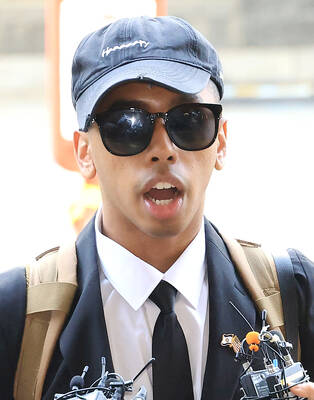
A US YouTuber who caused outrage for filming himself kissing a statue commemorating Korean wartime sex slaves has been sentenced to six months in prison, a court in Seoul said yesterday. Johnny Somali, 25, gained notoriety several years ago for recording himself doing a series of provocative stunts in South Korea and Japan, and streaming them on platforms such as YouTube and Twitch. South Korean authorities indicted Somali — whose real name is Ramsey Khalid Ismael — in 2024 on public order violations and obstruction of business, and banned him from leaving the country. “The court has sentenced him to six months in

Former Lima mayor Rafael Lopez Aliaga, a Peruvian presidential hopeful, gathered hundreds of supporters in Lima on Tuesday and gave authorities 24 hours to annul the first round of the country’s election over allegations of fraud. Lopez Aliaga is locked in a tight three-way race with two other candidates for second place in Sunday’s vote. The election runner-up wins a ticket to June’s presidential run-off against front-runner Keiko Fujimori. “I am giving them 24 hours to declare this electoral fraud null and void,” said Lopez Aliaga, surrounded by a crowd of several hundred supporters. “If it is not declared null and void tomorrow,

PAPAL RETORT: Pope Leo told reporters that he has ‘no fear, neither of the Trump administration nor speaking out loudly about the message of the Gospel’ US President Donald Trump has feuded with Pope Leo XIV over the Iran conflict — setting off an unholy row that could have serious political implications for the Republican leader back in the US. Trump has drawn barbs even from some allies over the attacks on the US-born pontiff, who has criticized the Trump administration over its immigration crackdown, the intervention in Venezuela and the Iran war. The president risks alienating the religious right in November’s crucial US midterm elections. So far the unprecedented clash between the leader of the most powerful military on Earth and the head of the world’s 1.4 billion

A 16-year-old boy has been charged with murder and aggravated sexual abuse in Florida in the death of his 18-year-old stepsister on a Carnival Cruise ship, the US Department of Justice said on Monday. Timothy Hudson was initially charged in February and subsequently indicted on March 10, but the breadth of the case was not known until a seal was lifted on Friday last week, weeks after US District Judge Beth Bloom in Miami said that he would be prosecuted as an adult at the request of the government. Anna Kepner had been traveling on the Carnival Horizon ship in November last


 RSS
RSS