


After 20 years of torment for victims' families, a Canadian court today will hand down a verdict on two Sikhs accused of planting a bomb which reaped 329 lives as it tore through an Air India jet.
Justice Ian Bruce Josephson will pass judgement in a blast-resistant courtroom on the world's worst airborne terror strike prior to the Sept. 11 attacks.
The two accused, Ajaib Singh Bagri and Ripudaman Singh Malik will learn their fate on eight charges of murder and conspiracy, watched by dozens of relatives of the victims.
Josephson's judgement comes after a dramatic trial, replete with tales of religious passion, intrigue and jilted lovers undercut by the sombre memory of hundreds of innocent civilians who perished.
Malik and Bagri, orthodox Sikhs who immigrated to Canada from Punjab, are accused of conspiring to plant suitcase bombs on two aircraft.
During the 19-month trial which Josephson heard without a jury, prosecutors contended that Malik, a millionaire Vancouver businessman, and Bagri, a rural millworker, were part of a radical Sikh group based on Canada's west coast.
Their mission was to punish India for its crackdown on Sikhs in the early 1980s and the armys attack on the Sikh Golden Temple at Amritsar, prosecutor Robert Wright told the court.
At the time, Sikhs worldwide were also campaigning for an independent homeland, to be called Amritsar.
Prosecutors presented evidence they said proved the Sikh group built suitcase bombs on Vancouver Island, bought airplane tickets, then planted the explosives on two flights from Vancouver that connected with Air India planes.
The first bomb exploded June 23, 1985, at Japan's Narita airport, killing two baggage handlers transferring suitcases to Air India Flight 201.
Some 54 minutes later, a second bomb exploded in the baggage hold of Air India Flight 182. All 329 people aboard the Jumbo Jet died over the Atlantic, off the coast of Ireland.
Malik and Bagri were not charged until 2000, along with a third man, Inderjit Singh Reyat.
Reyat had earlier been convicted in the Narita explosion and sentenced to 10 years, before he was charged with the bomb on Flight 182. In 2003, just before the trial was to begin, Reyat pleaded guilty to manslaughter, and is serving a five-year sentence.
Another immigrant to Canada, Tarwinder Singh Parma, was the alleged mastermind of the plot and died in a 1992 police shootout in India.
For the families of the Air India victims, the long wait for justice has been grueling. The 15-year international investigation was marred with controversies and setbacks, including the revelation that Canadian intelligence agents erased wiretap evidence.
The trial spread over 19 months, and several witnesses who were expected to provide key testimony suffered attacks of amnesia.
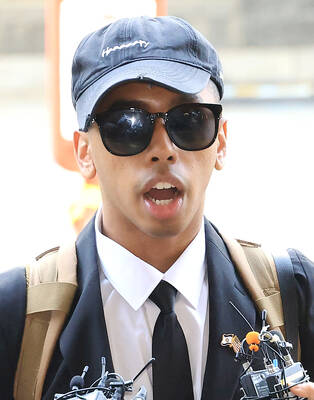
A US YouTuber who caused outrage for filming himself kissing a statue commemorating Korean wartime sex slaves has been sentenced to six months in prison, a court in Seoul said yesterday. Johnny Somali, 25, gained notoriety several years ago for recording himself doing a series of provocative stunts in South Korea and Japan, and streaming them on platforms such as YouTube and Twitch. South Korean authorities indicted Somali — whose real name is Ramsey Khalid Ismael — in 2024 on public order violations and obstruction of business, and banned him from leaving the country. “The court has sentenced him to six months in
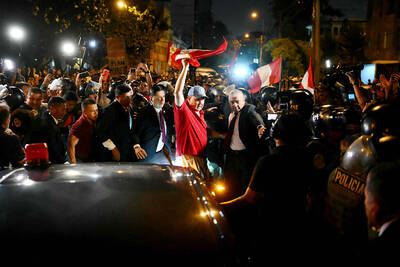
Former Lima mayor Rafael Lopez Aliaga, a Peruvian presidential hopeful, gathered hundreds of supporters in Lima on Tuesday and gave authorities 24 hours to annul the first round of the country’s election over allegations of fraud. Lopez Aliaga is locked in a tight three-way race with two other candidates for second place in Sunday’s vote. The election runner-up wins a ticket to June’s presidential run-off against front-runner Keiko Fujimori. “I am giving them 24 hours to declare this electoral fraud null and void,” said Lopez Aliaga, surrounded by a crowd of several hundred supporters. “If it is not declared null and void tomorrow,

PAPAL RETORT: Pope Leo told reporters that he has ‘no fear, neither of the Trump administration nor speaking out loudly about the message of the Gospel’ US President Donald Trump has feuded with Pope Leo XIV over the Iran conflict — setting off an unholy row that could have serious political implications for the Republican leader back in the US. Trump has drawn barbs even from some allies over the attacks on the US-born pontiff, who has criticized the Trump administration over its immigration crackdown, the intervention in Venezuela and the Iran war. The president risks alienating the religious right in November’s crucial US midterm elections. So far the unprecedented clash between the leader of the most powerful military on Earth and the head of the world’s 1.4 billion

A 16-year-old boy has been charged with murder and aggravated sexual abuse in Florida in the death of his 18-year-old stepsister on a Carnival Cruise ship, the US Department of Justice said on Monday. Timothy Hudson was initially charged in February and subsequently indicted on March 10, but the breadth of the case was not known until a seal was lifted on Friday last week, weeks after US District Judge Beth Bloom in Miami said that he would be prosecuted as an adult at the request of the government. Anna Kepner had been traveling on the Carnival Horizon ship in November last


 RSS
RSS