


Europe's leading nations, yielding to US demands for a tougher stance on Iran, warned on Friday that any failure by the Iranian government to give up its suspected nuclear arms program would leave them "no choice" but to seek punishments at the UN Security Council.
The European warning came as a diplomatic counterpart to a statement by Secretary of State Condoleezza Rice confirming that the US, too, had shifted its position on Iran -- in its case toward a more conciliatory approach of offering limited economic incentives if Iran cooperated on nuclear matters.
Rice said that US President George W. Bush would drop his objections to Iran's application to the WTO and would "consider, on a case-by-case basis, the licensing of spare parts of Iranian civilian aircraft."
"We share the desire of European governments to secure Iran's adherence to its obligations through peaceful and diplomatic means," she said in the statement.
"Today's announcement demonstrates that we are prepared to take practical steps to support European efforts to this end," Rice said.
Taken together, the statements, issued in an orchestrated fashion in Washington and Brussels, Belgium, opened a new phase in efforts to defuse the crisis over Iran's nuclear program.
Now that Europe and the US are in harmony on specific incentives and threats, there is an expectation that talks can move forward. In the last two years, Iran's nuclear program has moved up on the agenda for the US and Europe, but there has been a gulf over how sternly to deal with it.
European officials said the agreement's importance went beyond Iran, because it showed that Bush had decided to throw his support behind the effort. What that also represented, some in the administration acknowledged, was a White House move to restrain administration hawks for now.
Rice and other officials acknowledged that Bush moved only after becoming convinced that he was in danger of being blamed if the talks failed because he had repeatedly rebuffed European demands to join in the incentives.
The administration has been sensitive to the charge by conservatives and others that going too far to placate the Europeans could put the administration in the position of legitimizing Iran's government, overlooking its links to terrorism, and rewarding it for bad behavior.
But Rice and other officials said the administration's view of Iran as a rogue state was unchanged. All that had changed, she said, was the way of dealing with Iran.
No timetable was set for negotiations. Rice and other officials hinted that a quick deadline might force Iran to walk away and resume suspended uranium enrichment.
A European official, endorsing that view, said, "Iran right now has suspended its activities, verified by inspections. That means we don't have to be in such a hurry. If the Iranians try to cheat, we're in a position to know it."
US and European officials also emphasized on Friday that their joint agreement meant that, at some point in the talks, the West would raise concerns about Iran's support of Hezbollah and other groups.
The announcements, a culmination of weeks of negotiations led by Rice, clarified aspects of her talks. For example, US and European officials said the statements made clear that the West would not tolerate Iran enriching uranium for civilian nuclear energy, despite international accords that allow it.

SPEAKING OUT: After Siranudh Scott’s allegations surfaced, celebrities and public figures took to social media to share their own experiences of sexual misconduct and abuse A high-profile alleged sexual abuse case within a wealthy Thai beer brewing family has prompted a wave of painful accounts from survivors of unconnected abuse in the conservative nation. Siranudh Scott, a member of the billionaire Thai family that founded the ubiquitous Singha beer brand, posted an emotional video this month accusing his elder brother Sunit of repeatedly abusing him when he was a teenager. Sunit, who is in his 30s, later denied the allegations in a video posted online, but Singha parent Boonrawd dismissed him from his executive role with the company on Tuesday last week. “I felt I needed to speak

SEEKING ORDER: Rodrigo Paz said that ‘anyone who wants to destroy the nation will have to deal with this president and the full force of the constitution’ Bolivian President Rodrigo Paz on Wednesday said that the nation was at a “breaking point” after nearly a month of protests that have caused shortages of food, fuel and medicine. Paz, who took office six months ago amid the worst economic crisis there in four decades, is battling a groundswell of fury over his policies. The political capital, La Paz, has been besieged by low-income workers and members of the indigenous majority calling for his resignation. “The country needs order and is reaching breaking point,” the 58-year-old said at a public event in La Paz, renewing his appeal for dialogue. On Tuesday, the Bolivian
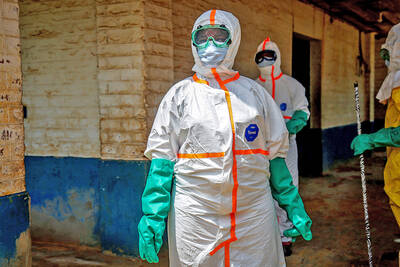
COMMUNITY CONFLICT: Concerns about disease spread from corpses has run up against friends and families’ desire to bury their dead as infection spreads in the area Angry residents of a town at the epicenter of the Ebola outbreak in the Democratic Republic of the Congo (DR Congo) attacked and burned a tent that was part of a health center where people are being treated for the virus, the staff there said Saturday. It was the second such attack in the region in a week. No one was hurt in the attack, according to reports but as patients ran out to escape the fire, 18 people with suspected Ebola infections fled the facility and are unaccounted for, a hospital director said. Angry residents arrived at the clinic in the
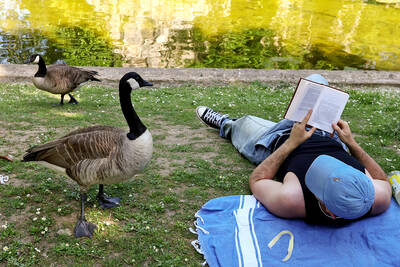
Forecasters in Europe yesterday warned of exceptional heat as record temperatures driven by a “heat dome” push temperatures well above seasonal norms across the continent. The surge follows a record-breaking Monday, with France logging its hottest day in the month of May on record, its weather agency said, and the UK also posting unprecedented highs. A so-called “heat dome” of warm air from northern Africa trapped under a high-pressure system over western Europe is behind the high temperatures not usually seen until high summer. Restrictions on outdoor work were imposed in parts of Italy, beaches in southwest France filled earlier than usual and


 RSS
RSS