


Iraq's religious leaders called for calm yesterday amid fears of revenge attacks one day after a suicide bomber killed 47 Iraqis and wounded more than 80 in a packed Shiite funeral tent in Mosul.
Grieving families cancelled a planned public funeral procession for the victims in the northern city after a mortar shell early yesterday slammed into the site of the carnage 24 hours earlier.
Sunni Muslim leaders, fearful of reprisals, urged calm in the city.
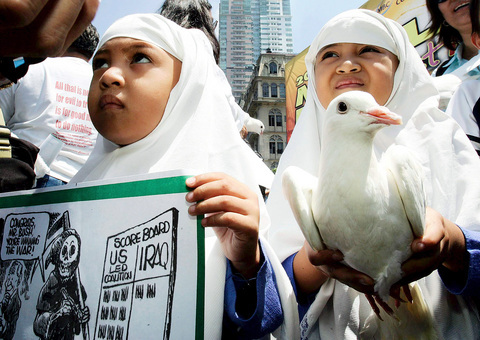
PHOTO: EPA
"It was a terrorist attack meant to spark civil war but I think the Sunnis and Shiites will not succumb," said Nureddine Hayali, a spokesman for the Islamic Party.
Iraq's Shiite clerics urged cool heads after the latest calamity.
The office of Grand Ayatollah Ali al-Sistani, the spiritual guide for Iraq's Shiites, said the revered cleric was calling for "unity and solidarity among all Iraqis despite the attacks targeting the innocent."
Sistani has consistently denounced vigilante justice against Iraq's Sunnis, perceived as fuelling the insurgency, whom the 15-million strong Shiite majority blames for many attacks carried out against it.
Mosque struck
The bomber struck on Thursday as mourners gathered next to the Sadreen mosque, where a service was being held for Hisham al-Araji, the Mosul representative for radical Shiite leader Moqtada Sadr.
Shiite cleric Sayed Jassem Mohamed recalled the moment when the explosion shredded a jammed funeral tent at 5:20pm.
"A ball of fire shot out, followed by falling debris, and panic swept the outdoor tent next to the Sadreen mosque," Jassem said.
"Volunteers started to put out the flames while others evacuated the dead and the wounded from the middle of the tent, which was destroyed by the blast."
Doctors put the dead at 47 and the wounded at 81.
In Mosul, residents expressed their anger.
"Who pretends this is holy war? The authors of this cowardly attack are looking to destroy Iraq and push it into the abyss," said Jalal Qassem, a doctor.
Sunni Muslim Arabs make up about half of Mosul's 1.5 million population, while the rest are divided among Kurds, Turkmen, Shiites, Christians and other groups.
The city is a stronghold of Islamic militant fighters and former regime loyalists. It has been gripped by violence since November when rebels launched an offensive and police abandoned their posts.
Coalition planned
The latest blow for Iraq's majority Shiites came as their political alliance, which swept the elections, was putting the final touches on a deal with the Kurds to form a coalition ahead of the new parliament's first session on Wednesday.
The two sides have drafted a three-page principle of understanding that will formalize their alliance, the Shiite side said.
"Both sides agree. Most likely it will be signed Sunday [tomorrow]," said Adnan Ali, an aide to the frontrunner for prime minister, Ibrahim Jaafari, a Shiite.
The document reaffirms Iraq's commitment to the transitional law (TAL), passed under the US occupation.
"We all agree that the TAL is the constitution for this government," Adnan said, adding it would govern the sensitive issue of the northern oil city of Kirkuk, which Kurds claim as their own.
He said the sides were in accord that Jaafari would be prime minister and Kurdish leader Jalal Talabani would be president.

A US YouTuber who caused outrage for filming himself kissing a statue commemorating Korean wartime sex slaves has been sentenced to six months in prison, a court in Seoul said yesterday. Johnny Somali, 25, gained notoriety several years ago for recording himself doing a series of provocative stunts in South Korea and Japan, and streaming them on platforms such as YouTube and Twitch. South Korean authorities indicted Somali — whose real name is Ramsey Khalid Ismael — in 2024 on public order violations and obstruction of business, and banned him from leaving the country. “The court has sentenced him to six months in

Former Lima mayor Rafael Lopez Aliaga, a Peruvian presidential hopeful, gathered hundreds of supporters in Lima on Tuesday and gave authorities 24 hours to annul the first round of the country’s election over allegations of fraud. Lopez Aliaga is locked in a tight three-way race with two other candidates for second place in Sunday’s vote. The election runner-up wins a ticket to June’s presidential run-off against front-runner Keiko Fujimori. “I am giving them 24 hours to declare this electoral fraud null and void,” said Lopez Aliaga, surrounded by a crowd of several hundred supporters. “If it is not declared null and void tomorrow,

PAPAL RETORT: Pope Leo told reporters that he has ‘no fear, neither of the Trump administration nor speaking out loudly about the message of the Gospel’ US President Donald Trump has feuded with Pope Leo XIV over the Iran conflict — setting off an unholy row that could have serious political implications for the Republican leader back in the US. Trump has drawn barbs even from some allies over the attacks on the US-born pontiff, who has criticized the Trump administration over its immigration crackdown, the intervention in Venezuela and the Iran war. The president risks alienating the religious right in November’s crucial US midterm elections. So far the unprecedented clash between the leader of the most powerful military on Earth and the head of the world’s 1.4 billion

A 16-year-old boy has been charged with murder and aggravated sexual abuse in Florida in the death of his 18-year-old stepsister on a Carnival Cruise ship, the US Department of Justice said on Monday. Timothy Hudson was initially charged in February and subsequently indicted on March 10, but the breadth of the case was not known until a seal was lifted on Friday last week, weeks after US District Judge Beth Bloom in Miami said that he would be prosecuted as an adult at the request of the government. Anna Kepner had been traveling on the Carnival Horizon ship in November last


 RSS
RSS