


Lebanese legislators on Wednesday ignored the popular anti-government protests and decided to re-install the pro-Syrian premier who was forced to step down last week, a move ensuring Damascus' continued dominance but raising opposition denunciation.
Syria's redeployment to eastern Lebanon picked up pace late Wednesday as its soldiers evacuated positions in the north and center of the country. Long convoys of Syrian trucks and buses headed east on mountain roads and Syrian soldiers evacuated most of their positions in the northern port of Tripoli, witnesses reported.
In some cases, Lebanese soldiers quickly took over the Syrian bases. In north Lebanon's Batroun district, local residents cheered and waved Lebanese flags after the Syrians departed.
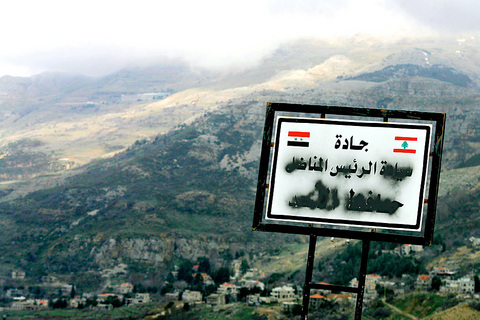
PHOTO: AP
Outgoing Prime Minister Omar Karami was virtually assured nomination after 71 of 78 legislators put forward his name during consultations with President Emile Lahoud, according to announcements by the legislators as they left the presidential palace.
Under the constitution, the president is obliged to comply with the choice of the majority of legislators.
A formal announcement will be made Thursday after Lahoud meets with parliament Speaker Nabih Berri, said an official at the presidential palace.
The pro-Syrian parliament members apparently were emboldened in their choice by a thundering protest in Beirut the day before that showed loyalty to Syria, countering weeks of anti-government and anti-Syrian demonstrations.
Syria is keen to keep its hold on Lebanese decisionmaking as it pulls its forces back to the Bekaa Valley and negotiates with the government in Beirut on the troops' full removal at a later date.
Opposition member Samir Franjieh described a reappointment of Karami as an escalation by the government aimed at scuttling any attempts at dialogue.
"It is a step that greatly challenges the opposition and the people's feelings," Franjieh said. He did not say how the opposition plans to react.
In a move certain to anger the opposition, the staunchly pro-Syrian Lahoud refused to accept the demands, according to his office, saying the consultations were limited to naming a premier and that the opposition could submit their demands to the new government. He said the investigation into Hariri's assassination was already a priority for the Lebanese government.
On Wednesday night, a convoy of about 70 Syrian army vehicles drove over the central mountains on it way to the eastern Bekaa Valley. The convoy, which vacated a base near the resort of Aley, included 10 buses of troops and seven trucks towing artillery pieces.
A Lebanese army officer in Aley said Lebanese troops had taken over some of the vacated positions.
In Tripoli, Lebanon's second biggest city, seven of Syria's nine military positions in the city had been evacuated by Wednesday night. A convoy of 50 trucks headed toward northern Syria.
A number of Syrian military positions stood empty after late Tuesday night withdrawals in Batroun, northern Lebanon, and at the mountain base of Dahr al-Wahash east of Beirut. Outside one high mountain position near Hammana, vandals had sprayed black paint over the signpost of a main road named for the late Syrian president, the father of the current leader, blotting out the name, "Mr. President Hafez Assad Avenue."
Soldiers busily loaded supplies and packed up their personal belongings, flashing victory signs and waving their automatic rifles as they drove east toward the Bekaa Valley. One helmeted soldier riding in the back of one truck looked backward down the road, chewing and spitting watermelon seeds.
A first lieutenant said: "Some of us are going to Syria and some to the Bekaa." "We're going to Syria, God willing," a captain said.

A US YouTuber who caused outrage for filming himself kissing a statue commemorating Korean wartime sex slaves has been sentenced to six months in prison, a court in Seoul said yesterday. Johnny Somali, 25, gained notoriety several years ago for recording himself doing a series of provocative stunts in South Korea and Japan, and streaming them on platforms such as YouTube and Twitch. South Korean authorities indicted Somali — whose real name is Ramsey Khalid Ismael — in 2024 on public order violations and obstruction of business, and banned him from leaving the country. “The court has sentenced him to six months in

Former Lima mayor Rafael Lopez Aliaga, a Peruvian presidential hopeful, gathered hundreds of supporters in Lima on Tuesday and gave authorities 24 hours to annul the first round of the country’s election over allegations of fraud. Lopez Aliaga is locked in a tight three-way race with two other candidates for second place in Sunday’s vote. The election runner-up wins a ticket to June’s presidential run-off against front-runner Keiko Fujimori. “I am giving them 24 hours to declare this electoral fraud null and void,” said Lopez Aliaga, surrounded by a crowd of several hundred supporters. “If it is not declared null and void tomorrow,

PAPAL RETORT: Pope Leo told reporters that he has ‘no fear, neither of the Trump administration nor speaking out loudly about the message of the Gospel’ US President Donald Trump has feuded with Pope Leo XIV over the Iran conflict — setting off an unholy row that could have serious political implications for the Republican leader back in the US. Trump has drawn barbs even from some allies over the attacks on the US-born pontiff, who has criticized the Trump administration over its immigration crackdown, the intervention in Venezuela and the Iran war. The president risks alienating the religious right in November’s crucial US midterm elections. So far the unprecedented clash between the leader of the most powerful military on Earth and the head of the world’s 1.4 billion

A 16-year-old boy has been charged with murder and aggravated sexual abuse in Florida in the death of his 18-year-old stepsister on a Carnival Cruise ship, the US Department of Justice said on Monday. Timothy Hudson was initially charged in February and subsequently indicted on March 10, but the breadth of the case was not known until a seal was lifted on Friday last week, weeks after US District Judge Beth Bloom in Miami said that he would be prosecuted as an adult at the request of the government. Anna Kepner had been traveling on the Carnival Horizon ship in November last


 RSS
RSS