


A suicide bomber detonated a garbage truck packed with explosives yesterday outside a hotel used by Western contractors, killing himself and at least three people, officials said.
Dozens of people were injured in the dawn truck blast. Police officer Mazin Hamid said the attacker drove the truck into a parking lot between the Sadeer hotel, which has been repeatedly attacked by gunmen in the past, and the Ministry of Agriculture.
Volleys of automatic weapons fire could be heard before and after the explosion.
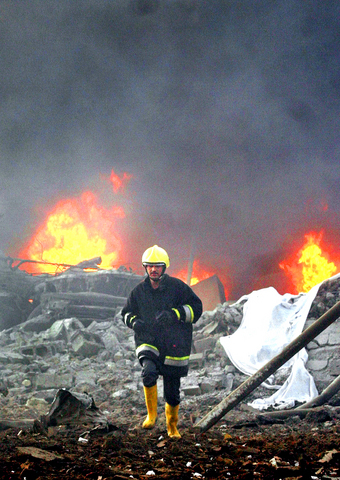
PHOTO: AP
Police said a group of insurgents wearing police uniforms first shot dead a guard at the ministry's gate, allowing the garbage truck to enter a compound the ministry shares with the hotel. Foreign security officials said other security guards in the area then fired on the vehicle, trying to disable it before it exploded.
Casualties were taken to several hospitals in the city.
Officials at al-Kindi hospital said at least three dead and five wounded were taken there.
Ibn al-Nafis hospital counted at least 27 wounded, said Dr Falleh al-Jubouri.
The massive blast shook buildings in the area and covered a huge swath of sky with acrid black smoke, much of it coming from the flaming wreckage of the truck and several other burning cars. Around 20 vehicles in the parking lot were damaged.
35 bodies discovered
Police yesterday also said they found 35 bodies in two different places in Iraq, some shot to death, the others beheaded.
Twenty of the corpses were found late on Tuesday near Rumana, a village about 20km east of the western city of Qaim, near the Syrian border, police Captain Muzahim al-Karbouli said.
Each of the bodies was riddled with bullets and found wearing civilian clothes, al-Karbouli said. The dead included one woman, but their identities were not known, he said.
Al-Karbouli said the victims appeared to have been killed several days earlier. They had not been died up or beheaded, as other victims have in Iraq.
A separate discovery was made on Tuesday south of Baghdad in Latifiya, where 15 headless bodies were found by Iraqi troops.
The decapitated corpses were found inside an abandoned base of the former Iraqi army, defense ministry Captain Sabah Yassin said. The bodies included 10 men, three women and two children.
Yassin said the bodies had no identification on them. But some of the dead men were thought to have been part of a group of Iraqi soldiers who were kidnapped by insurgents in the area two weeks ago, Yassin said.
`friendly fire' probes
Meanwhile, the US military said it will fast-track an investigation into why American troops fired on a car carrying Italian journalist Giuliana Sgrena, a journalist for the left-wing Il Manifesto newspaper, during a rescue from insurgents. Sgrena was wounded and Italian intelligence agent Nicola Calipari was killed in the incident.
The decision came as it also opened an inquiry on Tuesday into the shooting death of a Bulgarian soldier Private Gardi Gardev. That death appeared to be another friendly fire incident that also happened on Friday.
Both probes were an indication of the pressure being brought on the Bush administration by the few US allies in Europe that have steadfastly supported his policies in Iraq.
Italy and its prime minister, Silvio Berlusconi, sent 3,000 troops to Iraq, while Bulgaria has 460. Both countries have said they will not withdraw their troops, but domestic pressure to bring them home has been growing -- especially in Bulgaria where it has become an election issue.
In other news, Interim National Security Adviser Mouwafak al-Rubaie said ousted dictator Saddam Hussein could stand trial by year's end. "I will be surprised if I do not see Saddam in the box before the end of the year," he said. "I am very much hopeful that Saddam will be in the box around September and October, before the general referendum" on a constitution.
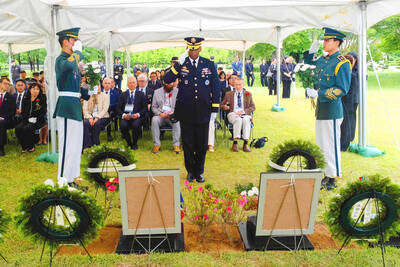
‘CROSSING THE LINE’: China’s embassy in Seoul criticized US Forces Korea Commander General Xavier Brunson, asking if his ‘hostile’ remarks were authorized by Washington South Korea and the US are in talks over recent public remarks by the commander of US Forces Korea, Seoul’s presidential office said yesterday, after the comments drew sharp criticism from China. In a recent podcast interview, US Forces Korea Commander General Xavier Brunson described South Korea as “the dagger in the heart of Asia” from China’s east coast, prompting the Chinese embassy in Seoul to say that he had “truly crossed the line.” The interview came amid growing speculation that Washington might seek to expand the role of US Forces Korea in countering the growing regional influence of China, a key
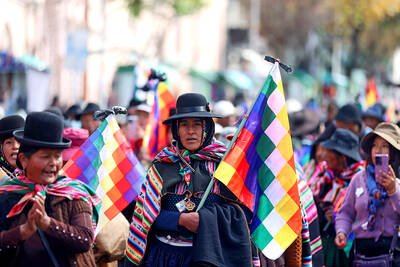
SEEKING ORDER: Rodrigo Paz said that ‘anyone who wants to destroy the nation will have to deal with this president and the full force of the constitution’ Bolivian President Rodrigo Paz on Wednesday said that the nation was at a “breaking point” after nearly a month of protests that have caused shortages of food, fuel and medicine. Paz, who took office six months ago amid the worst economic crisis there in four decades, is battling a groundswell of fury over his policies. The political capital, La Paz, has been besieged by low-income workers and members of the indigenous majority calling for his resignation. “The country needs order and is reaching breaking point,” the 58-year-old said at a public event in La Paz, renewing his appeal for dialogue. On Tuesday, the Bolivian

Through the noise of rushing papers and whirring belts at a print factory in Kyoto, two creators watch their photo essay come to life in broadsheet form — part of an effort to win new audiences in the age of artificial intelligence (AI). Despite the decline of the publishing industry, self-publication and handmade “zine” magazines are growing in popularity in Japan, reflecting the nation’s enduring love of paper in the digital era. While speaking to Agence France-Presse at the plant, his hands black with ink, one of the creators, Kazuma Obara, said: “I think [paper] is a medium that engages all five

Australian researchers have trained lab-grown brain cells on a silicon computer chip to play the 1990s shooter game Doom and said they are just scratching the surface of what the neurons could be capable of doing. It is the science-fiction work of biotech boffins at Cortical Labs, who researched and developed the technology that harnesses the workings of the brain’s networking system. Each so-called “biological computer” contains about 200,000 living human brain cells, grown from stem cells that were harvested from blood donations. Having mastered the simple computer game Pong, where a paddle is moved up and down to send a ball


 RSS
RSS