

The founder of Amnesty International, Peter Benenson, has died at the age of 84. Amnesty has become one of the world's most important human rights organizations, created in the wake of an article Benenson wrote in the London-based Observer newspaper in 1961.
Benenson, an Eton-educated London lawyer, penned the opinion piece after being outraged by the arrest and imprisonment of two students who had drunk a toast to liberty in a Lisbon cafe.
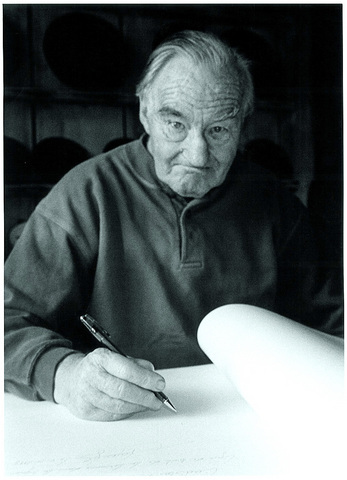
PHOTO: AFP
"Open your newspaper any day of the week and you will find a report from somewhere in the world of someone being imprisoned, tortured or executed because his opinions or religion are unacceptable to his government. The newspaper reader feels a sickening sense of impotence. Yet if these feelings of disgust all over the world could be united into common action, something effective could be done."
These sentiments struck a chord with the British public, and a few years later Amnesty International was created. From South Africa and Chile to China and Iraq, Amnesty has since helped highlight the abuse of prisoners. The organization coined the term "prisoners of conscience" while its logo, a candle surrounded by barbed wire, became a symbol of hope and freedom. In 1977 the organization won the Nobel Peace Prize for "its tireless fight for justice round the world," as the award committee put it.
"When I first lit the Amnesty candle, I had in mind the old Chinese proverb: Better light a candle than curse the darkness," Benenson explained.
Born in July 1921, the grandson of a Russian Jewish banker, Benenson revealed a flair for controversy at an early age. When 16 he launched his first campaign, to get school support during the Spanish Civil War for a relief committee which was helping Republican war orphans.
Irene Khan, secretary-general of Amnesty, said Benenson's vision gave birth to human rights activism.
"His life was a courageous testament to his visionary commitment to fight injustice around the world. He brought light into the darkness of prisons, the horror of torture chambers and tragedy of death camps," Khan said.
Benenson's family said he had been ill for some time and he died on Friday evening.
John Jackson, director of Burma Campaign, said: "Peter showed us that something as simple as a letter can save lives, and that's a strategy we still use. He demonstrated the power of the pen. It shows that the world is watching."

A Chinese artificial intelligence (AI) cybersecurity tool called ARTEX was used in a spate of recent hacks of Japanese companies, the subsidiary of a major Tokyo-based Internet company yesterday. Dozens of Japanese companies, from restaurant chains to a car hire operator, have disclosed unauthorized access or data breaches in the past weeks — potentially impacting millions of customers. The information security arm of GMO Internet Group said it had “confirmed ARTEX was used” having investigated the attacks in collaboration with external organizations. “It also became clear ... the attacks were almost exclusively targeting Japan,” GMO cybersecurity center director Daiki Fukumori

On his terrace overlooking the forest in eastern Pennsylvania, Ed Negra lays out four letters. All are from a developer promising a US$10,000 check to each household once its data center is running. “I call it a bribe,” the US retiree said. The scene is picture-perfect. Autumn leaves are turning russet, and there is a stunning mountain view in this corner of Pennsylvania, a key state in the US’ upcoming midterm elections. “We thought it was a beautiful place to retire,” said the septuagenarian, who used to manage a large building-supply store in neighboring New Jersey. He and his wife settled in a sprawling
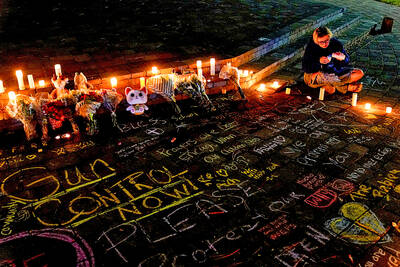
A 16-year-old on Thursday shot his way through locked doors to get into an elementary school in Bend, Oregon, killing three children and a teacher. He was then shot by a person at the scene who followed him inside, authorities said. The suspect was found dead inside the school minutes after the shooting was first reported, Bend Police Chief Mike Krantz said. The three children killed were aged 5, 8 and 11. Another child, 7, and a teacher, 54, were injured and taken to the hospital in critical condition, he said. The first 911 call came just before 1pm from a person in
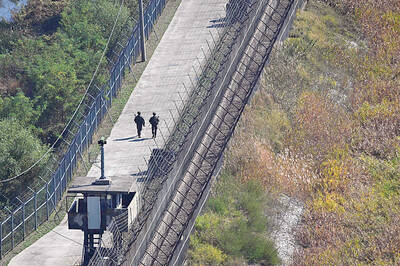
A STEP UP: The moving of small military positions forward should be taken seriously amid the North’s recent demonstrations of its firepower, an analyst said North Korea has moved new units into “firing positions,” the sister of leader Kim Jong-un said yesterday, days after Pyongyang warned it was considering deploying additional strike means to its border with South Korea. Tensions between Seoul and Pyongyang have soared since the South last month blamed an explosion inside the heavily fortified demilitarized zone (DMZ) separating the two countries on landmines laid by North Korea, an accusation it has rejected. “Our military leadership underlined the need to make those rogues aware that our new firepower units have taken their firing positions,” state media cited Kim Yo-jong as saying. Her statement came a


 RSS
RSS