


Philippine soldiers captured a key jungle stronghold of Muslim rebels, ousting defenders blamed for recent attacks on an army post and bombings in Manila and two other cities, military officials said yesterday.
Lieutenant General Alberto Braganza, commander of the military's Southern Command, was to fly by helicopter with other military officials to Bitan-ag, the hilly complex near Panamao town that hundreds of troops wrested from armed followers of jailed Muslim rebel leader Nur Misuari after days of fierce gunbattles.
Philippine Army Captain Abdurasad Sirajan, spokesman for an anti-terrorist military task force, told reporters that "the entire Bitan-ag camp has been fully captured."
All of the fewer than 100 gunmen fled in small groups toward Jolo's mountainous center as the military moved in. Soldiers would pursue the gunmen, who are led by local religious leader Habier Malik, the military said.
After suffering heavy casualties in the clashes, military officials brimmed with pride over the rebel camp's capture.
"They can't win over the government, whatever their lawless desire is," Southern Command chief of staff Colonel Domingo Tutaan said.
About 3,000 soldiers and marines have been pursuing Misuari's followers -- backed by guerrillas of the Abu Sayyaf group -- since they attacked an army detachment in Panamao on Feb. 7, provoking clashes that killed 27 soldiers and wounded 72 others. Troops have killed 37 gunmen and wounded scores of others, the military said.
The rebel attacks were apparently a retaliation for the death of a number of people, including a child, who were caught in a crossfire when troops assaulted a community of Misuari's followers while pursuing suspected Abu Sayyaf guerrillas. The military has acknowledged the child was accidentally hit in an army assault.
Abu Sayyaf -- blamed for numerous kidnappings in the southern Philippines -- claimed responsibility for bombings Monday in Manila's financial district and the southern cities of General Santos and Davao which killed seven people and wounded at least 123, apparently to divert the military's attention and ease the pressure on the beleaguered gunmen on Jolo, the military said.
Despite the bomb attacks, President Gloria Arroyo said Tuesday that the military assaults on Jolo would continue. She vowed to crush the al-Qaida-linked Abu Sayyaf.
"The desperation of the enemy cannot be underestimated, even as it lies in the throes of defeat," Arroyo said. "More than ever, we must not pull back but move forward to wipe out the remnants of the Abu Sayyaf."
Security forces were placed on full alert nationwide to thwart more bombings.
Misuari formerly headed the Moro National Liberation Front, a large Muslim separatist group that accepted limited autonomy and signed a peace accord with the government in 1996.
But violence reignited years later and Misuari was imprisoned near Manila on charges of rebellion. Many of his armed followers have peacefully settled in Jolo but have been periodically accused of coddling Abu Sayyaf guerrillas.
From his mountain lair protected by dense jungle, Haber Malik, leader of the Muslim rebellion on remote Jolo island in the southern Philippines, made an impassioned plea recently for support.
In a tape recorded message Malik, who heads one of the many factions of the Moro National Liberation Front (MNLF), called on fellow Muslims to unify against "abuses" by troops cracking down on militants in the Sulu archipelago, where Jolo is located.
"My brothers and sisters in Jolo and the surrounding islands, we have to help each other. If you let the military get away with these abuses, we will be like chickens, being eaten one by one," he urged.
Then came the Valentine's Day bombings, three explosions which rocked the capital Manila as well as Davao City and General Santos on southern Mindanao island, killing 12 people and injuring more than 130.
Another Muslim group, the extremist Abu Sayyaf, claimed responsibility for the attacks.
Its spokesman Abu Solaiman said on radio shortly after Monday night's bombings that it was a "response to the Philippine government's atrocities committed against Muslims everywhere ... from Manila to remote areas like Sulu."
For the government and the military the concern was that the Abu Sayyaf -- a kidnap gang named by the US as a terror organization believed to have links to Al Qaeda -- had joined forces with Malik.
In recent years Abu Sayyaf, which has been kidnapping Christians and foreigners for ransom and staging bombing attacks throughout the country, has been the main thorn in the side of successive Philippine governments and the military.
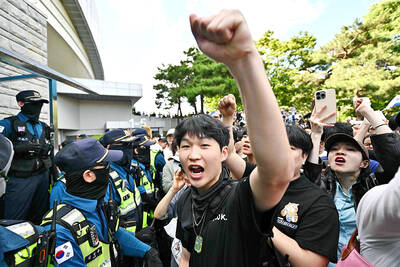
‘ABSURD MISTAKE’: The election commission said that there had been a failure to anticipate turnout after 14 polling stations ran short of ballot papers South Korean riot police yesterday cleared protesters from a Seoul polling station after a 35-hour blockade sparked by a shortage of ballot papers during local elections earlier this week. Wednesday’s election was the first nationwide vote since South Korean President Lee Jae-myung took office following the ouster of Yoon Suk-yeol over his short-lived martial law declaration. Lee’s ruling Democratic Party swept most races, but failed to flip the crucial Seoul mayoral seat. The South Korean National Election Commission apologized, blaming a failure to anticipate turnout after 14 polling stations in Seoul ran short of ballot papers. Some polling stations stayed open until 10pm to

France experienced its hottest spring on record, the French weather service said on Tuesday, after an exceptional early heat wave that also broke highs for the season in England and Wales. Meteo-France said the average nationwide temperature over March to May was 13.8°C — about 1.7°C above the norm, and surpassing records set in 2011 and 2020. “The warmest spring since records began in 1900,” it said in a bulletin. All three months were warmer than average, but the onset of an “unprecedented heatwave” late last month pushed the mercury to highs typically seen at the height of the summer. “Our country had never

A Sherpa guide was found crawling to base camp on Mount Everest a week after he went missing and was reunited with his family, who had given up hope he would return. Dawa Sherpa was last seen on Friday last week descending the mountain, but he did not reach base camp even though his client did. The pair were among the last climbers on the mountain as the climbing season came to an end and the route was dismantled. Dawa was located by a cleaning crew on Thursday morning as he was crawling down the snowy slopes around the Khumbu Icefall, just above
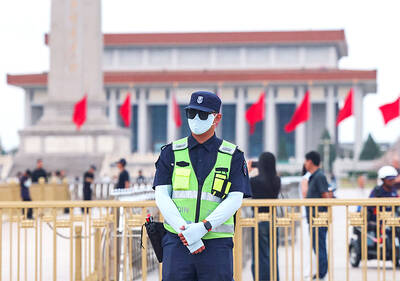
Chinese authorities are snuffing out any remembrance of the deadly 1989 military crackdown on student-led pro-democracy protests in Tiananmen Square, which happened 37 years ago yesterday, in a further tightening of a years-long campaign to erase what happened from public memory. Police told relatives of the victims they would not be allowed to visit a cemetery in Beijing on the anniversary of the crackdown, a person with knowledge of the matter said. Relatives of the victims visited the cemetery on the anniversary for more than 30 years to read memorial statements with police keeping watch, Amnesty International said. Hundreds of people,


 RSS
RSS