


China has defended its shooting of what it called Vietnamese "robbers" in the Gulf of Tonkin, after Hanoi demanded Beijing punish police who killed nine Vietnamese fishermen in early January.
Sailors on three Vietnamese boats robbed and fired on Chinese fisherman in the gulf on Jan. 8, prompting police to return fire, Foreign Ministry spokesman Kong Quan said in a statement.
Kong said the Chinese boats were in China's waters when they were attacked. Maritime police rushed to the site and ``were forced to take necessary actions'' when the Vietnamese boats opened fire, he said.
"It was really a serious armed robbery incident at sea," Kong said in the statement, posted on the ministry Web site www.mfa.gov.cn late on Friday.
"Having received calls for help, Chinese public security boats rushed to the area for rescue, but the three armed boats first shot at the Chinese boats and law enforcement personnel," he said.
"[The police] shot dead several robbers and seized one ship and eight robbers," he said. "They also confiscated some weapons and ammunition."
The Xinhua report did not say how many Vietnamese were killed.
Vietnamese officials, however, have said Chinese coast guards fired on two Vietnamese fishing boats in separate attacks, killing nine Vietnamese and wounding six others.
They have asked that the Chinese maritime authorities be punished for their "wrongful acts," saying that the Vietnamese boats were in waters shared by the two sides.
But Kong said the Vietnamese "confessed they had carried out four other armed robberies aimed at Chinese fishing boats in the gulf."
He said Beijing had informed Hanoi of the case and will continue to investigate. The Chinese side has gathered plenty of evidence and witnesses, he said.
Fishing rights have long been caught up in territorial disputes between China and Vietnam which, despite ideological and cultural similarities, have historically had testy relations.
"China is willing to cooperate with the Vietnam side to tighten cooperations in cracking down on all criminal offences at sea and maintaining joint efforts to promote safety and stability in the northern gulf," Kong said, using the Chinese name for the Gulf of Tonkin.
He did not elaborate.
China and Vietnam signed a fishing agreement in 2000, but Beijing stirred a protest from Hanoi in August 2002 by banning fishing in the South China Sea, over which Vietnam claims jurisdiction.
In late December, China held nine Vietnamese fishing boats and their crew of 80 on the southern island province of Hainan on suspicion of trespassing in Chinese waters, Chinese media reported.
The shooting incident is the latest territorial disagreement between China and Vietnam, which have a history of such disputes.
The Spratly Islands, an uninhabited archipelago in the South China Sea, are the center of another long-standing dispute between the two sides. The area is believed to be rich in oil and natural gas and is also claimed all or in part by the Philippines, Brunei, Malaysia and Taiwan.
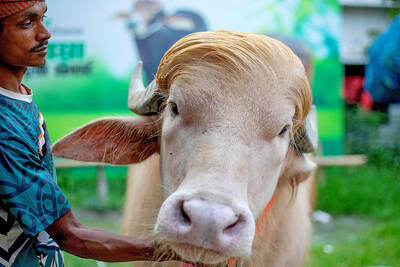
Crowds in Bangladesh are flocking to snap photographs with an unlikely social media star — an albino buffalo with flowing blond hair nicknamed “Donald Trump” that is due to be sacrificed within days. Owner Zia Uddin Mridha, 38, said his brother named the 700kg bull over its flowing helmet of hair resembling the signature look of the US president. “My younger brother picked this name because of the buffalo’s extraordinary hair,” he said at his farm in Narayanganj, just outside the capital, Dhaka. Mridha said that a constant stream of curious visitors — social media fans, onlookers and children — have come throughout

It began as a satirical online project. Now millions of young people in India are flocking to it as an outlet for their frustration. A parody political party called the Cockroach Janta Party, with the insect as its symbol, has exploded across India’s social media by turning absurdist humor into protest. Memes and short videos mocking corruption, joblessness and political dysfunction have flooded social media sites, where millions of users are embracing the cockroach — known for its ability to survive harsh conditions — as a tongue-in-cheek symbol of endurance. The online movement’s rise has been unusually rapid. The Cockroach Janta Party (CJP)
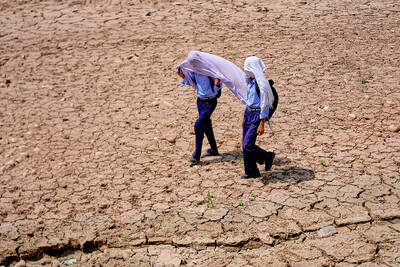
HOTTER: While Indians are accustomed to summer heat, climate change has caused northwestern India to warm faster than other parts of the country, an academic said Roads and markets have emptied during afternoons and some farmers have switched to nighttime work to avoid scorching temperatures as a heat wave grips large parts of India. The India Meteorological Department forecast maximum temperatures for yesterday of about 45°C in the capital, New Delhi, where authorities have opened temporary “cooling zones” to help people cope. The weather department warned that conditions would likely persist across several northern regions in the coming days, with temperatures staying well above seasonal averages. Authorities urged people to stay indoors during the hottest hours and take precautions against heat-related illnesses. India declares a heat wave whenever maximum temperatures

SPEAKING OUT: After Siranudh Scott’s allegations surfaced, celebrities and public figures took to social media to share their own experiences of sexual misconduct and abuse A high-profile alleged sexual abuse case within a wealthy Thai beer brewing family has prompted a wave of painful accounts from survivors of unconnected abuse in the conservative nation. Siranudh Scott, a member of the billionaire Thai family that founded the ubiquitous Singha beer brand, posted an emotional video this month accusing his elder brother Sunit of repeatedly abusing him when he was a teenager. Sunit, who is in his 30s, later denied the allegations in a video posted online, but Singha parent Boonrawd dismissed him from his executive role with the company on Tuesday last week. “I felt I needed to speak


 RSS
RSS