


Radical Chechen rebel leader Shamil Basayev purportedly took responsibility yesterday for a recent series of terrorist attacks in Russia but put ultimate blame for a school massacre on Russian President Vladimir Putin.
In a letter posted yesterday on the Kavkaz-Center Web site, Basayev purportedly said he had sent a letter to Putin proposing "independence [for Chechnya] in exchange for security." It was impossible to confirm whether the text -- signed by Basayev's nom de guerre, "Abdallakh Shamil, Emir of the Riyadus Salikhin Martyrs' Brigade" -- on the Web site was genuine. But the site is considered a mouthpiece for Basayev and his previous claims of responsibility have appeared there.
Basayev purportedly said that if Russia withdrew its troops and recognized Chechen independence, Chechnya would neither support nor finance groups fighting Russia, and "we can guarantee that all of Russia's Muslims would refrain from armed methods of struggle against the Russian Federation, at least for 10-15 years, on condition that freedom of religion [as is guaranteed in the Russian Federation] be respected."
The letter said Chechnya would join the Commonwealth of Independent States, a loose federation of former Soviet republics.
He purportedly said his brigade was responsible for an explosion last month at a bus stop outside Moscow, the near-simultaneous bombings of two planes the same night, a suicide bombing outside a Moscow subway station a week later, and the school hostage-taking in Beslan that ended in a hail of gunfire and explosions.
More than 430 people were killed in the attacks, with some 338 of those deaths coming during the hostage crisis in the Beslan school.
"A terrible tragedy occurred in the city of Beslan; the Kremlin vampire destroyed and wounded 1,000 children and adults, giving the ordering to storm the school for the sake of imperial ambitions and the preservation of his own throne," Basayev purportedly wrote.
Putin and other officials said repeatedly that in order to avert a bloodbath, they had not planned to storm the school, where the attackers had rigged bombs surrounding the approximately 1,200 hostages. According to Russian officials and witnesses, after explosions rocked the school, and armed volunteers started shooting, the special forces opened fire, too.
But Basayev disputed that.
"We declare that the Russian special services stormed the school, [and that] it was planned from the very beginning," he wrote, according to the Web site.
He purportedly said the attackers' demands had been clear: an immediate stop to the war in Chechnya and a start to the withdrawal of Russian troops, or Putin's resignation if he "does not want peace." If the president would decree an end to fighting, the return of troops to their barracks and a troop withdrawal, Basayev said, the attackers promised they would give the hostages water. And if the troops were really being withdrawn, they would have given them food.
"As soon as the troops are withdrawn from the mountains, we will let children up to age 10 go; the rest after the full troop withdrawal," he said of the attackers' conditions.
If Putin had resigned, the attackers would have freed all the children and left for Chechnya with the remainder of the hostages, the letter said.
He said he sent his message to Putin through former Ingush President Ruslan Aushev -- a respected regional figure who successfully negotiated freedom for 26 of the hostages -- and North Ossetian President Alexander Dzasokhov.
Putin has firmly ruled out any negotiations with Chechen rebels, insisting that the war-battered region is returning to normalcy under the Kremlin's twin programs of vesting increasing authority in elected Chechen officials and law enforcement services and reconstruction.
The Federal Security Service's spokesman in Chechnya, Major-General Ilya Shabalkin, said authorities had known "long ago" that Basayev was responsible for the series of attacks.
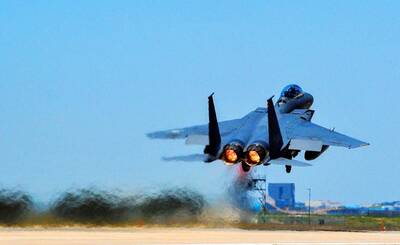
South Korea’s air force yesterday apologized for a 2021 midair collision involving two fighter jets, a day after auditors said the pilots were taking selfies and filming during the flight and held them responsible for the accident. “We sincerely apologize to the public for the concern caused by the accident that occurred in 2021,” an air force spokesman told a news conference, adding that one of the pilots involved had been suspended from flying duties, received severe disciplinary action and has since left the military. The apology followed a report released on Wednesday by the South Korean Board of Audit and Inspection,

Indonesian police have arrested 13 people after shocking images of alleged abuse against small children at a daycare center went viral, sparking outrage across the nation, officials said on Monday. Police on Friday last week raided Little Aresha, a daycare center in Yogyakarta on Java island, following a report from a former employee. CCTV footage circulating on social media showed children, most younger than two, lying on the floor wearing only diapers, their hands and feet bound with rags. The police have confirmed that the footage is authentic. Police said they also found 20 children crammed into a room just 3m by 3m. “So

About 240 Indians claiming descent from a Biblical tribe landed at Tel Aviv airport on Thursday as part of a government operation to relocate them to Israel. The newcomers passed under a balloon arch in blue and white, the colors of the Israeli flag, as dozens of well-wishers welcomed them with a traditional Jewish song. They were the first “bnei Menashe” (“sons of Manasseh”) to arrive in Israel since the government in November last year announced funding for the immigration of about 6,000 members of the community from the states of Manipur and Mizoram in northeast India. The community claims to descend from

‘TROUBLING’: The firing of Phelan, who was an adviser to a nonprofit that supported the defense of Taiwan, was another example of ‘dysfunction’ under Trump, a US senator said US Secretary of the Navy John Phelan has been fired, a US official and a person familiar with the matter said on Wednesday, in another wartime shakeup at the Pentagon coming just weeks after US Secretary of Defense Pete Hegseth ousted the Army’s top general. The Pentagon announced his departure in a brief statement, saying he was leaving the administration “effective immediately,” but it did not provide a reason or say whether it was his decision to go. The sources, who spoke on condition of anonymity, said Phelan was dismissed in part because he was moving too slowly to implement reforms to


 RSS
RSS