


Iraq's elections will go ahead as scheduled in January even if some Iraqis are unable to vote due to the security situation in the country, interim Prime Minister Iyad Allawi said in an interview published yesterday in the several western daily newspapers.
The Iraqi leader acknowledged that there were currently problems in his country, especially in the violence-wracked city of Fallujah, but said these would not prevent the elections being held.
In the interview, published in several British and US dailies as well as in the French paper Le Figaro, Allawi declared: "If for any reason 300,000 people cannot have an election, cannot vote because terrorists decide so, then frankly 300,000 people ... is not going to alter 25 million people voting."
If the elections were prevented in the flashpoint city of Fallujah -- where US military strikes were again underway yesterday -- its inhabitants could vote later, the prime minister said.
"Militias have to disband. Criminals have to be surrendered to the government. Foreign fighters and the Iraqi police and national guard have to be fully deployed in Fallujah," he added.
His government was "determined to win the war against the terrorists, and establish democracy in Iraq," said, who was appointed last June when the US put in place an interim Iraqi administration to run the country until the elections.
The Iraqi premier also said he expected the captured former Iraqi president Saddam Hussein to go on trial before the end of the year.
He said he hoped the trial would help establish a clear distinction between members of Saddam's Baath Party who committed crimes during his rule, and those who simply joined the party because they had to.
Of former Baath Party officials who did not commit crimes, he said: "We are not interested in pursuing them. They should be part of the civil society of Iraq, part of the political process."
Meanwhile at least 45 people died in a wave of bombings and battles between US troops and rebels on Sunday as the US expressed confidence the violence would not halt the elections.
Loyalists of alleged al-Qaeda chief in Iraq, Abu Mussab al-Zarqawi, claimed attacks on the heavily fortified central Baghdad compound housing the government and the US embassy and on the notorious Abu Ghraib prison.
In Washington, US Secretary of State Colin Powell said the United States was confident elections could be held in Iraq on schedule despite the insurgency.
"There is an insurgency raging. We see it every day, there's no question about it," Powell said on the NBC television program Meet the Press." "This is a difficult time as this insurgency still rages and as we work to bring it under control.
"But it will be brought under control," he said. "It's not an impossible task, and when it has been brought under control you will find that the forces that keep Iraq together are stronger than the forces that would pull it apart.
"When that insurgency is put down, what the people of the world will see are Iraqis in charge of their own destiny," Powell said.

Kouri Richins, a Utah mother who published a children’s book about grief after the death of her husband is to serve a life sentence for his murder without the possibility of parole, a judge ruled on Wednesday. Richins was convicted in March of aggravated murder for lacing a cocktail given to her husband, Eric Richins, with five times the lethal dose of fentanyl at their home near Park City in 2022. A jury also found her guilty of four other felonies, including insurance fraud, forgery and attempted murder for trying to poison her husband weeks earlier on Feb. 14, 2022, with a
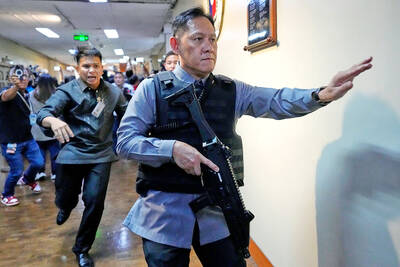
DELA ROSA CASE: The whereabouts of the senator, who is wanted by the ICC, was unclear, while President Marcos faces a political test over the senate situation Philippine authorities yesterday were seeking confirmation of reports that a top politician wanted by the International Criminal Court (ICC) had fled, a day after gunfire rang out at the Philippine Senate where he had taken refuge fearing his arrest. Senator Ronald “Bato” dela Rosa, the former national police chief and top enforcer of former Philippine president Rodrigo Duterte’s “war on drugs,” has been under Senate protection and is wanted for crimes against humanity, the same charges Duterte is accused of. “Several sources confirmed that the senator, Senator Bato, is no longer in the Senate premises, but we are still getting confirmation,” Presidential
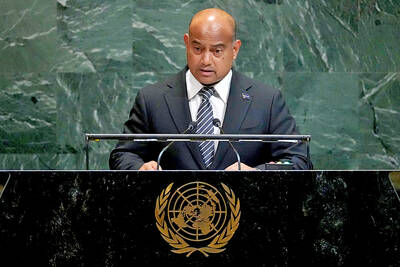
Nauru said it would hold a referendum to change its official name, described as a colonial relic from a time when “foreign tongues” mangled the native language. Nauru would change its name to Naoero to “more faithfully honor our nation’s heritage, our language and our identity,” Nauruan President David Adeang said in a statement on Tuesday. The Pacific island nation’s native language is Dorerin Naoero, which is spoken by the vast majority of its approximately 10,000 inhabitants. “Nauru emerged because Naoero could not be properly pronounced by foreign tongues, and was changed not by our choice, but for convenience,” the government said in

HELP DENIED? The US Department of State said that the Cuban leadership refuses to allow the US to provide aid to Cubans, ‘who are in desperate need of assistance’ US Secretary of State Marco Rubio on Wednesday said that Cuba’s leadership must change, as Washington renewed an offer of US$100 million in aid if the communist nation agrees to cooperate. Cuba has been suffering severe economic tumult led by an energy shortage that plunged 65 percent of the country into darkness on Tuesday. Cuba’s leaders have blamed US sanctions, but Rubio, a Cuban American and critic of the government established by Fidel Castro, said the system was to blame, including corruption by the military. “It’s a broken, nonfunctional economy, and it’s impossible to change it. I wish it were different,” he told


 RSS
RSS