


This week's suicide attack in southern Israel has sparked a war of words between Israel and Syria and increased pressure to finish the West Bank barrier that many Israelis believe saves lives, regardless of international condemnation. Also Thursday, four Palestinians were killed in a Gaza town in clashes after Israeli forces found a tunnel leading to a Jewish settlement.
As Israel mourned its 16 dead from Tuesday's twin bus bombings in Beersheba claimed by Hamas militants, officials ratcheted up their rhetoric against Syria, hinting at possible military action.
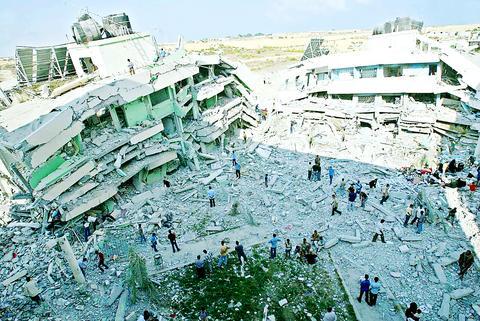
PHOTO: EPA
Syria and Hamas, apparently fearful of an Israeli strike, accused Israel of trying to aggravate tensions in the Middle East.
Although no Israeli strike appeared imminent -- security officials haven't even begun discussing the possibility -- the heated rhetoric underscored Israel's growing impatience with Syrian support for Palestinian militants.
Prime Minister Ariel Sharon told the Israeli president that Tuesday's bus bombings -- the deadliest attack in Israel in nearly a year -- were carried out on direct orders from Hamas leaders in Damascus, the Syrian capital.
A senior adviser to Sharon, Raanan Gissin, warned that neither Hamas nor Syria, which is now home to the Hamas top leadership, are "immune" to an Israeli strike.
And Foreign Minister Silvan Shalom warned that Syria's support for terrorists "will have very clear consequences."
However, the chief of Israeli military intelligence, in an interview with Channel 10 TV, refused to draw a straight line from Beersheba to Syria.
"We did not directly connect the terror attack that was carried out in Beersheba to the [Hamas] headquarters in Damascus," Major General Aharon Zeevi-Farkash said, while adding that there is "wide and comprehensive support from Damascus" for militants in the West Bank and Gaza.
Syrian Foreign Minister Farouk al-Sharaa was quoted as saying the threats would "worsen the already aggravated situation in the region." Ahmed Haj Ali, an adviser to the Syrian information minister, said Syria is taking the Israeli threats "seriously."
Hamas issued its own statement from Damascus, accusing Israel of trying to provoke a confrontation and insisting that its actions against Israelis are planned and executed from the Palestinian territories, not Syria.
Israel last struck a target inside Syria on Oct. 5, 2003, when its planes bombed a training camp belonging to Islamic Jihad outside Damascus.
Israel's most obvious target in Syria today would be Hamas leader Khaled Mashaal, who survived an Israeli assassination attempt in Jordan in 1997.
Israel has held Syria partly responsible for years of Hezbollah raids from Lebanon, where Syria maintains a large military presence. In practice, however, Israel has been hesitant to clash with Syria, and the border has been calm for decades.
Analyst Efraim Halevy, a former Mossad intelligence chief and diplomat, said if there is further violence traced to Syria, "I don't think Israel will necessarily play the game the way it's been playing it up to now."
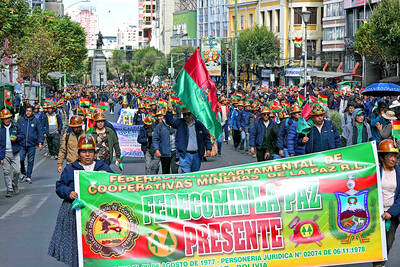
The Bolivian government on Friday struck a deal with protesting miners, but was still grappling with blockades and demonstrations by other workers across La Paz. Other groups are still blocking access roads into the city, which is also the seat of the government. Police on Thursday prevented the miners from entering the main square by using tear gas, while the demonstrators hurled stones and explosives with slingshots. Protests against the policies of Bolivian President Rodrigo Paz have convulsed the Andean nation since early this month, and roadblocks were choking routes into La Paz throughout Friday, the national road authority said. Miners demanded that Paz
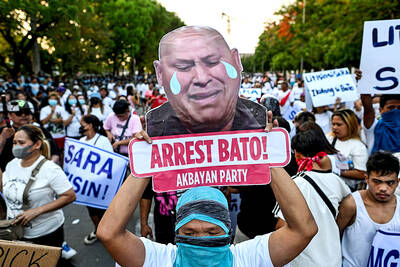
The Philippines said it has asked the country’s Supreme Court to allow it to arrest former Philippine president Rodrigo Duterte’s chief drug war enforcer to stand trial in an international tribunal. The International Criminal Court (ICC) last week unsealed an arrest warrant against Philippine Senator Ronald dela Rosa, accusing him along with Duterte and other “coperpetrators” of the “crime against humanity of murder.” Dela Rosa briefly sought refuge in the Philippine Senate last week while asking the Philippine Supreme Court to stop an ongoing attempt by government agents to arrest him. “By his own conduct, he has placed himself outside the protection of
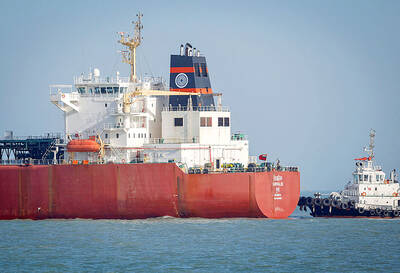
A ship anchored off the United Arab Emirates (UAE) was seized and taken toward Iran and another — a cargo ship near Oman — sank after being attacked, authorities said on Thursday, as tensions escalated near the Strait of Hormuz. It was not immediately clear who was behind these incidents, but they happened as a senior Iranian official reiterated his country’s claim of control over the waterway and another said it had a right to seize oil tankers connected to the US. The turmoil in the strait has been a sticking point for weeks in talks between the US and Iran to

Crowds in Bangladesh are flocking to snap photographs with an unlikely social media star — an albino buffalo with flowing blond hair nicknamed “Donald Trump” that is due to be sacrificed within days. Owner Zia Uddin Mridha, 38, said his brother named the 700kg bull over its flowing helmet of hair resembling the signature look of the US president. “My younger brother picked this name because of the buffalo’s extraordinary hair,” he said at his farm in Narayanganj, just outside the capital, Dhaka. Mridha said that a constant stream of curious visitors — social media fans, onlookers and children — have come throughout


 RSS
RSS