


The Falun Gong spiritual group claimed yesterday that 16 followers convicted of causing an obstruction during a protest are being treated unfairly -- after a Hong Kong court failed for a full year to rule on their appeals.
"Justice delayed is justice denied," Falun Gong spokeswoman Sharon Xu said in an interview. "It's not good for Hong Kong's image."
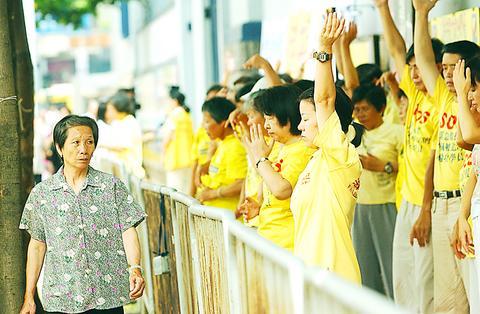
PHOTO: AP
About 30 Falun Gong followers staged a sit-in demonstration yesterday outside Beijing's representative office in Hong Kong -- near the scene of a protest that led to Hong Kong's first criminal charges against members of the meditation group banned as an "evil cult" in mainland China.
A magistrate convicted the 16 -- four Swiss, a New Zealander and 11 Hong Kong residents -- of creating a public obstruction during their demonstration against the mainland's deadly crackdown on Falun Gong. They claim hundreds have been killed there.
The group says its members were unfairly charged in the Hong Kong case, which it called a politically motivated measure to stifle its message.
The charges were minor and the defendants were only ordered to pay small fines. But the implications for free speech in Hong Kong could be significant, human rights activists say.
The Falun Gong followers said on appeal -- in a hearing a year ago -- that their protest had been a legal exercise of their constitutional rights. They had expected a ruling within a few weeks, but it has never come.
The group suspects that the politically sensitive nature of the case might have placed the judges under pressure, Xu said.
Chinese authorities are trying to eradicate Falun Gong, which alarmed Beijing several years ago with its organizational abilities.
But it remains legal in Hong Kong and holds frequent protests here, creating an uncomfortable situation for the Chinese territory's government.
Falun Gong says the 16 practitioners deserve a ruling because they now have criminal convictions on their records.
Xu said any unfair treatment is damaging to the "one country, two systems" arrangement set up when Britain returned this former colony to China in 1997, with guarantees of considerable autonomy -- including independent courts.
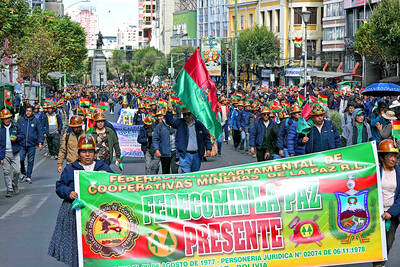
The Bolivian government on Friday struck a deal with protesting miners, but was still grappling with blockades and demonstrations by other workers across La Paz. Other groups are still blocking access roads into the city, which is also the seat of the government. Police on Thursday prevented the miners from entering the main square by using tear gas, while the demonstrators hurled stones and explosives with slingshots. Protests against the policies of Bolivian President Rodrigo Paz have convulsed the Andean nation since early this month, and roadblocks were choking routes into La Paz throughout Friday, the national road authority said. Miners demanded that Paz
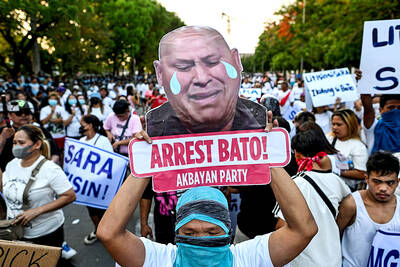
The Philippines said it has asked the country’s Supreme Court to allow it to arrest former Philippine president Rodrigo Duterte’s chief drug war enforcer to stand trial in an international tribunal. The International Criminal Court (ICC) last week unsealed an arrest warrant against Philippine Senator Ronald dela Rosa, accusing him along with Duterte and other “coperpetrators” of the “crime against humanity of murder.” Dela Rosa briefly sought refuge in the Philippine Senate last week while asking the Philippine Supreme Court to stop an ongoing attempt by government agents to arrest him. “By his own conduct, he has placed himself outside the protection of

A ship anchored off the United Arab Emirates (UAE) was seized and taken toward Iran and another — a cargo ship near Oman — sank after being attacked, authorities said on Thursday, as tensions escalated near the Strait of Hormuz. It was not immediately clear who was behind these incidents, but they happened as a senior Iranian official reiterated his country’s claim of control over the waterway and another said it had a right to seize oil tankers connected to the US. The turmoil in the strait has been a sticking point for weeks in talks between the US and Iran to

Crowds in Bangladesh are flocking to snap photographs with an unlikely social media star — an albino buffalo with flowing blond hair nicknamed “Donald Trump” that is due to be sacrificed within days. Owner Zia Uddin Mridha, 38, said his brother named the 700kg bull over its flowing helmet of hair resembling the signature look of the US president. “My younger brother picked this name because of the buffalo’s extraordinary hair,” he said at his farm in Narayanganj, just outside the capital, Dhaka. Mridha said that a constant stream of curious visitors — social media fans, onlookers and children — have come throughout


 RSS
RSS